

1 Thaler – Brunswick-Lüneburg-Calenberg
Germany
Context
Years: 1683–1687
Country: Germany 
Issuer: Brunswick-Lüneburg-Calenberg
Ruler: Ernest Augustus
Currency:
Demonetized: Yes
Material
References
KM: #Click to copy to clipboard306
Numista: #278654
Value
Bullion value: $80.80
Obverse
Description:
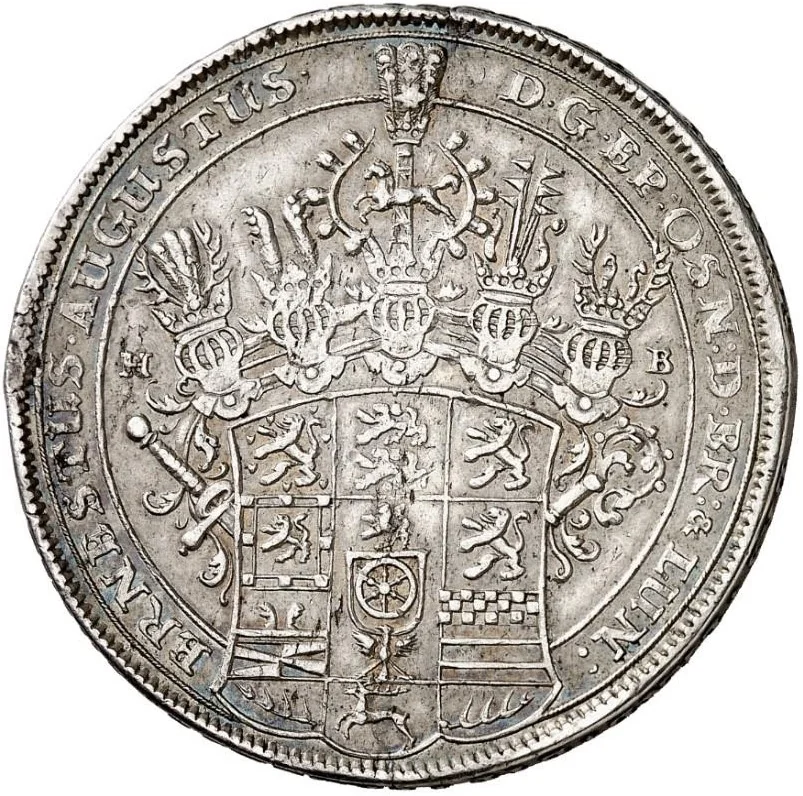
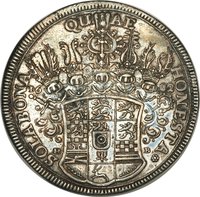
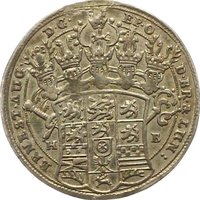
Crowned heraldic arm.
Inscription:
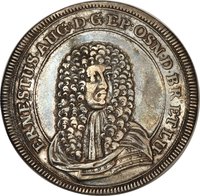
ERNESTUS AUGUSTUS D G EP OSN D BR & LUN
H B
H B
Script: Latin
Reverse
Edge
Mints
| Name | Mark |
|---|---|
| Clausthal | — |
Mintings
| Year | Mint Mark | Mintage | Quality | Collection |
|---|---|---|---|---|
| 1683 | — | — | ||
| 1685 | — | — | ||
| 1686 | — | — | ||
| 1687 | — | — |
Historical background
In 1683, the Duchy of Brunswick-Lüneburg, specifically the Principality of Calenberg under Duke Ernst August, was entangled in the complex and debilitating monetary issues common across the Holy Roman Empire. The primary problem was the proliferation of debased coinage, particularly the Klippe (emergency coinage) and low-quality Brakteaten, which were being minted in vast quantities by various authorities. This "Kipper und Wipper" crisis, though its peak had passed decades earlier, left a legacy of unstable currency, where the intrinsic metal value of coins was often far below their face value, destroying public trust and hampering trade.
Duke Ernst August’s government in Calenberg was actively attempting to combat this disorder through participation in imperial currency associations, most notably the Zinnaische Münzverein (founded 1667) and its successor, the Leipziger Münzfuß (established 1690). The goal of these treaties among several northern German states was to standardize the silver content of the Reichsthaler and its subdivisions, thereby creating a reliable, uniform currency for regional commerce. In 1683, efforts were focused on aligning Calenberg's minting practices with these emerging standards to phase out debased coins and restore monetary stability.
Consequently, the currency situation in 1683 was one of transition and intervention. While chaotic circulation from past debasements persisted, the ducal authority was actively working within a broader imperial framework to impose order. The success of this policy was crucial not only for economic recovery but also for Ernst August's political ambitions, as a stable treasury was essential for financing his costly pursuit of the prestigious Electorate of Hanover, which he would obtain in 1692.
Duke Ernst August’s government in Calenberg was actively attempting to combat this disorder through participation in imperial currency associations, most notably the Zinnaische Münzverein (founded 1667) and its successor, the Leipziger Münzfuß (established 1690). The goal of these treaties among several northern German states was to standardize the silver content of the Reichsthaler and its subdivisions, thereby creating a reliable, uniform currency for regional commerce. In 1683, efforts were focused on aligning Calenberg's minting practices with these emerging standards to phase out debased coins and restore monetary stability.
Consequently, the currency situation in 1683 was one of transition and intervention. While chaotic circulation from past debasements persisted, the ducal authority was actively working within a broader imperial framework to impose order. The success of this policy was crucial not only for economic recovery but also for Ernst August's political ambitions, as a stable treasury was essential for financing his costly pursuit of the prestigious Electorate of Hanover, which he would obtain in 1692.
✨ Legendary