

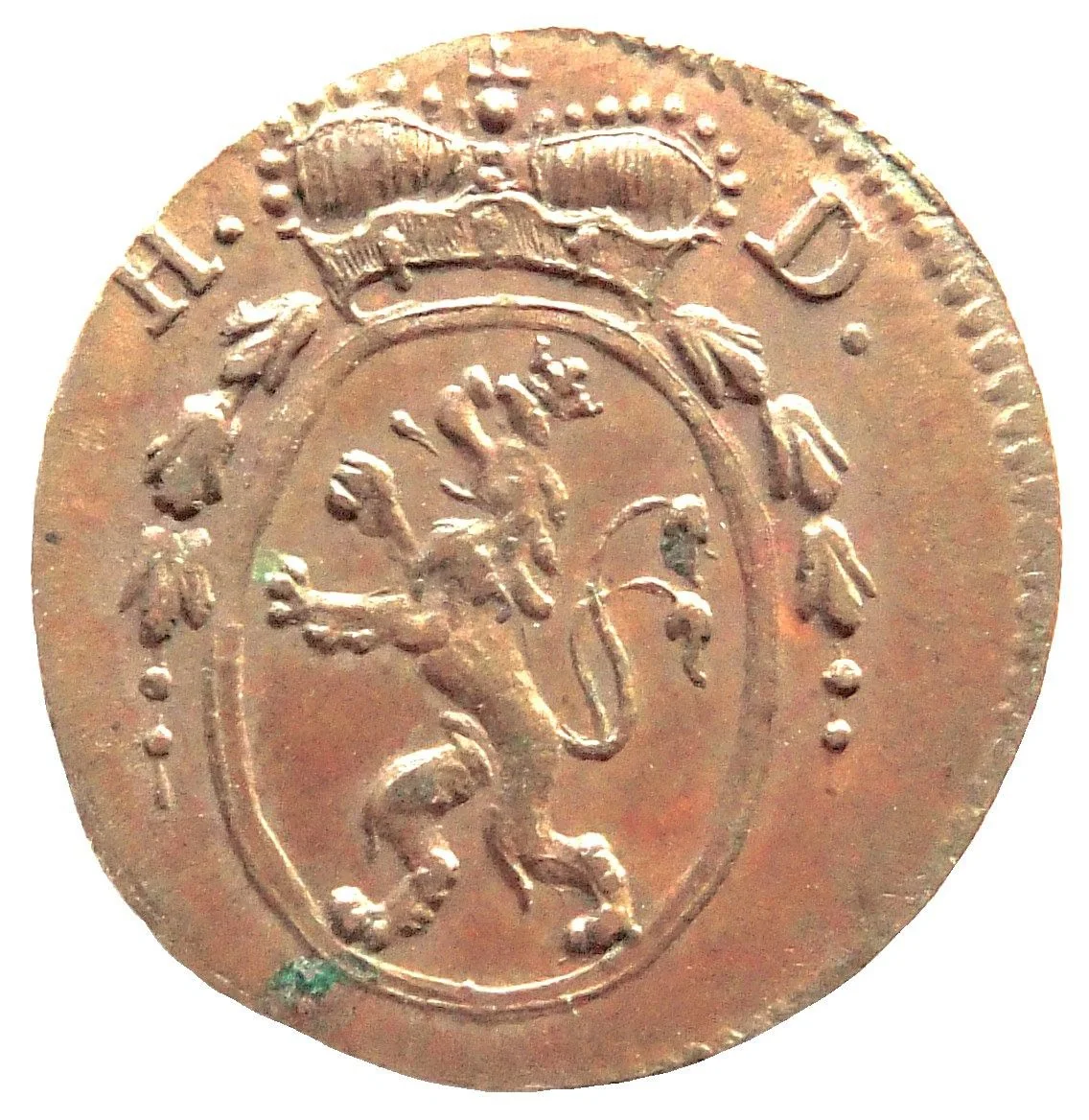
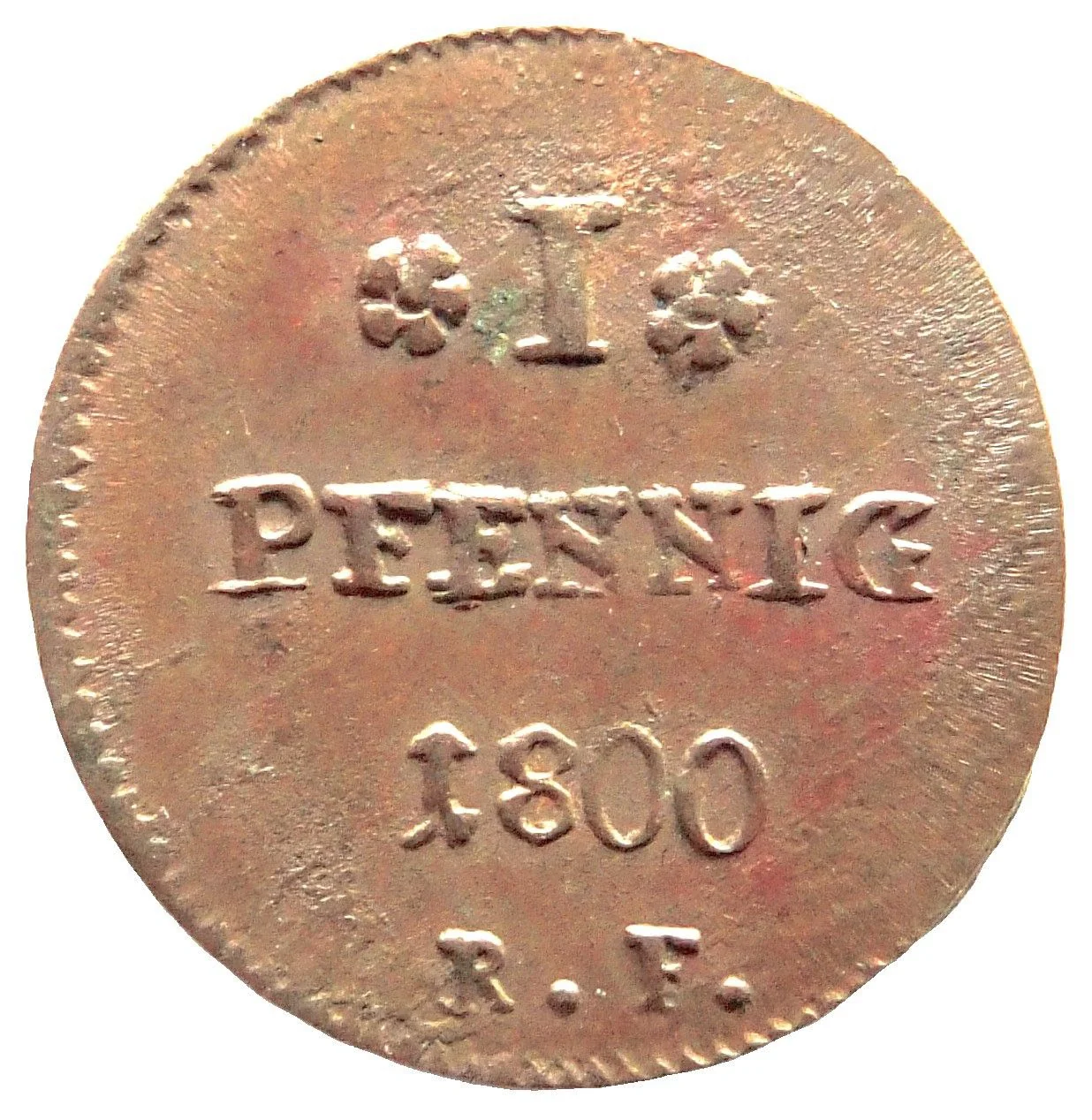
1 Pfennig – Landgraviate of Hesse-Darmstadt
Context
Years: 1797–1806
Issuer: Landgraviate of Hesse-Darmstadt
Ruler: Louis X
Currency:
(1568—1805)
Demonetized: Yes
Material
References
KM: #Click to copy to clipboard251
Numista: #27740
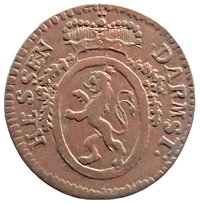
Obverse
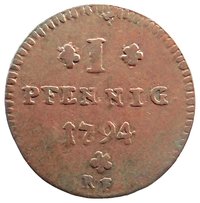
Reverse
Edge
Plain
Mints
| Name | Mark |
|---|---|
| Darmstadt | — |
Mintings
| Year | Mint Mark | Mintage | Quality | Collection |
|---|---|---|---|---|
| 1797 | — | — | ||
| 1798 | — | — | ||
| 1799 | — | — | ||
| 1800 | — | — | ||
| 1801 | — | — | ||
| 1802 | — | — | ||
| 1803 | — | — | ||
| 1804 | — | — | ||
| 1805 | — | — | ||
| 1806 | — | — |
Historical background
In 1797, the Landgraviate of Hesse-Darmstadt, like many German states of the Holy Roman Empire, navigated a complex and fragmented monetary landscape. The territory did not possess a fully sovereign, uniform currency system. Instead, it operated within the framework of the South German Gulden zone, adhering to the Conventionstaler standard established in 1754. This meant the official large silver coin was the Konventionstaler, valued at 2.4 Gulden, while daily transactions relied on a plethora of smaller silver and copper coins minted by the landgraviate itself and by numerous neighboring states.
This system was inherently unstable. The value and acceptance of coins depended heavily on their precious metal content, leading to frequent shortages of "good" full-weight coins, which were often hoarded or melted down. Consequently, a chaotic mix of circulating mediums—including older, debased regional coins and even foreign currencies—hindered trade and public finance. The landgraviate's own minting activities were limited and could not control the wider circulation, creating constant challenges for the treasury and merchants in determining real values and exchange rates.
Furthermore, the period was one of profound geopolitical and financial pressure. The aftershocks of the French Revolutionary Wars, including territorial changes and heavy war contributions demanded by France, strained Hesse-Darmstadt's economy. While not yet under direct French occupation, the landgraviate faced immense fiscal burdens that exacerbated the weaknesses of its monetary system. Thus, in 1797, the currency situation was characterized by a fragile multi-currency regime, vulnerable to manipulation and shortage, operating under the shadow of war and the impending dissolution of the old imperial order.
This system was inherently unstable. The value and acceptance of coins depended heavily on their precious metal content, leading to frequent shortages of "good" full-weight coins, which were often hoarded or melted down. Consequently, a chaotic mix of circulating mediums—including older, debased regional coins and even foreign currencies—hindered trade and public finance. The landgraviate's own minting activities were limited and could not control the wider circulation, creating constant challenges for the treasury and merchants in determining real values and exchange rates.
Furthermore, the period was one of profound geopolitical and financial pressure. The aftershocks of the French Revolutionary Wars, including territorial changes and heavy war contributions demanded by France, strained Hesse-Darmstadt's economy. While not yet under direct French occupation, the landgraviate faced immense fiscal burdens that exacerbated the weaknesses of its monetary system. Thus, in 1797, the currency situation was characterized by a fragile multi-currency regime, vulnerable to manipulation and shortage, operating under the shadow of war and the impending dissolution of the old imperial order.
⭐ Somewhat Rare