

1 Quattrino – Papal States
Vatican City
Context
Years: 1605–1606
Country: Vatican City 
Issuer: Papal States
Ruler: Paul V
Currency:
(1534—1835)
Demonetized: Yes
Material
Diameter: 20 mm
Weight: 2.6 g
Shape: Irregular round
Composition: Copper
Magnetic: No
Alignment: Medal alignment
flip
References
KM: #Click to copy to clipboard21
Numista: #27546
Obverse
Reverse
Description:
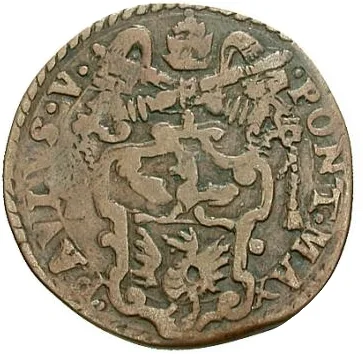
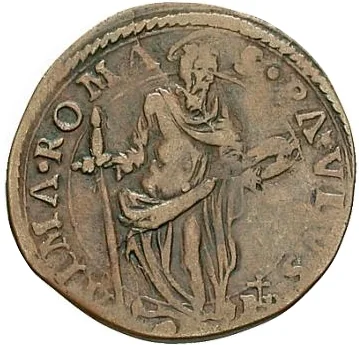
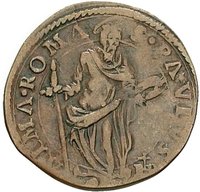
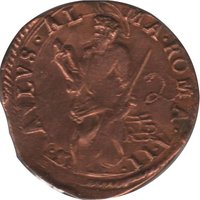
Saint Paul facing right, holding a book and sword.
Inscription:
S PAVLVS ALMA ROMA
Script: Latin
Edge
Categories
| Person> Religious figure |
| Symbol> Crown |
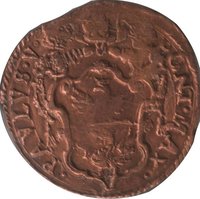
| Symbols> Coat of Arms |
| Object> Cold weapons |
Mintings
| Year | Mint Mark | Mintage | Quality | Collection |
|---|---|---|---|---|
| 1605 | — | — | ||
| 1606 | — | — |
Historical background
In 1605, the Papal States, a collection of territories in central Italy under the direct temporal rule of the Pope, operated within a complex and often chaotic monetary system. The primary unit of account was the scudo, a large silver coin, but the actual currency in circulation was a bewildering array of physical coins from various Italian and foreign states. These included papal issues, coins from other Italian mints like Florence and Venice, and even Spanish reales and French écus, all circulating simultaneously at fluctuating values. This proliferation created constant challenges for trade and taxation, as the relative worth of coins depended on their metal content, wear, and the often-shifting official exchange rates set by papal edicts.
The monetary policy of the Papal States was fundamentally aimed at securing revenue for the Apostolic Camera (the papal treasury) and funding the significant administrative and artistic projects of the Renaissance and Counter-Reformation papacy. A key method was seigniorage—the profit made from minting coins, where the state earned the difference between the face value of a coin and the cost of the precious metal it contained. Furthermore, the papacy frequently engaged in practices like crying down (officially reducing the value of older coins to drive them back to the mint for recoinage) and debasement (reducing the silver content in new coins while maintaining their face value). These actions, while lucrative in the short term, eroded public trust and contributed to inflation.
The ascension of Pope Paul V (Camillo Borghese) in May 1605 brought this fragile system under the control of a pope known for his legal mind and fiscal prudence. His immediate focus was on restoring papal finances and funding ambitious projects, including the completion of St. Peter's Basilica. While major monetary reforms would be implemented later in his pontificate, the currency situation in 1605 was one of inherited instability. It was a system straining under the weight of multiple currencies and past manipulations, now requiring careful management to fund the political and spiritual ambitions of the Baroque papacy without triggering economic crisis.
The monetary policy of the Papal States was fundamentally aimed at securing revenue for the Apostolic Camera (the papal treasury) and funding the significant administrative and artistic projects of the Renaissance and Counter-Reformation papacy. A key method was seigniorage—the profit made from minting coins, where the state earned the difference between the face value of a coin and the cost of the precious metal it contained. Furthermore, the papacy frequently engaged in practices like crying down (officially reducing the value of older coins to drive them back to the mint for recoinage) and debasement (reducing the silver content in new coins while maintaining their face value). These actions, while lucrative in the short term, eroded public trust and contributed to inflation.
The ascension of Pope Paul V (Camillo Borghese) in May 1605 brought this fragile system under the control of a pope known for his legal mind and fiscal prudence. His immediate focus was on restoring papal finances and funding ambitious projects, including the completion of St. Peter's Basilica. While major monetary reforms would be implemented later in his pontificate, the currency situation in 1605 was one of inherited instability. It was a system straining under the weight of multiple currencies and past manipulations, now requiring careful management to fund the political and spiritual ambitions of the Baroque papacy without triggering economic crisis.
✨ Legendary