

2 maravedis – Spain
Add to wishlist
Spain
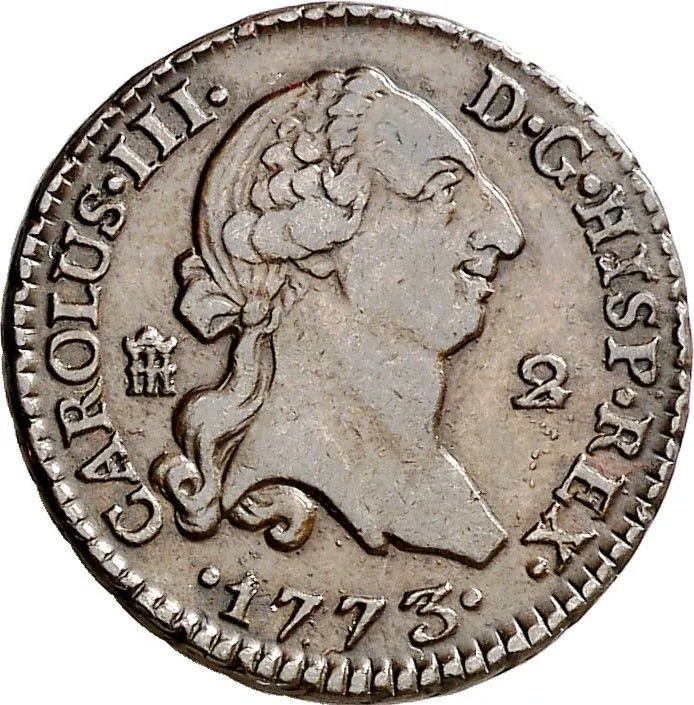
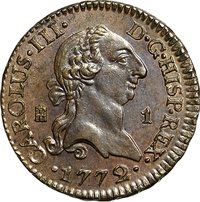
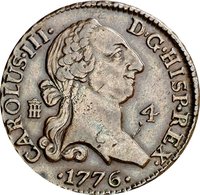
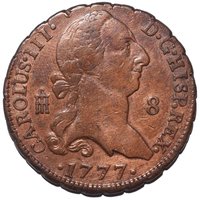
Obverse
Description:
King Charles IV facing right.
Inscription:
CAROLUS · III · D · G · HISP · REX ·
2
· 1773 ·
2
· 1773 ·
Script: Latin
Engraver: Tomás Francisco Prieto Martin
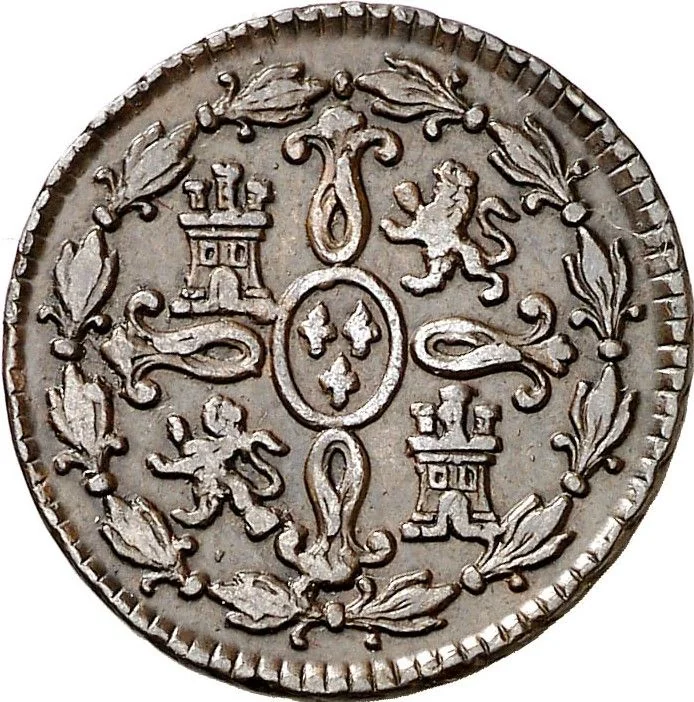
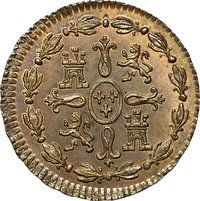
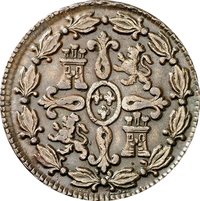
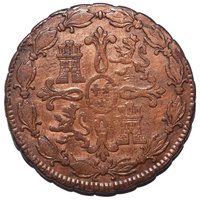
Reverse
Description:
Cross of Don Pelayo featuring castles and lions for Castile and Leon, a central Bourbon fleur-de-lis oval, and a perimeter wreath.
Engraver: Tomás Francisco Prieto Martin
Edge
Mints
| Name | Mark |
|---|---|
| Royal Mint of Segovia | — |
| Royal Mint of Madrid | (M) |
Mintings
| Year | Mint Mark | Mintage | Quality | Collection |
|---|---|---|---|---|
| 1770 | M | — | ||
| 1771 | M | — | ||
| 1772 | — | — | ||
| 1773 | — | — | ||
| 1774 | — | — | ||
| 1775 | — | — | ||
| 1776 | — | — | ||
| 1777 | — | — | ||
| 1778 | — | — | ||
| 1779 | — | — | ||
| 1780 | — | — | ||
| 1781 | — | — | ||
| 1782 | — | — | ||
| 1785 | — | — | ||
| 1787 | — | — | ||
| 1788 | — | — |
Historical background
In 1770, Spain's currency system was a complex and fragile patchwork, reflecting the broader challenges of the Bourbon monarchy's empire. The primary unit was the real, with 8 reales making a peso or "piece of eight," a silver coin famous in global trade. However, the system was plagued by a severe shortage of precious metals, particularly small-denomination coins for everyday use. Decades of war, colonial administration costs, and smuggling had drained the treasury, while the inflow of silver from the Americas, though still significant, was less reliable than in the previous century. This scarcity led to widespread use of a confusing array of foreign coins, especially French, Portuguese, and Spanish-American issues, all circulating at varying and fluctuating values.
King Charles III, a reform-minded monarch, was actively attempting to stabilize the monetary chaos. His government had embarked on a centralizing project to assert royal control over the minting process, which had been historically dispersed among various Spanish cities. A key reform was the issuance of new, uniform gold and silver coins from the Madrid mint, featuring the king's portrait, to gradually replace the older, debased and foreign currencies. These efforts were part of the broader "Bourbon Reforms" aimed at modernizing the state and increasing revenue. Despite these intentions, the reforms faced immense practical difficulties, including public distrust of new coinage, the entrenched habits of regional economies, and the sheer logistical challenge of recalling old money.
Consequently, the everyday economic experience for most Spaniards was one of inconvenience and uncertainty. Prices were often unstable, and transactions required careful negotiation and assessment of each coin's weight, metal content, and origin. The shortage of small change (vellón) was so acute that some towns and merchants resorted to issuing their own token money or IOUs. This unstable monetary environment hindered domestic commerce and investment, acting as a drag on economic growth. Thus, in 1770, Spain was caught between an ambitious royal program for a unified, modern currency and the stubborn reality of a fragmented, inefficient, and cash-starved economy.
King Charles III, a reform-minded monarch, was actively attempting to stabilize the monetary chaos. His government had embarked on a centralizing project to assert royal control over the minting process, which had been historically dispersed among various Spanish cities. A key reform was the issuance of new, uniform gold and silver coins from the Madrid mint, featuring the king's portrait, to gradually replace the older, debased and foreign currencies. These efforts were part of the broader "Bourbon Reforms" aimed at modernizing the state and increasing revenue. Despite these intentions, the reforms faced immense practical difficulties, including public distrust of new coinage, the entrenched habits of regional economies, and the sheer logistical challenge of recalling old money.
Consequently, the everyday economic experience for most Spaniards was one of inconvenience and uncertainty. Prices were often unstable, and transactions required careful negotiation and assessment of each coin's weight, metal content, and origin. The shortage of small change (vellón) was so acute that some towns and merchants resorted to issuing their own token money or IOUs. This unstable monetary environment hindered domestic commerce and investment, acting as a drag on economic growth. Thus, in 1770, Spain was caught between an ambitious royal program for a unified, modern currency and the stubborn reality of a fragmented, inefficient, and cash-starved economy.
Series: 1770 Spain circulation coins
🌱 Fairly Common