

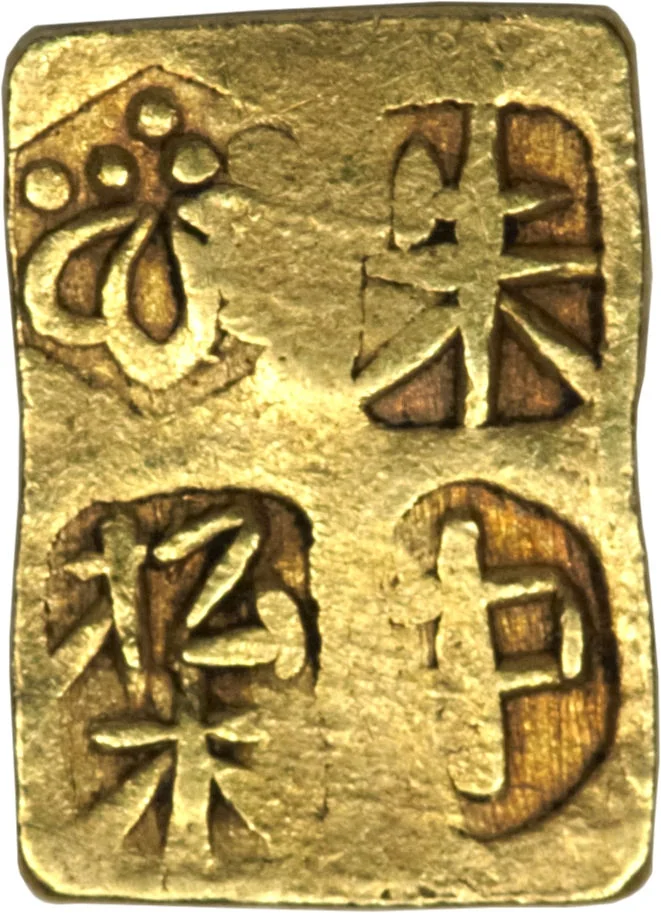
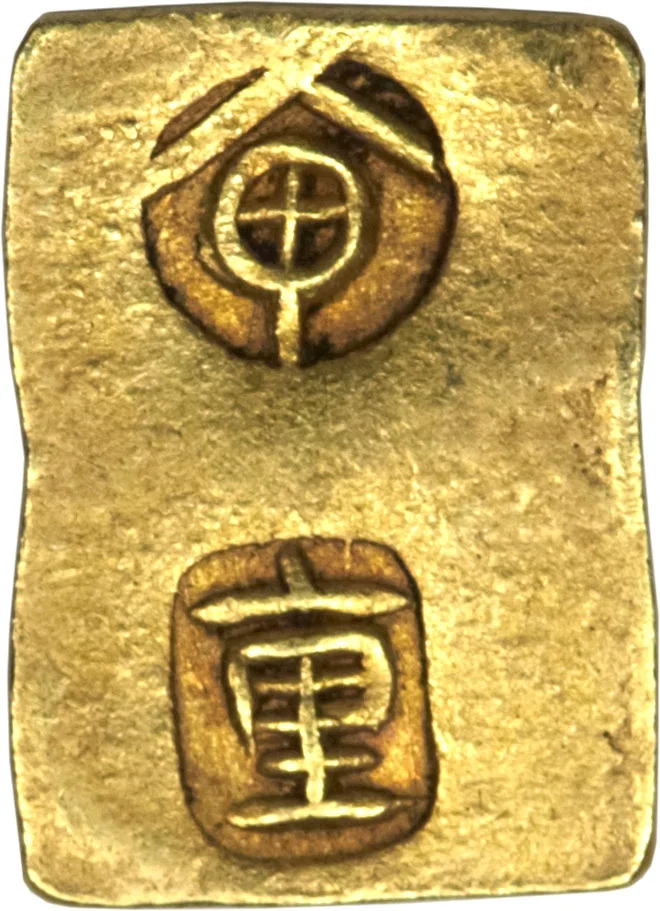
shunaka – Kai Province
Add to wishlist
Japan
Context
Year: 1650
Country: Japan
Issuer: Kai Province
Currency:
(1506—1871)
Subdivision: shunaka = ½ Shu = 1⁄32 Ryō
Demonetized: Yes
Material
References
KM: #
Numista: #27247
Value
Bullion value: $61.37
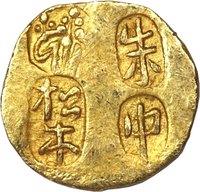
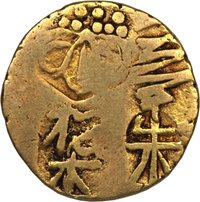
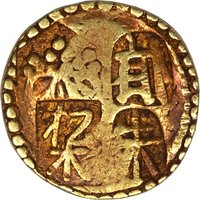
Obverse
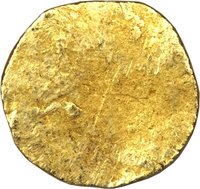
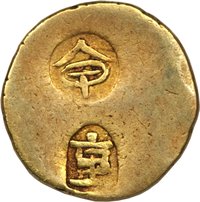
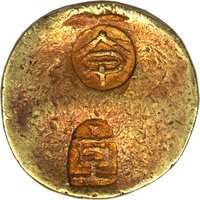
Reverse
Edge
Mintings
| Year | Mint Mark | Mintage | Quality | Collection |
|---|---|---|---|---|
| 1650 | — | — |
Historical background
In 1650, Kai Province (modern-day Yamanashi Prefecture) operated under Japan's complex, multi-tiered Tokugawa monetary system, but its landlocked, mountainous geography created distinct local challenges. The national economy was anchored by the shogunate's gold (koban) and silver (chogin) coins, which were used for large-scale transactions, domainal finance, and tribute payments to the Edo government. However, Kai's economy was primarily agrarian, focused on staple crops and limited silk production, meaning that everyday commerce for most peasants and merchants relied heavily on low-denomination copper coins (zeni) and, crucially, on private paper scrip known as hansatsu. The Takeda clan had historically ruled the province, but by 1650 it was under the direct control of the Tokugawa shogunate as a tenryō (imperial domain), administered by magistrates rather than a local daimyō.
The scarcity of official coinage, especially small change, in the province's inland villages and post-towns led to a reliance on credit and barter. To facilitate local trade, merchant houses and village heads often issued their own private notes or IOUs, which circulated within trusted networks. This patchwork of informal currency was both a necessity and a source of instability, as its value was highly localized and could fluctuate or become worthless if the issuing merchant failed. The provincial economy was also subtly shaped by its position on the Kōshū Kaidō, a major highway connecting Edo with the mineral-rich Shinano region. This traffic brought a flow of official currency through the post-towns and commercial services, but it primarily benefited merchants catering to travelers and did not deeply penetrate the financial systems of the isolated agricultural valleys.
Overall, Kai Province’s currency situation in 1650 was one of duality. On one level, it was integrated into the Tokugawa's centralized monetary order, with taxes assessed and paid in rice and eventually converted to silver for the shogunate's coffers. On the ground, however, economic life was sustained by a fragile, localized ecosystem of copper coins and private paper, disconnected from the high-value gold and silver used by the ruling samurai class. This reflected the broader Edo-period separation between the official, rice-based economy of the samurai and the vibrant, often cash-starved market economy of the commoners, a gap particularly pronounced in a remote, administratively direct shogunal territory like Kai.
The scarcity of official coinage, especially small change, in the province's inland villages and post-towns led to a reliance on credit and barter. To facilitate local trade, merchant houses and village heads often issued their own private notes or IOUs, which circulated within trusted networks. This patchwork of informal currency was both a necessity and a source of instability, as its value was highly localized and could fluctuate or become worthless if the issuing merchant failed. The provincial economy was also subtly shaped by its position on the Kōshū Kaidō, a major highway connecting Edo with the mineral-rich Shinano region. This traffic brought a flow of official currency through the post-towns and commercial services, but it primarily benefited merchants catering to travelers and did not deeply penetrate the financial systems of the isolated agricultural valleys.
Overall, Kai Province’s currency situation in 1650 was one of duality. On one level, it was integrated into the Tokugawa's centralized monetary order, with taxes assessed and paid in rice and eventually converted to silver for the shogunate's coffers. On the ground, however, economic life was sustained by a fragile, localized ecosystem of copper coins and private paper, disconnected from the high-value gold and silver used by the ruling samurai class. This reflected the broader Edo-period separation between the official, rice-based economy of the samurai and the vibrant, often cash-starved market economy of the commoners, a gap particularly pronounced in a remote, administratively direct shogunal territory like Kai.
✨ Legendary