Logo Title
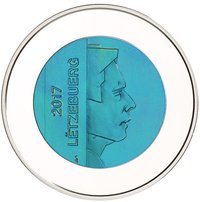
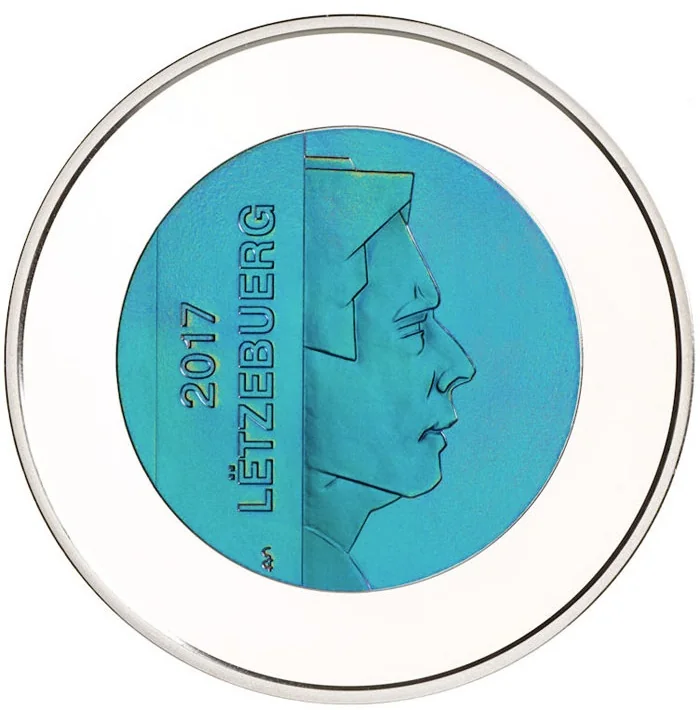
obverse
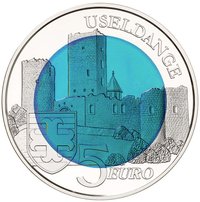
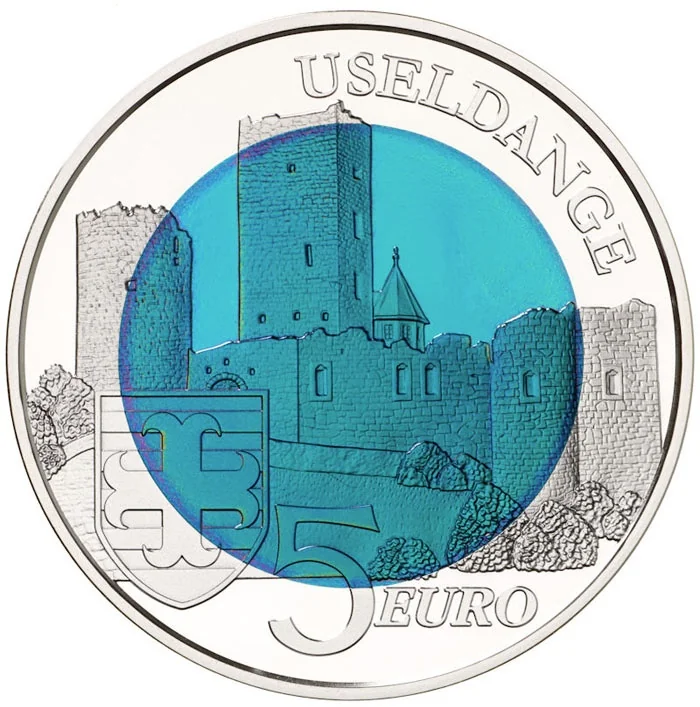
reverse
Banque centrale du Luxembourg

5 Euro – Grand Duchy of Luxembourg

Non-circulating coins
Commemoration: Useldange Castle
Luxembourg
Context
Year: 2017
Country: Luxembourg Country flag
Ruler: Henry
Currency:
(since 2002)
Total mintage: 3,000
Material
Diameter: 34 mm
Weight: 16.6 g
Thickness: 2.5 mm
Shape: Round
Composition: Bimetallic (Niobium center, Silver ring)
Technique: Milled
Alignment: Medal alignment
Obverse
OBVERSE ↑
flip
Reverse
REVERSE ↑
References
KM: #Click to copy to clipboard150
Numista: #116123
Value
Exchange value: 5 EUR = $5.91
Inflation-adjusted value: 6.29 EUR

Obverse

Description:
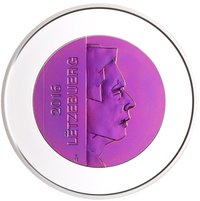
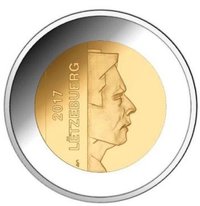
The right half features a geometric portrait of Grand Duke Henri, opposite the inscription LËTZEBUERG, the year, and the engraver's initials.
Inscription:
2017

LËTZEBUERG
Translation:
Luxembourg
Script: Latin
Languages: German, Luxembourgish

Reverse

Description:
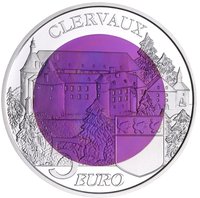
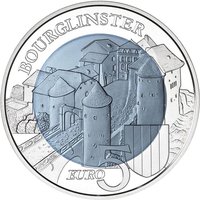
Useldange Castle view, with village name above and shield with value below.
Inscription:
USELDANGE

5 EURO
Script: Latin

Edge

Plain.

Mints

NameMark
Münze Österreich

Mintings

YearMint MarkMintageQualityCollection
20173,000Proof

Historical background

In 2017, the Grand Duchy of Luxembourg, as a founding member of the Eurozone, had its official currency firmly established as the euro (€). The nation had fully adopted the common currency in 2002, phasing out the Luxembourgish franc, and for fifteen years had been integrated into the European Central Bank's (ECB) monetary policy framework. This meant that Luxembourg, despite its robust and specialised financial sector, did not have an independent monetary policy; key decisions on interest rates and money supply were made by the ECB's Governing Council, where the Governor of the Central Bank of Luxembourg (BCL) held a vote. The country's financial stability was thus intrinsically linked to the broader health and policy decisions of the Eurozone.

The domestic currency situation was characterised by economic strength and stability. Luxembourg enjoyed AAA credit ratings, low public debt, and a high per-capita GDP, which bolstered confidence in its banking system and the euro within its borders. However, as a global financial hub, the Luxembourgish economy and its currency circulation were disproportionately influenced by cross-border banking activities and the presence of numerous investment funds. A significant portion of euro-denominated assets under management in the Eurozone were administered from Luxembourg, making the country highly sensitive to fluctuations in euro value and ECB policy shifts aimed at stimulating the wider European economy after the sovereign debt crisis.

Furthermore, 2017 was a year of ongoing adjustment to the ECB's expansive monetary policies, including quantitative easing and historically low interest rates. While these measures were designed to support the broader Eurozone recovery, they presented specific challenges for Luxembourg's competitive financial sector by compressing bank margins. Domestically, there was little to no public debate about reverting to a national currency; support for the euro remained strong among both the populace and political institutions. The key financial discussions in the country instead focused on banking transparency, anti-money laundering measures, and adapting its vast fund industry to new EU regulations, all within the unshakeable context of the common European currency.

Series: Châteaux du Luxembourg
5 Euro obverse
5 Euro reverse
5 Euro
2013
5 Euro obverse
5 Euro reverse
5 Euro
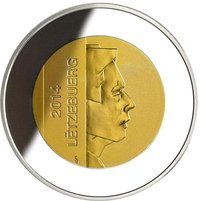
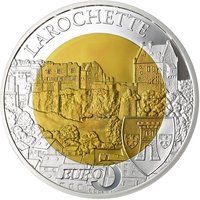
2014
5 Euro obverse
5 Euro reverse
5 Euro
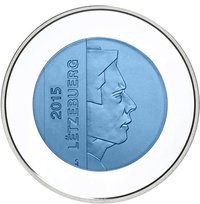
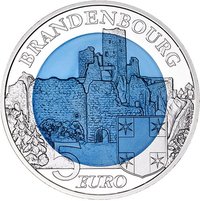
2015
5 Euro obverse
5 Euro reverse
5 Euro
2016
5 Euro obverse
5 Euro reverse
5 Euro
2017
5 Euro obverse
5 Euro reverse
5 Euro
2018
5 Euro obverse
5 Euro reverse
5 Euro
2019
💎 Extremely Rare