

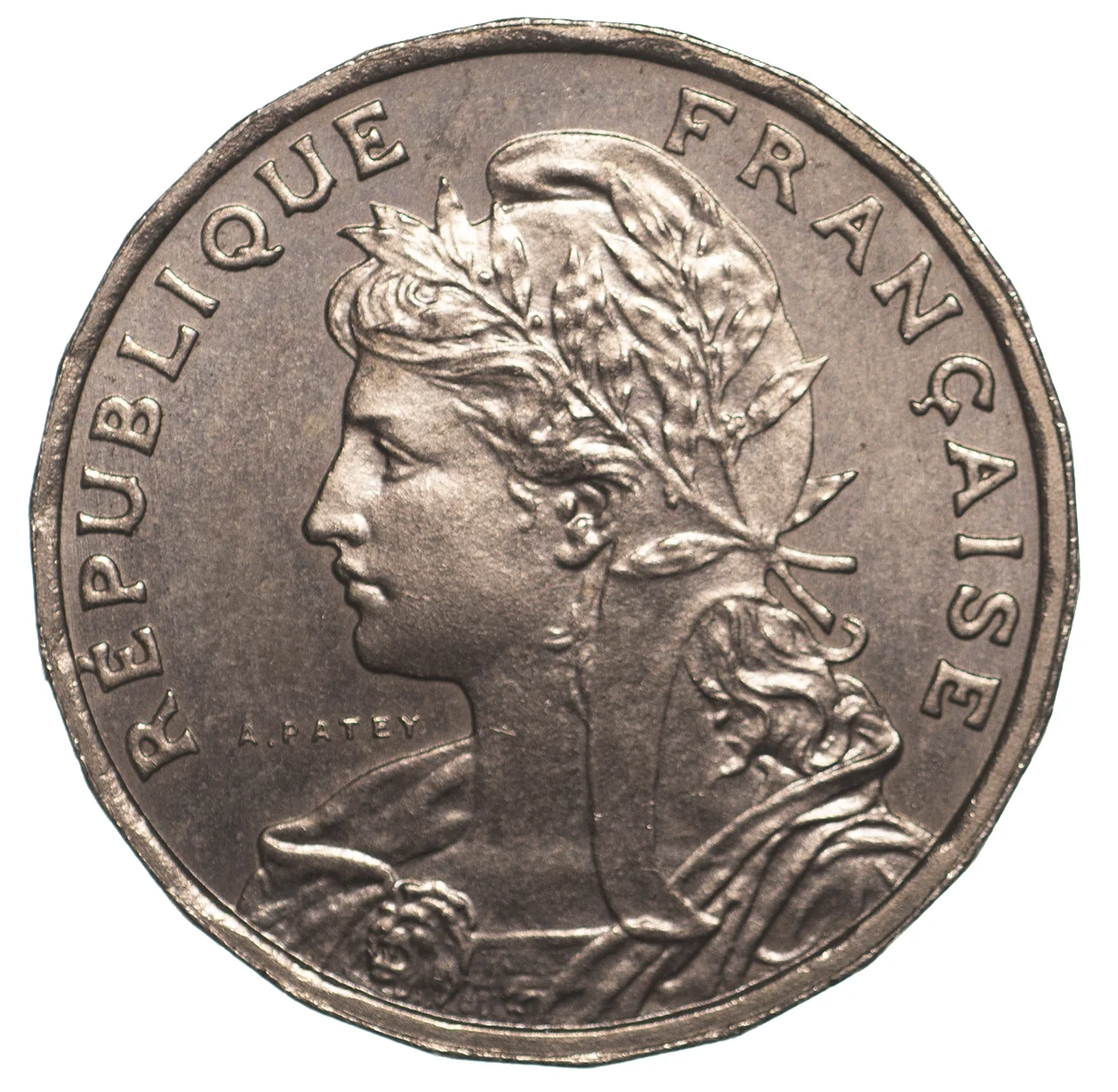
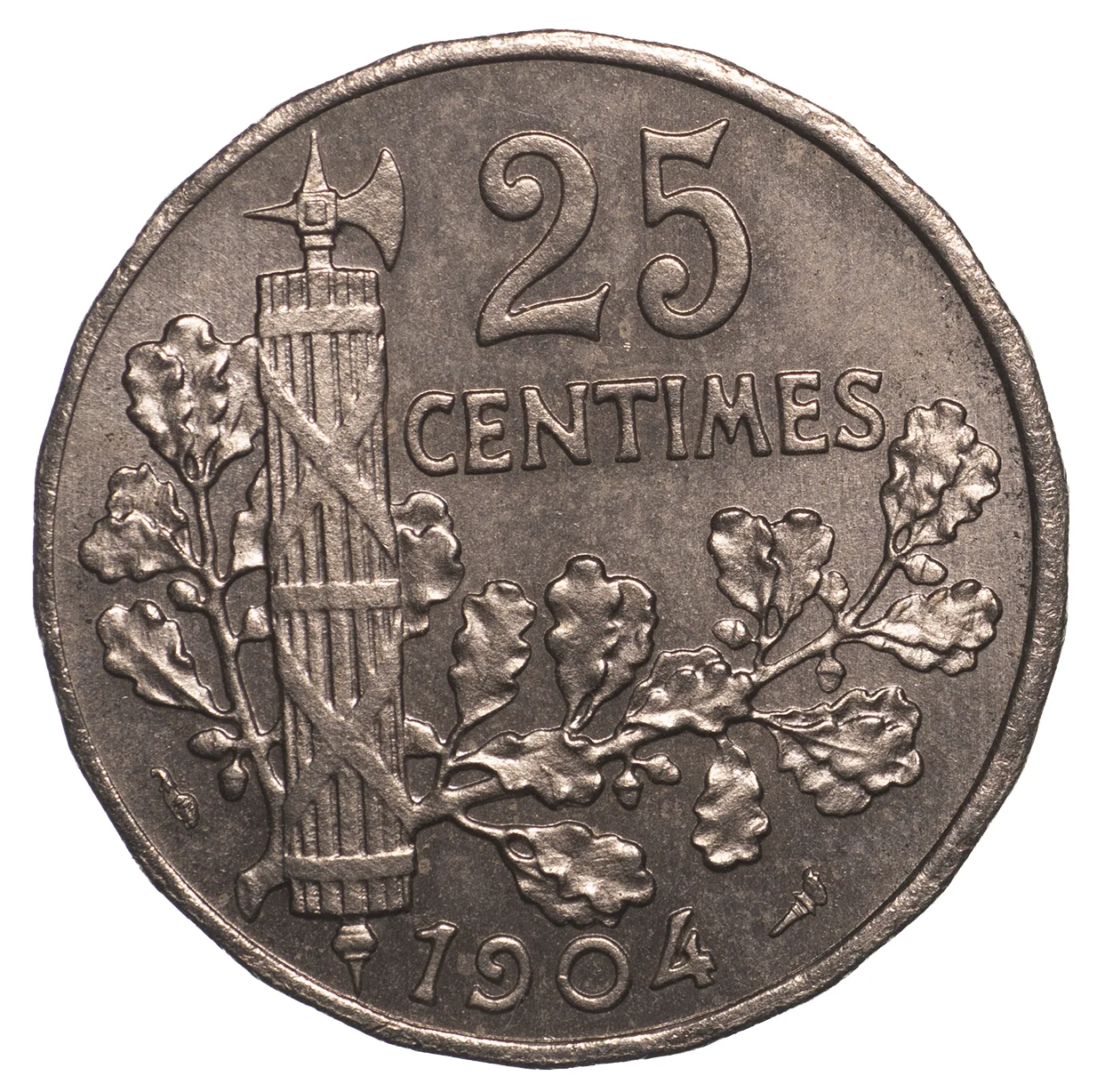
25 centimes – France
Add to wishlist
France
Context
Years: 1904–1908
Issuer: France
Period:
(1870—1940)
Currency:
(1795—1959)
Demonetization: 28 June 1933
Total mintage: 8,000,000
Material
Diameter: 24 mm
Weight: 7 g
Thickness: 1.9 mm
Shape: Icosidigonal
Composition: Nickel
Magnetic: Yes
Technique: Milled
Alignment: Coin alignment
flip
References
KM: #
Numista: #1161
Obverse
Description:
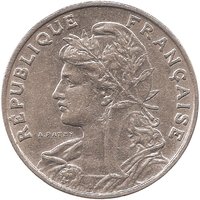
Liberty head left, engraver's name in left field.
Inscription:
RÉPUBLIQUE FRANÇAISE
A.PATEY
A.PATEY
Translation:
FRENCH REPUBLIC
A.PATEY
A.PATEY
Script: Latin
Language: French
Engraver: Henri-Auguste Patey
Reverse
Description:
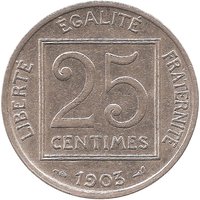
Axe with branches, denomination above, date below.
Inscription:
25
CENTIMES
1904
CENTIMES
1904
Script: Latin
Engraver: Henri-Auguste Patey
Edge
22-sided
Categories
| Symbol> Fasces |
| Symbol> Phrygian cap |
Mints
| Name | Mark |
|---|---|
| Monnaie de Paris | — |
Mintings
| Year | Mint Mark | Mintage | Quality | Collection |
|---|---|---|---|---|
| 1904 | — | — | ||
| 1905 | — | 8,000,000 | ||
| 1908 | — | — |
Historical background
In 1904, France operated under the franc germinal, a currency system established by Napoleon in 1803 that had proven remarkably stable for over a century. This system was bimetallic, meaning the franc was legally defined as a fixed weight of both gold (0.290322 grams) and silver (4.5 grams). In practice, however, France was part of the Latin Monetary Union (LMU), an international treaty formed in 1865 with Belgium, Italy, Switzerland, and later Greece. The LMU aimed to standardize coinage, allowing member nations' gold and silver coins to circulate freely across borders, effectively creating a multinational monetary zone.
By 1904, the Union was under significant strain. The fixed mint ratio between gold and silver had become outdated as the market value of silver plummeted due to global discoveries and increased production. This led to Gresham's Law in action: cheaper, full-weight silver coins from member states flooded France, while its gold coins were hoarded or exported. France, as the Union's largest and strongest economy, was forced to absorb these outflows to maintain the system, acting as a de facto guarantor at a considerable cost to its own gold reserves.
Consequently, while the franc itself remained strong and trusted domestically, the international framework supporting it was fragile. The French government and the Bank of France were engaged in ongoing debates about the future of bimetallism and the LMU, with a clear trend toward a de facto gold standard. The year 1904 thus represents a late, tense phase of the classical bimetallic system, with France clinging to its traditional monetary identity while economic realities increasingly pushed it toward the gold-based system already adopted by rivals like Britain and Germany.
By 1904, the Union was under significant strain. The fixed mint ratio between gold and silver had become outdated as the market value of silver plummeted due to global discoveries and increased production. This led to Gresham's Law in action: cheaper, full-weight silver coins from member states flooded France, while its gold coins were hoarded or exported. France, as the Union's largest and strongest economy, was forced to absorb these outflows to maintain the system, acting as a de facto guarantor at a considerable cost to its own gold reserves.
Consequently, while the franc itself remained strong and trusted domestically, the international framework supporting it was fragile. The French government and the Bank of France were engaged in ongoing debates about the future of bimetallism and the LMU, with a clear trend toward a de facto gold standard. The year 1904 thus represents a late, tense phase of the classical bimetallic system, with France clinging to its traditional monetary identity while economic realities increasingly pushed it toward the gold-based system already adopted by rivals like Britain and Germany.
🌱 Very Common