

20 ariary – Madagascar
Add to wishlist
Madagascar
Context
Material
Diameter: 30.6 mm
Weight: 12 g
Shape: Round
Composition: Copper-nickel
Technique: Milled
Alignment: Coin alignment
flip
References
KM: #
Numista: #11607
Value
Exchange value: 20 MGF
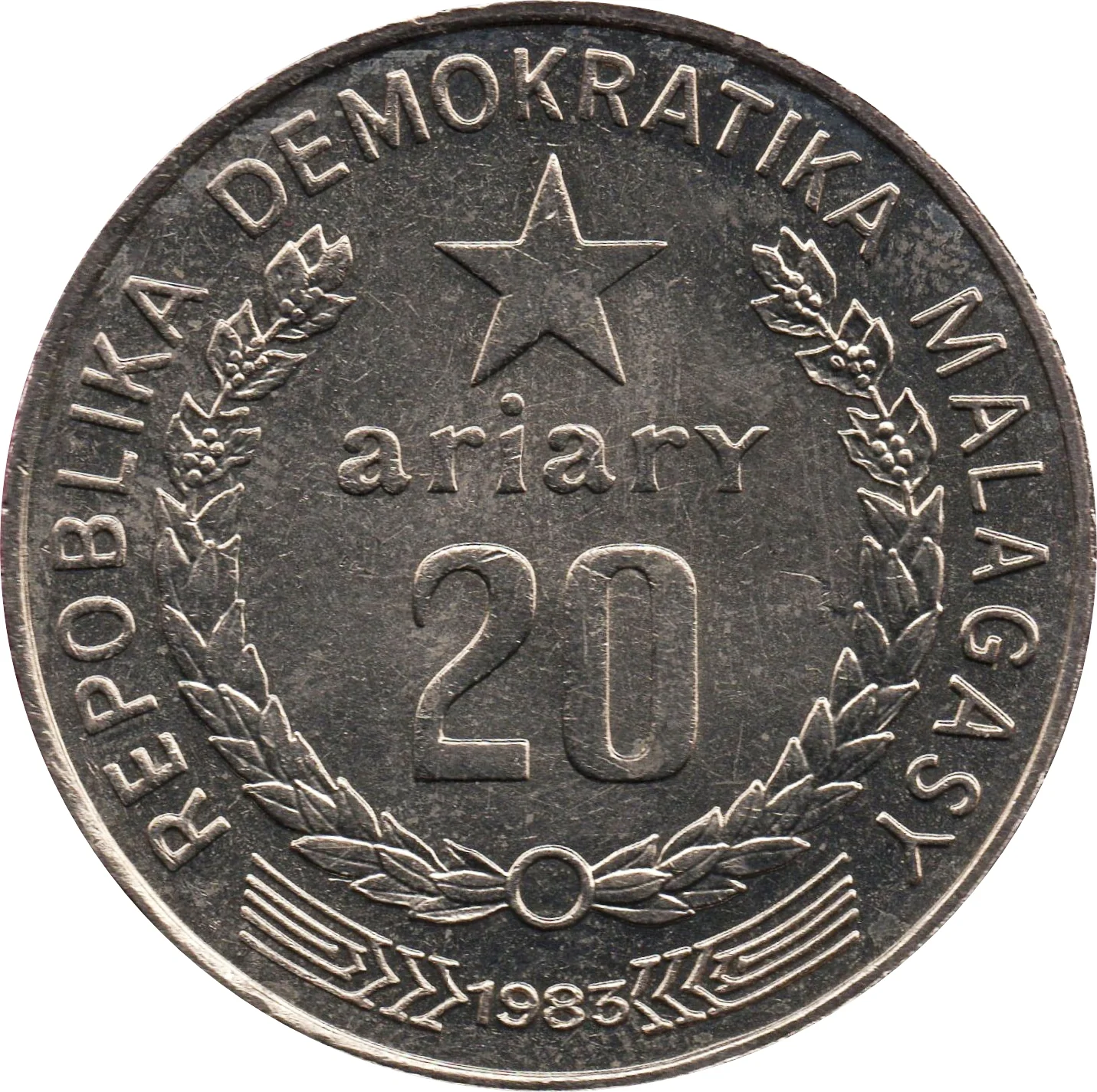
Obverse
Description:
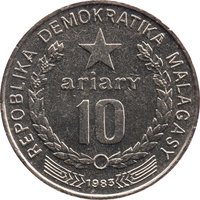
Star above value within wreath.
Inscription:
REPOBLIKA DEMOKRATIKA MALAGASY
ariary
20
1983
ariary
20
1983
Script: Latin
Reverse
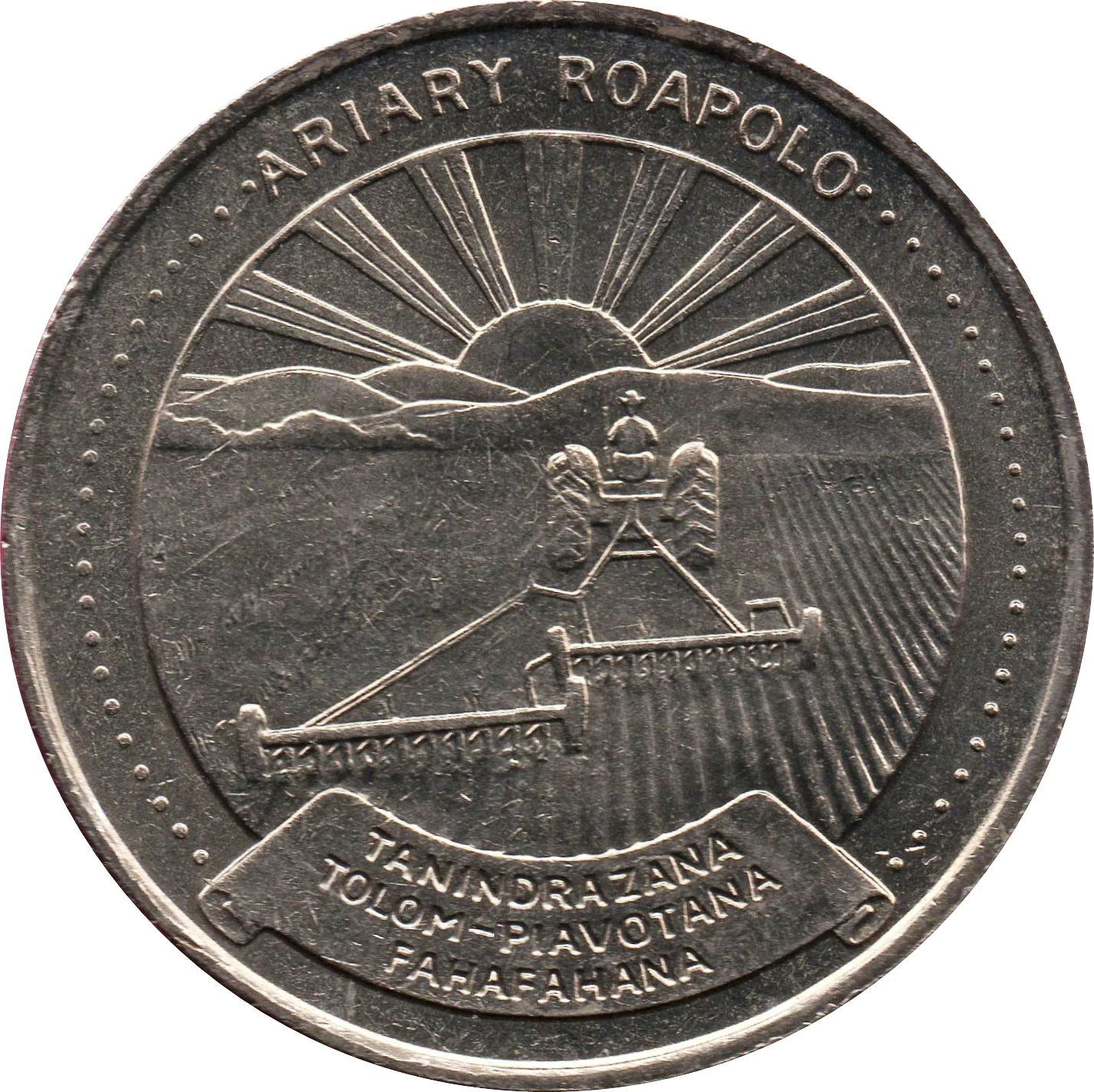
Description:
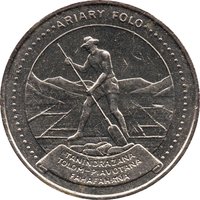
Farmer disking field with tractor.
Inscription:
ARIARY ROAPOLO
TANINDRAZANA
TOLOM - PIAVOTANA
FAHAFAHANA
TANINDRAZANA
TOLOM - PIAVOTANA
FAHAFAHANA
Translation:
ONE HUNDRED ARIARY
HOMELAND
JUSTICE - DEVELOPMENT
FREEDOM
HOMELAND
JUSTICE - DEVELOPMENT
FREEDOM
Script: Latin
Language: Malagasy
Engraver: Michael Hibbit
Edge
Reeded
Categories
| Agriculture |
| Transportation> Truck or tractor |
Mints
| Name | Mark |
|---|---|
| Royal Mint | — |
Mintings
| Year | Mint Mark | Mintage | Quality | Collection |
|---|---|---|---|---|
| 1983 | — | — |
Historical background
In 1983, Madagascar was in the midst of a severe and protracted economic crisis, with its currency, the Malagasy franc (FMG), serving as a key indicator of the nation's distress. The country's economy, heavily reliant on agricultural exports like coffee and vanilla, had been battered by a global recession, falling commodity prices, and the lingering effects of the 1970s oil shocks. This external pressure was compounded by decades of state-led socialist policies under President Didier Ratsiraka, which included extensive nationalizations, price controls, and a restrictive import-substitution industrialization model. These policies led to chronic budget deficits, a bloated public sector, and critical shortages of essential goods, creating a vast parallel market where the FMG traded at a fraction of its official value.
The official exchange rate was fixed by the government at an artificially high level, but it was largely inaccessible for most transactions. In reality, the currency was in a state of effective devaluation on the thriving black market, where the FMG's value was dictated by scarcity and lack of confidence. This dual system crippled formal trade, discouraged legitimate exports (as producers received vastly overvalued official rates), and fueled rampant inflation, which eroded purchasing power and living standards. The government's attempts to maintain the fixed rate drained foreign reserves and relied heavily on borrowing, particularly from the Soviet Union and other Eastern Bloc nations, further increasing the nation's debt burden.
Consequently, 1983 represented a pivotal point of mounting pressure for structural reform. The unsustainable currency situation and broader economic collapse forced the Ratsiraka government to begin a hesitant and contested shift away from its socialist framework. This period set the stage for the eventual negotiations with the International Monetary Fund (IMF) and the World Bank, which would lead to a Structural Adjustment Program in the late 1980s. The prescribed reforms included a dramatic devaluation of the FMG, unification of the exchange rates, and a move toward market liberalization—painful measures aimed at stabilizing the currency and restarting the economy.
The official exchange rate was fixed by the government at an artificially high level, but it was largely inaccessible for most transactions. In reality, the currency was in a state of effective devaluation on the thriving black market, where the FMG's value was dictated by scarcity and lack of confidence. This dual system crippled formal trade, discouraged legitimate exports (as producers received vastly overvalued official rates), and fueled rampant inflation, which eroded purchasing power and living standards. The government's attempts to maintain the fixed rate drained foreign reserves and relied heavily on borrowing, particularly from the Soviet Union and other Eastern Bloc nations, further increasing the nation's debt burden.
Consequently, 1983 represented a pivotal point of mounting pressure for structural reform. The unsustainable currency situation and broader economic collapse forced the Ratsiraka government to begin a hesitant and contested shift away from its socialist framework. This period set the stage for the eventual negotiations with the International Monetary Fund (IMF) and the World Bank, which would lead to a Structural Adjustment Program in the late 1980s. The prescribed reforms included a dramatic devaluation of the FMG, unification of the exchange rates, and a move toward market liberalization—painful measures aimed at stabilizing the currency and restarting the economy.
🌱 Common