

10 francs – Madagascar
Add to wishlist
Madagascar
Context
Year: 1991
Issuer: Madagascar
Period:
(1975—1992)
Currency:
(1963—2004)
Subdivision: 10 francs = 2 Ariary
Material
References
KM: #
Numista: #11603
Value
Exchange value: 2 MGF
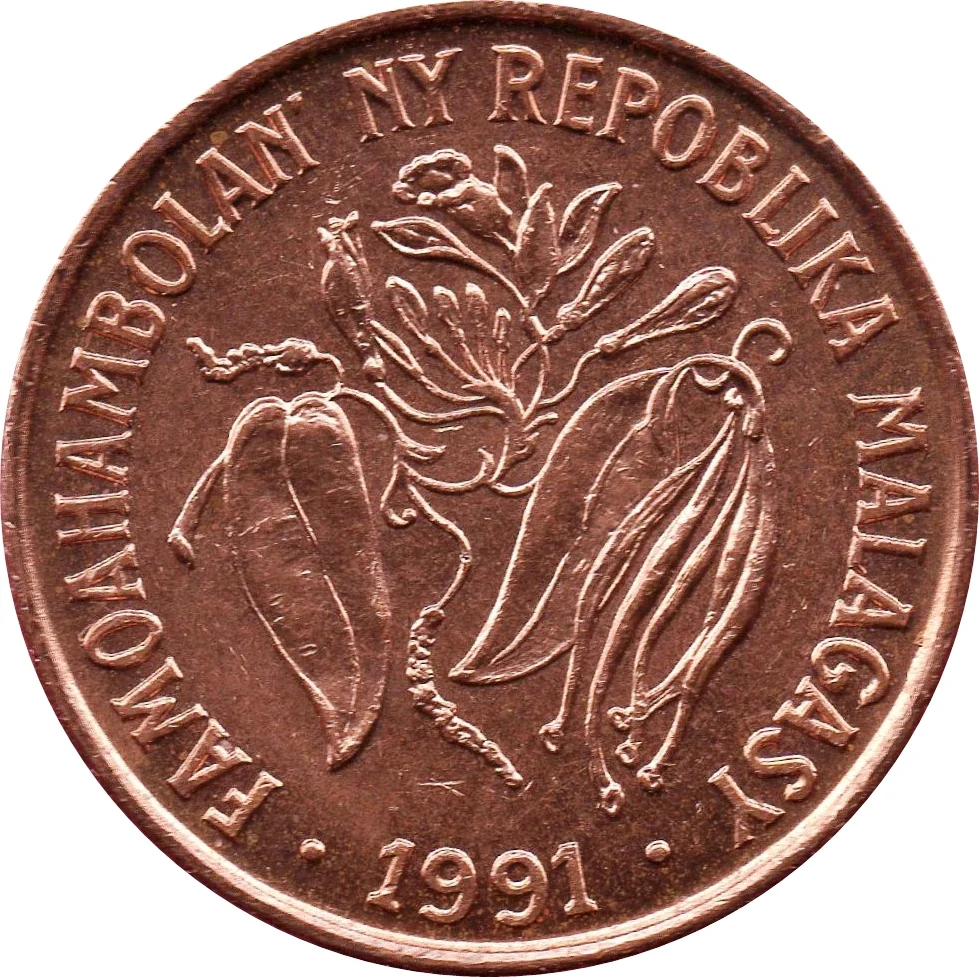
Obverse
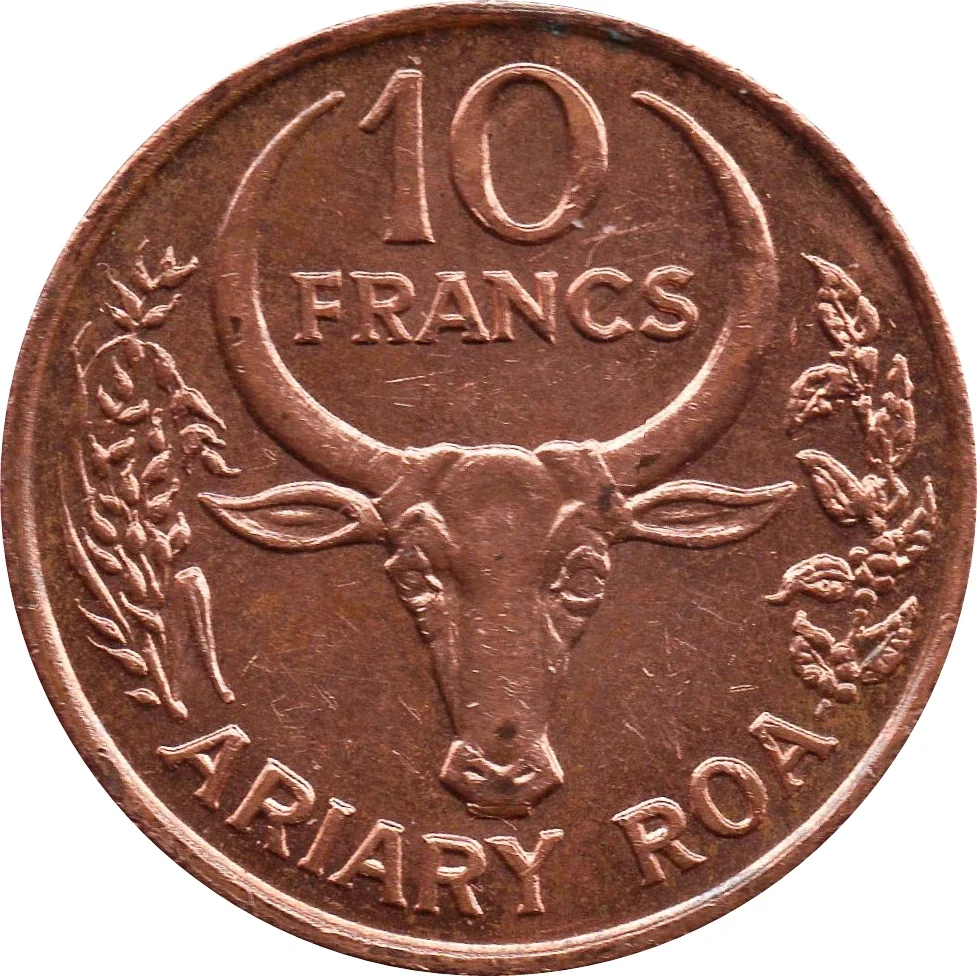
Reverse
Edge
Reeded
Categories
| Organization> FAO |
Mints
| Name | Mark |
|---|---|
| Monnaie de Paris | — |
Mintings
| Year | Mint Mark | Mintage | Quality | Collection |
|---|---|---|---|---|
| 1991 | — | — |
Historical background
In 1991, Madagascar was engulfed in a profound political and economic crisis that had severe repercussions on its currency, the Malagasy franc (FMG). The year was marked by widespread anti-government protests and a general strike, paralyzing the economy and state institutions. This instability was the culmination of nearly two decades of economic mismanagement under President Didier Ratsiraka's socialist-Marxist regime, characterized by failing state enterprises, a collapsing agricultural export sector, and heavy reliance on foreign borrowing. The economic foundation was so eroded that by 1991, the country was effectively bankrupt, with foreign reserves depleted and the government unable to service its debt or fund essential imports.
The currency situation was dire, defined by a vast and thriving black market for foreign exchange. The official exchange rate, set by the government, was artificially overvalued, but it was largely irrelevant as most legitimate access to hard currency had dried up. In practice, the real value of the FMG was determined by parallel market rates, where it traded at a fraction of its official value. This disparity crippled formal trade, encouraged capital flight, and fueled hyperinflation, which soared to over 40% annually. The population's purchasing power evaporated, and a severe shortage of basic commodities, including fuel and medicine, gripped the nation, exacerbating the social unrest.
The crisis reached its peak in the latter half of 1991, forcing a political transition. Under intense pressure, Ratsiraka ceded power to a transitional government led by opposition figure Albert Zafy. This new administration, installed in late 1991 and early 1992, immediately prioritized economic stabilization. A critical early step was seeking assistance from the International Monetary Fund (IMF) and World Bank, which would lead to a Structural Adjustment Program. A cornerstone of this program, implemented in the following years, was a decisive currency reform: a massive devaluation of the FMG to unify the official and black-market rates and restore monetary credibility, marking the painful beginning of economic liberalization.
The currency situation was dire, defined by a vast and thriving black market for foreign exchange. The official exchange rate, set by the government, was artificially overvalued, but it was largely irrelevant as most legitimate access to hard currency had dried up. In practice, the real value of the FMG was determined by parallel market rates, where it traded at a fraction of its official value. This disparity crippled formal trade, encouraged capital flight, and fueled hyperinflation, which soared to over 40% annually. The population's purchasing power evaporated, and a severe shortage of basic commodities, including fuel and medicine, gripped the nation, exacerbating the social unrest.
The crisis reached its peak in the latter half of 1991, forcing a political transition. Under intense pressure, Ratsiraka ceded power to a transitional government led by opposition figure Albert Zafy. This new administration, installed in late 1991 and early 1992, immediately prioritized economic stabilization. A critical early step was seeking assistance from the International Monetary Fund (IMF) and World Bank, which would lead to a Structural Adjustment Program. A cornerstone of this program, implemented in the following years, was a decisive currency reform: a massive devaluation of the FMG to unify the official and black-market rates and restore monetary credibility, marking the painful beginning of economic liberalization.
🌱 Common