

2 Ducats – Brunswick-Lüneburg-Celle
Germany
Context
Years: 1699–1700
Country: Germany 
Issuer: Brunswick-Lüneburg-Celle
Ruler: George William
Currency:
Demonetized: Yes
Material
References
KM: #Click to copy to clipboard357/8
Numista: #267976
Value
Bullion value: $1124.83
Obverse
Description:
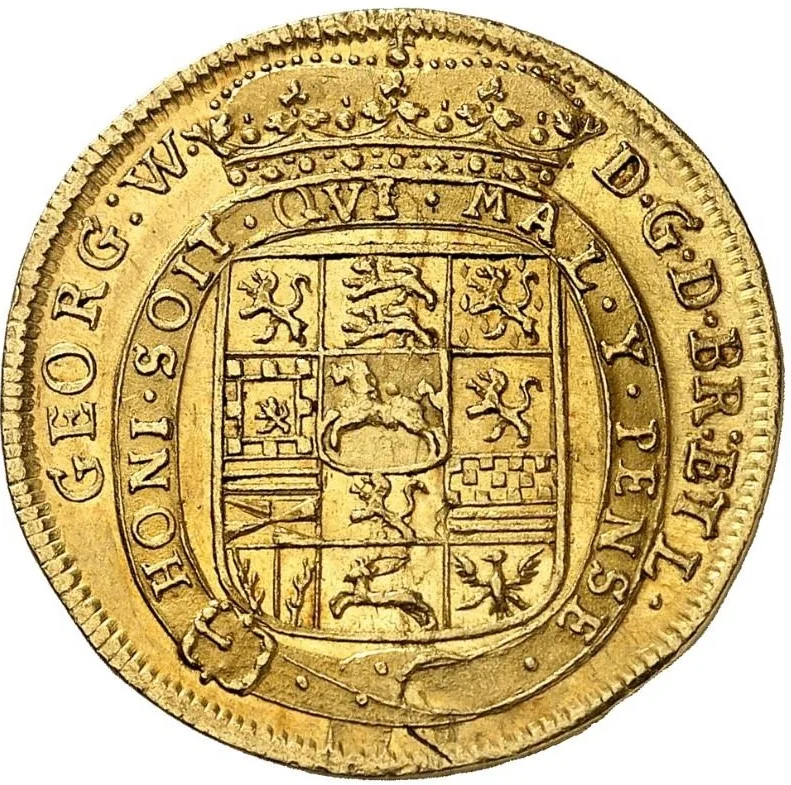
Twelve crowned arms in Garter.
Inscription:
GEORG : W . - D · G · D · BR : ET L
HONI · SOIT · QVI · MAL · Y · PENSE
HONI · SOIT · QVI · MAL · Y · PENSE
Script: Latin
Reverse
Edge
Mints
| Name | Mark |
|---|---|
| Celle | — |
Mintings
| Year | Mint Mark | Mintage | Quality | Collection |
|---|---|---|---|---|
| 1699 | — | — | ||
| 1700 | — | — |
Historical background
In 1699, the Duchy of Brunswick-Lüneburg, specifically the Principality of Celle under Duke George William, faced a complex and fragmented currency situation typical of the Holy Roman Empire. The region was not a unified monetary zone; instead, it operated within a web of competing coinage systems. The official currency was based on the Reichsthaler, a silver standard mandated by imperial decree, but in daily life, a plethora of lower-value coins circulated. These included various Gute Groschen, Mariengroschen, and Pfennige, whose values and silver content could vary significantly between different issuing authorities, leading to chronic confusion and instability in everyday trade.
This monetary fragmentation was exacerbated by the practice of "Kippermünze," where rulers, including neighbouring states, would debase their coinage by reducing silver content to generate short-term profit, often to finance military expenditures. While Duke George William of Celle was known for relatively prudent fiscal management, his duchy was not immune to the inflationary effects of debased coins flooding the region from less scrupulous mints. The result was a loss of public trust in coinage, with merchants and citizens forced to constantly evaluate and haggle over the actual value of the metal in their hands, severely hampering commerce.
Consequently, there was a growing recognition of the need for reform. The year 1699 fell within a period of increasing efforts toward monetary stabilization, notably through regional treaties like the Zinnaische Münzfuß (1667) and the upcoming Leipziger Münzfuß (1690/1700). These agreements aimed to standardise the silver content of coins across multiple German states. For Brunswick-Lüneburg-Celle, the push was toward aligning its currency with these more reliable standards to facilitate trade, ensure stable state revenues, and reduce the economic damage caused by a chaotic and unreliable monetary system.
This monetary fragmentation was exacerbated by the practice of "Kippermünze," where rulers, including neighbouring states, would debase their coinage by reducing silver content to generate short-term profit, often to finance military expenditures. While Duke George William of Celle was known for relatively prudent fiscal management, his duchy was not immune to the inflationary effects of debased coins flooding the region from less scrupulous mints. The result was a loss of public trust in coinage, with merchants and citizens forced to constantly evaluate and haggle over the actual value of the metal in their hands, severely hampering commerce.
Consequently, there was a growing recognition of the need for reform. The year 1699 fell within a period of increasing efforts toward monetary stabilization, notably through regional treaties like the Zinnaische Münzfuß (1667) and the upcoming Leipziger Münzfuß (1690/1700). These agreements aimed to standardise the silver content of coins across multiple German states. For Brunswick-Lüneburg-Celle, the push was toward aligning its currency with these more reliable standards to facilitate trade, ensure stable state revenues, and reduce the economic damage caused by a chaotic and unreliable monetary system.
✨ Legendary