

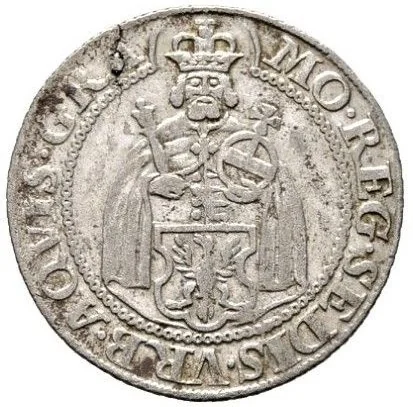
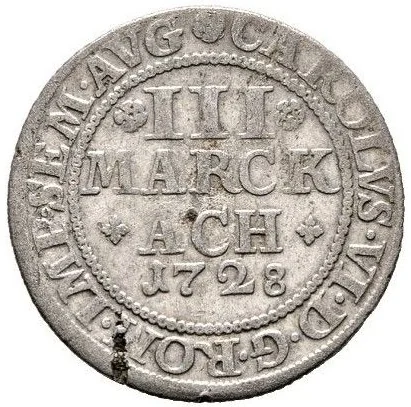
3 marks – Aachen
Add to wishlist
Germany
Context
Year: 1728
Country: Germany
Issuer: Aachen
Period:
(1166—1798)
Ruler: Charles VI
Currency:
(1504—1798)
Demonetized: Yes
Material
References
KM: #
Numista: #267438
Obverse
Description:
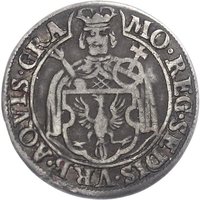
Charlemagne half-figure above arms
Inscription:
MO REG SEDIS VRB AQVIS GRA
Script: Latin
Reverse
Description:
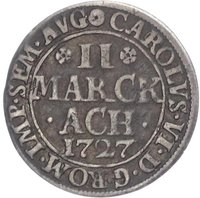
Value and date centered, encircled by Karl VI's titles.
Inscription:
CAROLVS VI D G ROM IMP SEM AVG
III
MARCK
1728
III
MARCK
1728
Script: Latin
Edge
Mints
| Name | Mark |
|---|---|
| Aachen | — |
Mintings
| Year | Mint Mark | Mintage | Quality | Collection |
|---|---|---|---|---|
| 1728 | — | — |
Historical background
In 1728, the Free Imperial City of Aachen operated within the complex and fragmented monetary landscape of the Holy Roman Empire. The city did not possess the sovereign right to mint its own coins; instead, it primarily used currency issued by regional territorial powers, most notably the Reichstaler and its subdivisions. However, the circulation of countless foreign coins, from nearby Dutch guilders and Brabant patards to French écus and various German regional issues, created a persistent challenge. This multiplicity led to chronic confusion in everyday trade, as the intrinsic silver content and exchange rates between these coins were in constant fluctuation.
The city authorities attempted to impose order through regular Münzmandate (currency ordinances). These decrees fixed the legal exchange rates for the myriad of coins in circulation, declaring some invalid and setting the value for accepted types. The ordinance of 1728 would have been one such attempt to stabilize local commerce by defining which specific coins were legal tender within the city walls and at what value. Despite these efforts, enforcement was difficult, and the ordinances often had to be updated frequently as the values of foreign coins shifted due to political debasements and international bullion flows.
This monetary instability was more than an inconvenience; it was a direct threat to Aachen's economic lifeblood—its trade and textile industries. Merchants and master craftsmen faced significant uncertainty in contracts and payments, risking losses with every transaction. Consequently, alongside the official ordinances, much high-value and wholesale business was likely conducted using trusted weighted silver or through bill-based banking systems to bypass the unreliable coinage. Thus, in 1728, Aachen’s currency situation was characterized by a continuous civic struggle to overlay a semblance of order onto a inherently chaotic imperial monetary system.
The city authorities attempted to impose order through regular Münzmandate (currency ordinances). These decrees fixed the legal exchange rates for the myriad of coins in circulation, declaring some invalid and setting the value for accepted types. The ordinance of 1728 would have been one such attempt to stabilize local commerce by defining which specific coins were legal tender within the city walls and at what value. Despite these efforts, enforcement was difficult, and the ordinances often had to be updated frequently as the values of foreign coins shifted due to political debasements and international bullion flows.
This monetary instability was more than an inconvenience; it was a direct threat to Aachen's economic lifeblood—its trade and textile industries. Merchants and master craftsmen faced significant uncertainty in contracts and payments, risking losses with every transaction. Consequently, alongside the official ordinances, much high-value and wholesale business was likely conducted using trusted weighted silver or through bill-based banking systems to bypass the unreliable coinage. Thus, in 1728, Aachen’s currency situation was characterized by a continuous civic struggle to overlay a semblance of order onto a inherently chaotic imperial monetary system.
✨ Legendary