

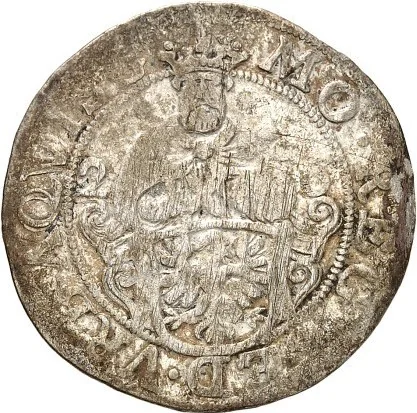
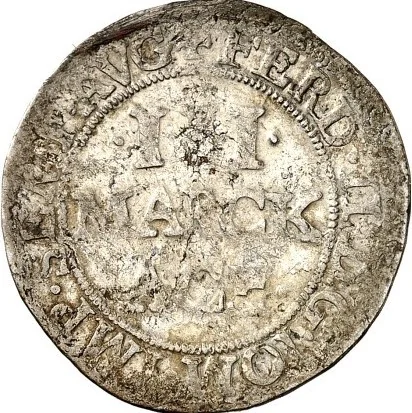
3 Marks – Aachen
Germany
Context
Years: 1626–1634
Country: Germany 
Issuer: Aachen
Period:
(1166—1798)
Ruler: Ferdinand II
Currency:
(1504—1798)
Demonetized: Yes
Material
References
KM: #Click to copy to clipboard15
Numista: #266873
Value
Bullion value: $7.86
Obverse
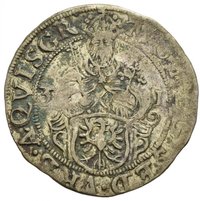
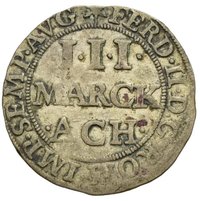
Reverse
Description:
Inscription within circle: value and date. Legend around. Titles of Ferdinand II.
Inscription:
FERD II D G ROM IMP SEMP AVG
III
MARCK
ACH
III
MARCK
ACH
Script: Latin
Edge
Mintings
| Year | Mint Mark | Mintage | Quality | Collection |
|---|---|---|---|---|
| 1626 | — | — | ||
| 1631 | — | — | ||
| 1634 | — | — |
Historical background
In 1626, the Free Imperial City of Aachen, like much of the Holy Roman Empire, was grappling with severe monetary instability exacerbated by the Thirty Years' War. The city's economy, traditionally reliant on its prestigious cloth industry and its status as a pilgrimage and coronation site, was strained by wartime levies, disrupted trade routes, and the general economic contraction affecting the Rhineland. This context created a precarious environment where the city council struggled to maintain fiscal sovereignty and a reliable circulating medium amidst empire-wide chaos.
The core of the monetary problem was the proliferation of debased coinage. Aachen, while minting its own Pfennigs and Albus for local use, was inundated with inferior coins from neighboring territories engaging in "Kipper und Wipper" practices—clipping, sweating, and issuing coins with reduced precious metal content. This speculative debasement, which peaked in the early 1620s, led to Gresham's Law in action: good, full-weight coins were hoarded or melted down, while poor-quality money flooded the market, causing rampant price inflation and eroding public trust in the currency system.
The Aachen city council responded with defensive ordinances, repeatedly issuing mandates to fix exchange rates and prohibit the circulation of specific foreign coins deemed particularly debased. However, these measures were largely reactive and of limited effect. The city's ability to control its currency was constrained by its obligations to imperial monetary ordinances and the overwhelming economic forces of the war. Thus, in 1626, Aachen's merchants and citizens navigated daily transactions with a heterogeneous and unstable mix of coins, a tangible reflection of the city's struggle to preserve economic order in a fragmented and conflict-ridden empire.
The core of the monetary problem was the proliferation of debased coinage. Aachen, while minting its own Pfennigs and Albus for local use, was inundated with inferior coins from neighboring territories engaging in "Kipper und Wipper" practices—clipping, sweating, and issuing coins with reduced precious metal content. This speculative debasement, which peaked in the early 1620s, led to Gresham's Law in action: good, full-weight coins were hoarded or melted down, while poor-quality money flooded the market, causing rampant price inflation and eroding public trust in the currency system.
The Aachen city council responded with defensive ordinances, repeatedly issuing mandates to fix exchange rates and prohibit the circulation of specific foreign coins deemed particularly debased. However, these measures were largely reactive and of limited effect. The city's ability to control its currency was constrained by its obligations to imperial monetary ordinances and the overwhelming economic forces of the war. Thus, in 1626, Aachen's merchants and citizens navigated daily transactions with a heterogeneous and unstable mix of coins, a tangible reflection of the city's struggle to preserve economic order in a fragmented and conflict-ridden empire.

✨ Legendary