

3 Thalers – Brunswick-Lüneburg-Calenberg
Germany
Context
Year: 1677
Country: Germany 
Issuer: Brunswick-Lüneburg-Calenberg
Ruler: John Frederick
Currency:
Demonetized: Yes
Material
References
KM: #Click to copy to clipboard133.2
Numista: #266686
Value
Bullion value: $238.75
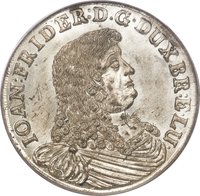
Obverse
Description:
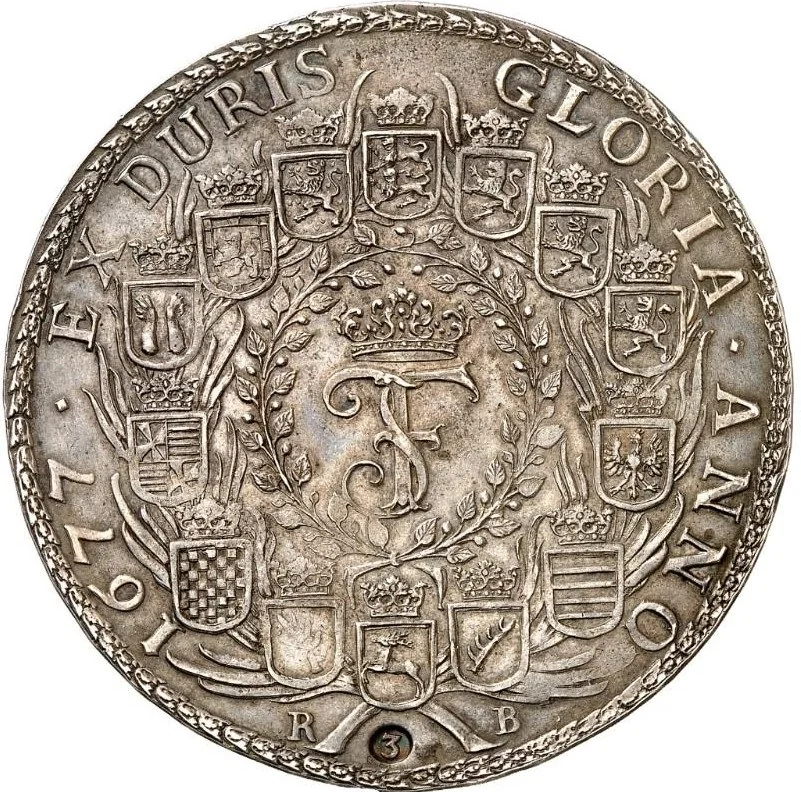
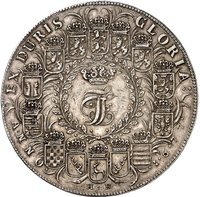
Crowned JF monogram encircled by 14 small shields, legend with date, 3 punched.
Inscription:
EX DURIS GLORIA ANNO 1677
JF
3
RB
JF
3
RB
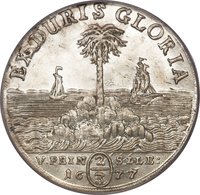
Reverse
Description:
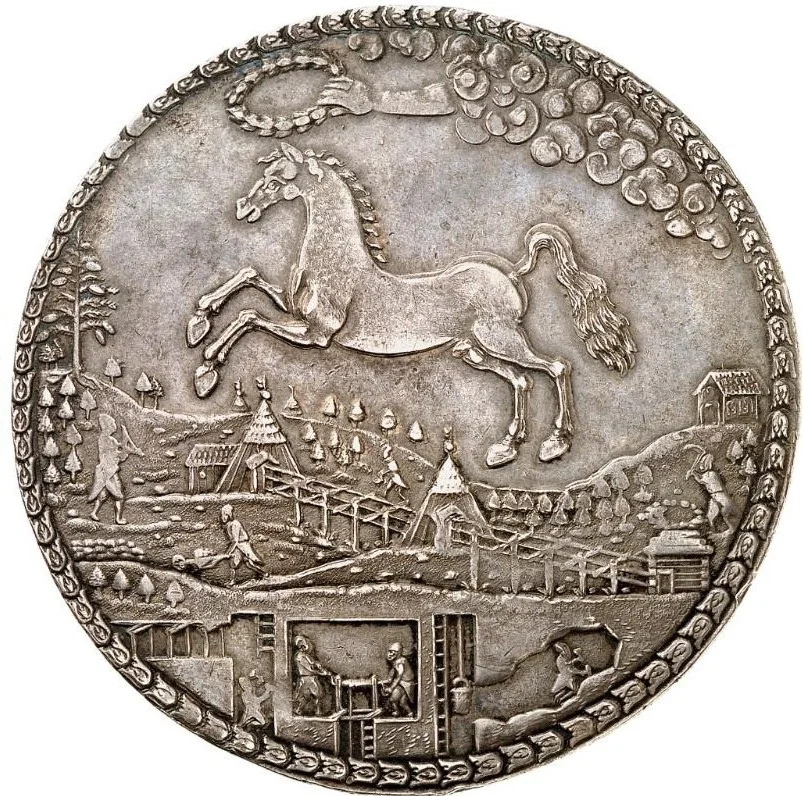
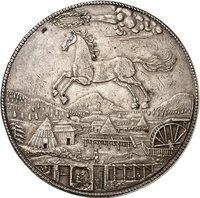
Horse jumping over a mine.
Edge
Mintings
| Year | Mint Mark | Mintage | Quality | Collection |
|---|---|---|---|---|
| 1677 | — | — |
Historical background
In 1677, the Duchy of Brunswick-Lüneburg, specifically the Principality of Calenberg under Duke Johann Friedrich, was entangled in the complex and debilitating monetary chaos that plagued the Holy Roman Empire. The primary issue was the proliferation of debased coinage, particularly the Kipper- und Wipperzeit inflation crisis of the early 1620s, whose effects lingered for decades. While the worst was over, a fragmented imperial monetary system and the practice of neighboring states issuing inferior coins led to a chronic circulation of underweight and overvalued currency within Calenberg, disrupting trade and eroding public trust.
Duke Johann Friedrich, a ruler with strong ties to France and a focus on cultural and economic development, faced significant fiscal pressure. His ambitions, including the expansion of his residence city of Hanover, required substantial revenue. One historical source of income for German princes was Schlagschatz – the profit made from minting coins. There was a strong temptation to engage in competitive devaluation, issuing lighter coins with less precious metal content to stretch treasury funds, especially to pay for military obligations and building projects, thereby exacerbating the local currency instability.
Consequently, the currency situation in Calenberg in 1677 was characterized by uncertainty and transition. Johann Friedrich was likely navigating between the immediate financial needs of his state and the longer-term necessity of stable currency for economic growth. While specific ordinances for that exact year are less documented, his reign saw active, if struggling, participation in regional monetary treaties (Münzvereine) aimed at standardizing coin values. Thus, the background is one of a ruler attempting to manage inherited monetary disorder while his own fiscal demands and the actions of neighboring mints continued to challenge the stability of the currency in circulation.
Duke Johann Friedrich, a ruler with strong ties to France and a focus on cultural and economic development, faced significant fiscal pressure. His ambitions, including the expansion of his residence city of Hanover, required substantial revenue. One historical source of income for German princes was Schlagschatz – the profit made from minting coins. There was a strong temptation to engage in competitive devaluation, issuing lighter coins with less precious metal content to stretch treasury funds, especially to pay for military obligations and building projects, thereby exacerbating the local currency instability.
Consequently, the currency situation in Calenberg in 1677 was characterized by uncertainty and transition. Johann Friedrich was likely navigating between the immediate financial needs of his state and the longer-term necessity of stable currency for economic growth. While specific ordinances for that exact year are less documented, his reign saw active, if struggling, participation in regional monetary treaties (Münzvereine) aimed at standardizing coin values. Thus, the background is one of a ruler attempting to manage inherited monetary disorder while his own fiscal demands and the actions of neighboring mints continued to challenge the stability of the currency in circulation.
✨ Legendary