

1½ Thaler – Brunswick-Lüneburg-Calenberg
Germany
Context
Years: 1670–1672
Country: Germany 
Issuer: Brunswick-Lüneburg-Calenberg
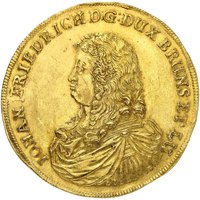
Ruler: John Frederick
Currency:
Demonetized: Yes
Material
References
KM: #Click to copy to clipboard131
Numista: #266684
Value
Bullion value: $123.90
Obverse
Description:
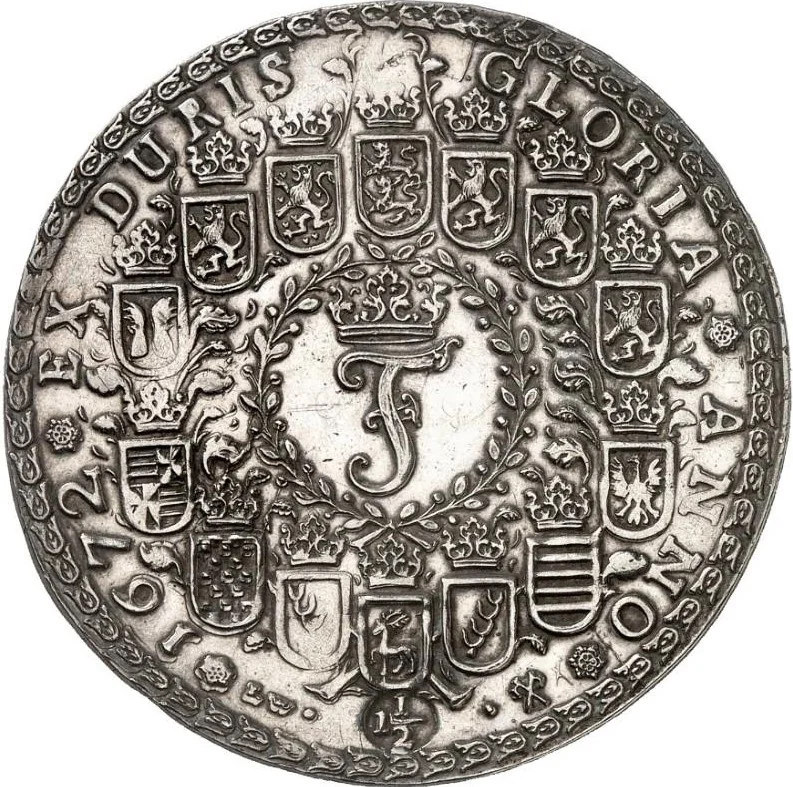
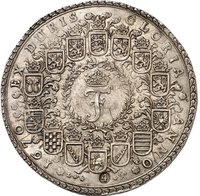
Crowned JF monogram encircled by 14 shields, date in legend, punched 1 1/2.
Inscription:
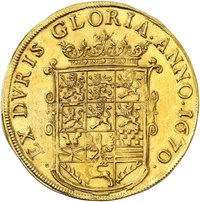
EX DURIS GLORIA ANNO 1672
JF
1 1/2
LW
JF
1 1/2
LW
Reverse
Description:
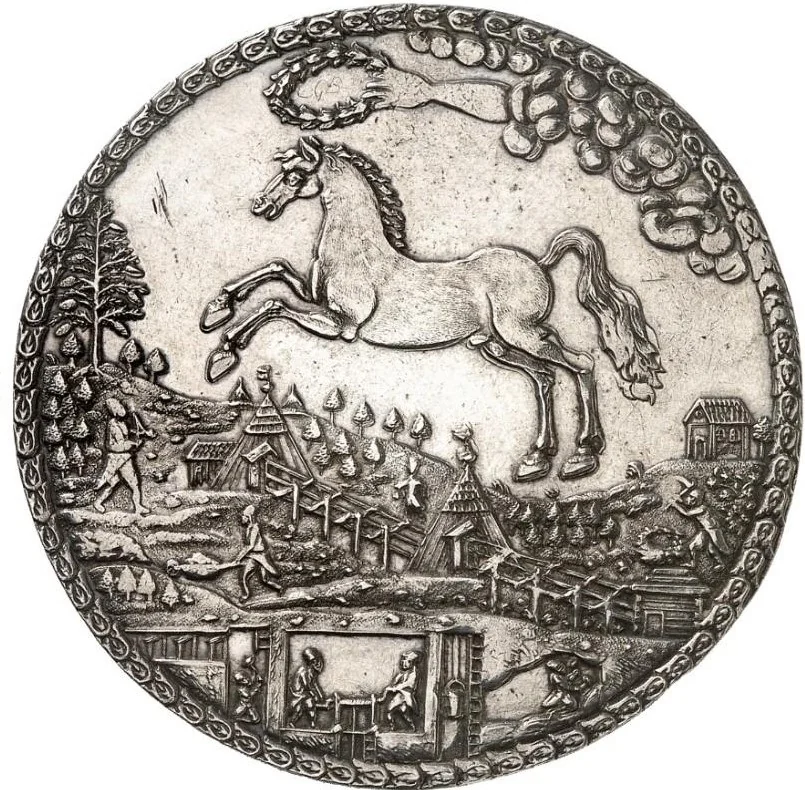
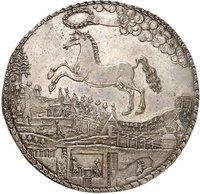
Horse jumping over a mine.
Edge
Mints
| Name | Mark |
|---|---|
| Clausthal | — |
Mintings
| Year | Mint Mark | Mintage | Quality | Collection |
|---|---|---|---|---|
| 1670 | — | — | ||
| 1671 | — | — | ||
| 1672 | — | — |
Historical background
In 1670, the currency situation in the Principality of Calenberg (a division of the larger Duchy of Brunswick-Lüneburg) was characterized by significant instability and complexity, a common challenge across the German states following the Thirty Years' War. The region suffered from a proliferation of debased and foreign coins circulating alongside official issues, leading to chronic uncertainty in trade. This "Kipper- und Wipperzeit" (clipping and waving period) had left a legacy of poor-quality coinage, and despite attempts at reform, the monetary system remained fragmented, with values fluctuating based on metal content and origin rather than face value.
The core of the problem lay in the competition between various minting authorities. The ruling House of Welf itself had multiple branches issuing coinage from mints in Hanover, Zellerfeld, and elsewhere, often with varying standards. Furthermore, neighboring states and countless counterfeit coins entered circulation, eroding public trust. This monetary confusion hampered economic recovery, as merchants and peasants alike were uncertain of the real value of their payments, creating friction in everyday transactions and long-distance commerce.
Recognizing the need for order, the princely government in Calenberg was actively engaged in efforts to assert control. While a comprehensive reform was still in the future, authorities were likely enforcing existing ordinances and negotiating with other territories to standardize values. The situation in 1670 was thus one of transition, caught between the chaotic legacy of the past and the growing administrative push for a stable, uniform currency that would underpin the principality's economic and political ambitions, which would later culminate in the establishment of the Electorate of Hanover.
The core of the problem lay in the competition between various minting authorities. The ruling House of Welf itself had multiple branches issuing coinage from mints in Hanover, Zellerfeld, and elsewhere, often with varying standards. Furthermore, neighboring states and countless counterfeit coins entered circulation, eroding public trust. This monetary confusion hampered economic recovery, as merchants and peasants alike were uncertain of the real value of their payments, creating friction in everyday transactions and long-distance commerce.
Recognizing the need for order, the princely government in Calenberg was actively engaged in efforts to assert control. While a comprehensive reform was still in the future, authorities were likely enforcing existing ordinances and negotiating with other territories to standardize values. The situation in 1670 was thus one of transition, caught between the chaotic legacy of the past and the growing administrative push for a stable, uniform currency that would underpin the principality's economic and political ambitions, which would later culminate in the establishment of the Electorate of Hanover.
✨ Legendary