Logo Title
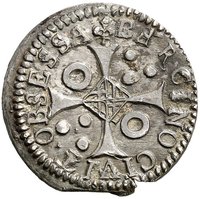
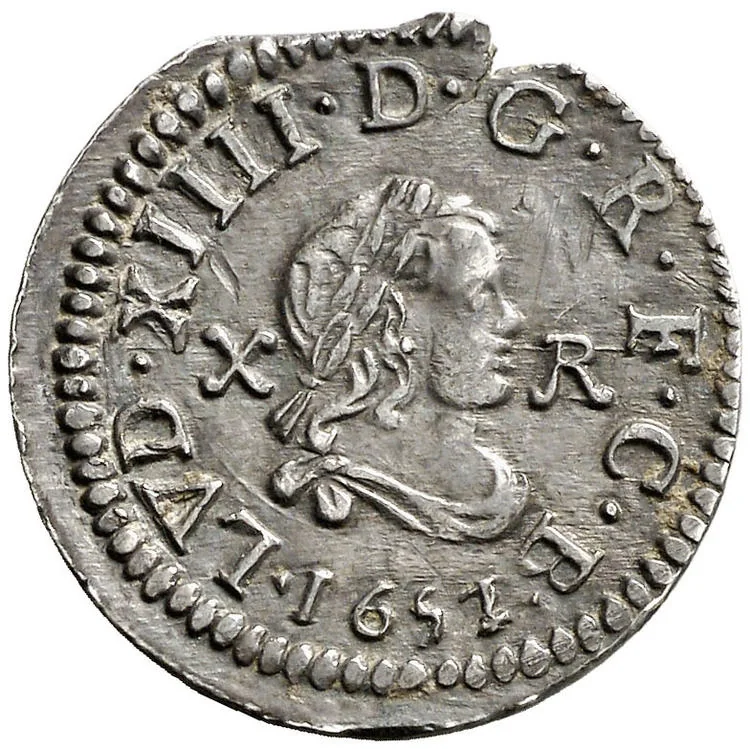
obverse
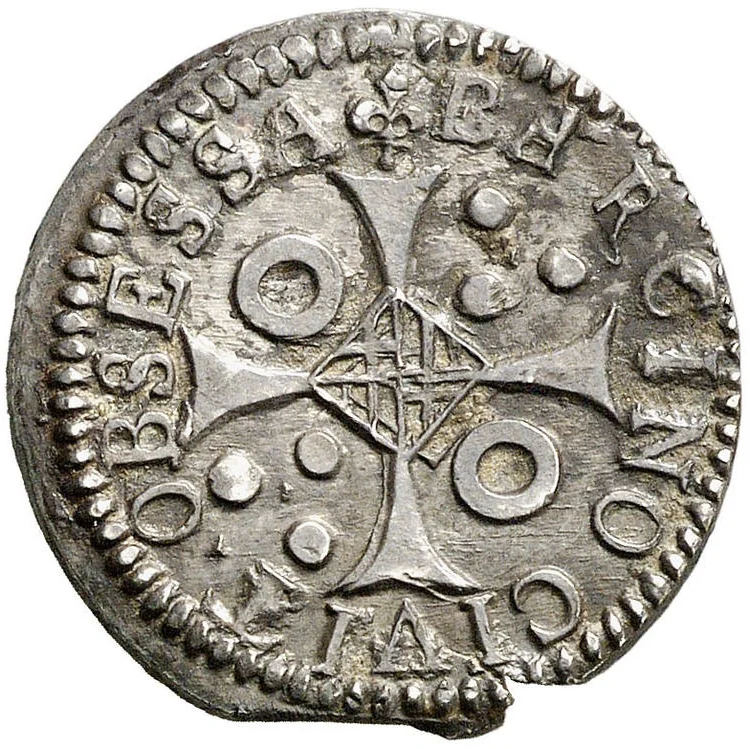
reverse
Aureo & Calicó S.L., subastas numismáticas

10 Reales – Principality of Catalonia

Spain
Context
Year: 1652
Country: Spain Country flag
Currency:
Demonetized: Yes
Material
Diameter: 20 mm
Weight: 3.5 g
Silver weight: 3.21 g
Composition: 91.7% Silver
Magnetic: No
Technique: Hammered
Alignment: Coin alignment
Obverse
OBVERSE ↑
flip
Reverse
REVERSE ↓
References
KM: #Click to copy to clipboard39
Numista: #110674
Value
Bullion value: $9.08

Obverse

Description:
Bust right divides value within beaded circle.
Inscription:
X R

LVD·XIIII·D·G·R·F·C·B

·1651·
Script: Latin

Reverse

Description:
Short cross with an annulet in the first and fourth angles, three bezants in the second and third. Central lozenge shield. Legend within a beaded circle.
Inscription:
BARCINO CIVIT.OBSESSA
Script: Latin

Edge

Categories

Object> Armour
Symbol> Cross

Mints

NameMark
Barcelona Mint / La Seca

Mintings

YearMint MarkMintageQualityCollection
1652

Historical background

By 1652, the Principality of Catalonia was emerging from over a decade of profound crisis, a period known as the Reapers' War (Guerra dels Segadors). This conflict, which began as a revolt against the centralizing policies of the Spanish Crown in 1640, had led Catalonia to declare King Louis XIII of France as its sovereign. The war devastated the countryside, disrupted trade, and placed immense strain on the public treasury. The financial exhaustion was absolute, with the Generalitat (the governing body) deeply in debt from funding the war effort, leading to a severe scarcity of specie (coinage) in circulation.

The currency situation was chaotic and inflationary. To meet wartime expenses, the authorities had repeatedly resorted to debasing the coinage, notably the principat and the sou. They issued billon coins (made of base metal with a small silver content) of increasingly poor quality and reduced intrinsic value. Furthermore, the prolonged conflict saw both Spanish and French royal mints operating within Catalonia, issuing competing currencies to finance their armies, which further confused the monetary system. This proliferation of debased coinage led to a classic "bad money drives out good" scenario (Gresham's Law), where older, higher-value coins were hoarded or melted down, leaving only the poorest quality money in active use, eroding public trust and disrupting everyday commerce.

The year 1652 itself marked a pivotal turning point, as Barcelona fell to Spanish forces in October, effectively ending the French protectorate and reincorporating Catalonia into the Spanish Monarchy under Philip IV. The immediate monetary priority for the victorious Spanish authorities was to stabilize the currency by reasserting royal control over the mints and gradually replacing the chaotic mix of debased and foreign coins with standardized Castilian currency. However, the process was slow, and the principality entered a period of post-war recovery with a crippled economy, a heavy burden of debt, and a monetary system in need of complete restoration, tasks that would define its financial landscape for the remainder of the 17th century.
Legendary