

1 ducat – Sweden
Add to wishlist
Sweden
Context
Years: 1793–1795
Issuer: Sweden
Ruler: Gustav IV Adolf
Currency:
(1719—1798)
Demonetized: Yes
Total mintage: 19,999
Material
References
KM: #
Numista: #100516
Value
Bullion value: $521.44
Obverse
Description:
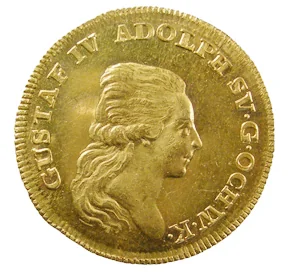
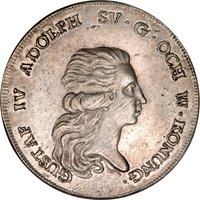
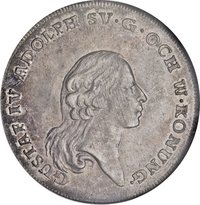
King Gustav IV Adolf, right-facing portrait. Legend encircling rim.
Inscription:
GUSTAF IV ADOLPH SV • G • OCH W • K •
Script: Latin
Reverse
Description:
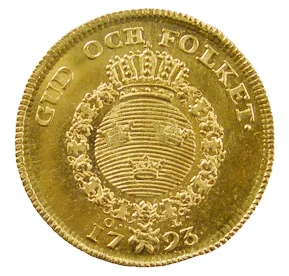
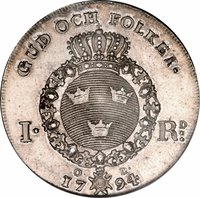
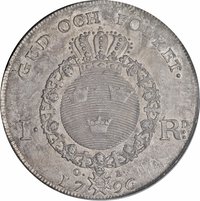
Sweden’s Three Crowns within the Seraphim Order chain, pendant dividing date and mintmark. The King’s motto is above the crown.
Inscription:
GUD OCH FOLKET •
O• L•
17 94
O• L•
17 94
Script: Latin
Edge
Categories
| Symbols> Coat of Arms |
Mintings
| Year | Mint Mark | Mintage | Quality | Collection |
|---|---|---|---|---|
| 1793 | OL | 1,528 | ||
| 1794 | OL | 14,400 | ||
| 1795 | OL | 4,071 |
Historical background
In 1793, Sweden was navigating a precarious monetary landscape shaped by decades of war, inflation, and institutional instability. The nation was still reeling from the disastrous Russo-Swedish War (1788–1790), which had emptied the treasury and forced the state to rely heavily on borrowing. The primary currency in circulation was the riksdaler, but its value was undermined by the simultaneous existence of a depreciated paper money known as the riksdaler riksgälds, issued by the National Debt Office (Riksgäldskontoret) to finance state deficits. This created a problematic dual-currency system where the paper money traded at a significant discount against the silver-backed riksdaler specie.
The situation was a direct legacy of the Age of Liberty and the unchecked power of the Riksdag of the Estates, which had funded wars and government operations by printing ever more paper money without sufficient metallic backing. By 1793, during the early reign of King Gustav IV Adolf, the gap between the nominal value of this paper currency and its real purchasing power was a source of economic strain and public distrust. Prices were unstable, and foreign trade was complicated by the need to negotiate exchange rates between Sweden's weak paper money and stronger international metallic currencies.
Consequently, 1793 fell within a period of unresolved monetary tension preceding more decisive action. While discussions about stabilization and reform were ongoing, no fundamental restructuring had yet been implemented. The government's reliance on deficit financing and paper money continued, setting the stage for the major monetary reforms that would follow later in the decade, particularly after the Riksdag of 1800. Thus, the currency situation of 1793 was characterized by fragility, marking a low point of confidence in state-issued money before the eventual push toward a more unified and secure monetary system.
The situation was a direct legacy of the Age of Liberty and the unchecked power of the Riksdag of the Estates, which had funded wars and government operations by printing ever more paper money without sufficient metallic backing. By 1793, during the early reign of King Gustav IV Adolf, the gap between the nominal value of this paper currency and its real purchasing power was a source of economic strain and public distrust. Prices were unstable, and foreign trade was complicated by the need to negotiate exchange rates between Sweden's weak paper money and stronger international metallic currencies.
Consequently, 1793 fell within a period of unresolved monetary tension preceding more decisive action. While discussions about stabilization and reform were ongoing, no fundamental restructuring had yet been implemented. The government's reliance on deficit financing and paper money continued, setting the stage for the major monetary reforms that would follow later in the decade, particularly after the Riksdag of 1800. Thus, the currency situation of 1793 was characterized by fragility, marking a low point of confidence in state-issued money before the eventual push toward a more unified and secure monetary system.
✨ Legendary