

Gigot – Spanish Netherlands
Netherlands
Context
Years: 1602–1610
Country: Netherlands 
Issuer: Spanish Netherlands
Currency:
(1506—1713)
Subdivision: Gigot = ½ Liard
Demonetized: Yes
Material
Diameter: 23 mm
Weight: 2.4 g
Shape: Irregular round
Composition: Copper
Magnetic: No
Technique: Hammered
Alignment: Coin alignment
flip
References
KM: #Click to copy to clipboard22
Numista: #100283
Obverse
Description:
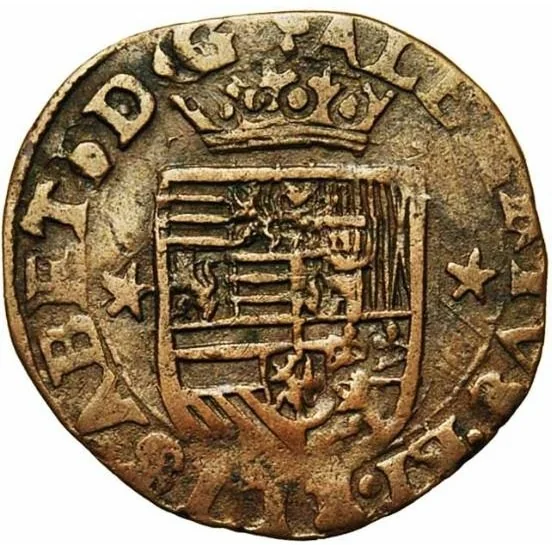
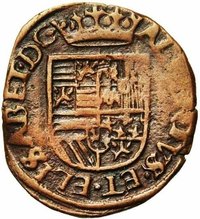
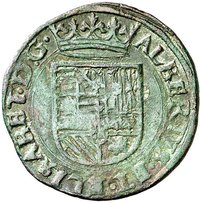
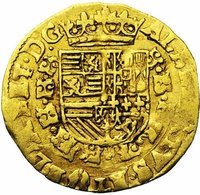
Austria-Burgundy arms crowned, flanked by stars.
Inscription:
ALBERTVS ET ELISABET DEI G
Script: Latin
Reverse
Description:
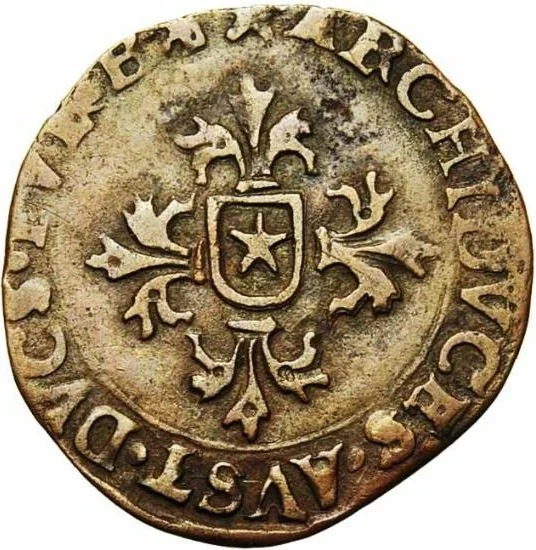
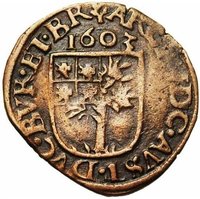
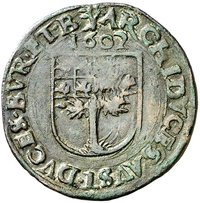
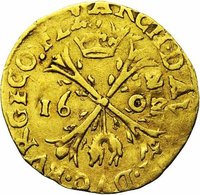
Maastricht arms on a floriate cross shield.
Inscription:
ARCHIDVCES AVST DV[CE] BV[R] ET B
Script: Latin
Edge
Mints
| Name | Mark |
|---|---|
| Maastricht | — |
Mintings
| Year | Mint Mark | Mintage | Quality | Collection |
|---|---|---|---|---|
| — | étoile | — |
Historical background
In 1602, the Spanish Netherlands found itself in a complex and debilitating currency crisis, a direct consequence of the ongoing Eighty Years' War (1568-1648). The region, a hub of European commerce, was financially exhausted by the immense costs of maintaining the Army of Flanders. To meet these expenses, the authorities, under Archduke Albert and Archduchess Isabella, resorted to repeated debasements of the coinage. This involved reducing the precious metal content in coins while officially maintaining their face value, a practice that flooded the economy with unstable currency and shattered public trust.
The situation was exacerbated by the circulation of a chaotic mix of coins. Alongside the debased domestic issues, there were older, full-value coins (which were hoarded), and a plethora of foreign currencies from trade, particularly the stable Dutch Republic rijksdaalder and German thaler. This led to Gresham's Law in action: "bad money drives out good." People used the debased coins for daily transactions and saved or exported the full-weight coins, further draining the economy of sound money. Prices soared, wages failed to keep pace, and market transactions were plagued by confusion and suspicion over the real value of any coin.
This monetary instability presented a severe obstacle to economic recovery and governance. While the authorities recognized the problem, effective solutions were elusive within the wartime context. The crisis of 1602 was therefore a critical point, highlighting the deep interconnection between the financial health of the state, the pressures of prolonged military conflict, and the disruption of the region's vital commercial networks. It underscored the near-impossible task of maintaining a stable economy while fighting a costly war for survival.
The situation was exacerbated by the circulation of a chaotic mix of coins. Alongside the debased domestic issues, there were older, full-value coins (which were hoarded), and a plethora of foreign currencies from trade, particularly the stable Dutch Republic rijksdaalder and German thaler. This led to Gresham's Law in action: "bad money drives out good." People used the debased coins for daily transactions and saved or exported the full-weight coins, further draining the economy of sound money. Prices soared, wages failed to keep pace, and market transactions were plagued by confusion and suspicion over the real value of any coin.
This monetary instability presented a severe obstacle to economic recovery and governance. While the authorities recognized the problem, effective solutions were elusive within the wartime context. The crisis of 1602 was therefore a critical point, highlighting the deep interconnection between the financial health of the state, the pressures of prolonged military conflict, and the disruption of the region's vital commercial networks. It underscored the near-impossible task of maintaining a stable economy while fighting a costly war for survival.
✨ Legendary