

24 skilling – Norway
Add to wishlist
Norway
Context
Material
References
KM: #
Numista: #100218
Value
Bullion value: $13.07
Obverse
Description:
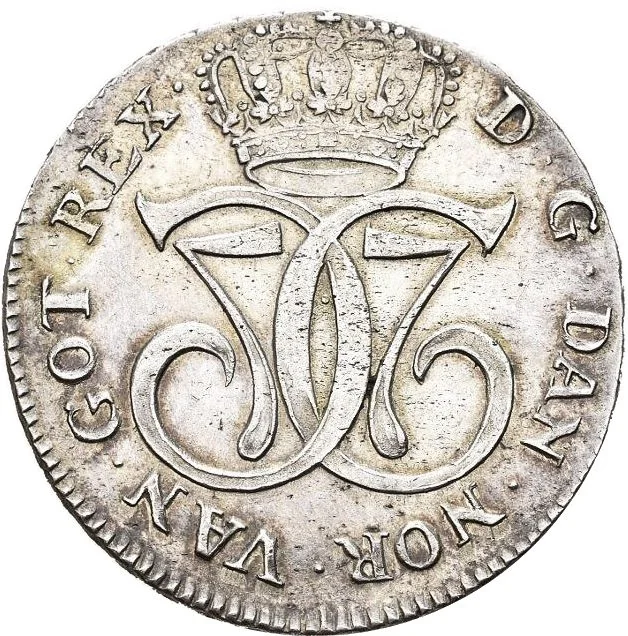
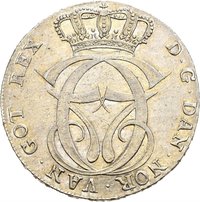
Crowned mirrored monogram of Christian VII within an inscription and beaded border.
Inscription:
D · G · DAN · NOR · VAN · GOT · REX ·
Script: Latin
Reverse
Description:
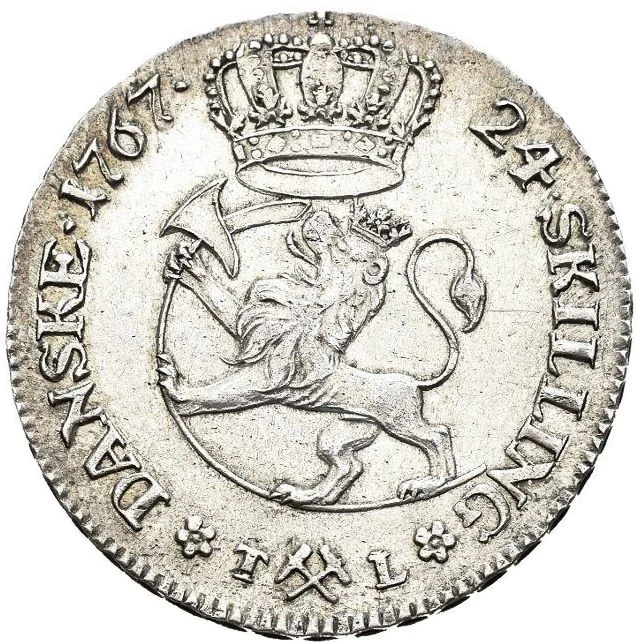
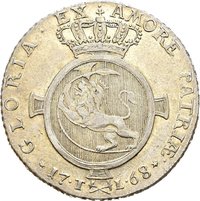
Norwegian lion with axe facing left, crowned twice. Inscription surrounds, mintmark and initials below. Beaded edge.
Inscription:
24·SKILLING | DANSKE·1767·
✿ T ⚒ L ✿
✿ T ⚒ L ✿
Script: Latin
Edge
Mints
| Name | Mark |
|---|---|
| Norwegian Mint | — |
Mintings
| Year | Mint Mark | Mintage | Quality | Collection |
|---|---|---|---|---|
| 1767 | — | — |
Historical background
In 1767, Norway found itself in a complex monetary situation, still deeply entangled with Denmark due to the Dano-Norwegian union. The official currency was the Danish rigsdaler, divided into 96 skilling. However, the system was plagued by a severe shortage of official coinage, particularly small-denomination coins needed for everyday transactions. This scarcity was a chronic issue, leading to widespread use of makeshift solutions. Locally, merchants, mining companies, and even municipalities issued their own forms of credit notes and token coins (klippemynter and kreditivsedler) to facilitate local trade, creating a confusing patchwork of unofficial currencies.
The underlying problem was structural. Norway's economy, heavily reliant on exports like timber, fish, and metals, often saw its silver coinage flow out to settle trade deficits, especially with other Baltic regions. Furthermore, the state's fiscal policy, controlled from Copenhagen, often prioritized the needs of the Danish realm as a whole, failing to adequately address Norway's specific circulatory needs. The result was a monetary environment where the value and acceptance of various forms of payment could vary significantly from town to town, hindering commerce and creating uncertainty for both merchants and the general population.
Recognizing the destabilizing effect of this chaos, the central authorities in Copenhagen had begun attempts at reform. Just a few years prior, in 1763, a new bank, Den Københavnske Assignations-, Veksel- og Laanebank (the Copenhagen Assignment, Exchange and Loan Bank), was established with a mandate to improve the currency situation across the dual monarchy. By 1767, it was actively working to recall the plethora of unstable local notes and replace them with more reliable, nationally-backed paper money. Thus, 1767 represents a pivotal moment of transition, caught between the old era of monetary fragmentation and a new, uncertain push toward a more unified and stable currency system under central oversight.
The underlying problem was structural. Norway's economy, heavily reliant on exports like timber, fish, and metals, often saw its silver coinage flow out to settle trade deficits, especially with other Baltic regions. Furthermore, the state's fiscal policy, controlled from Copenhagen, often prioritized the needs of the Danish realm as a whole, failing to adequately address Norway's specific circulatory needs. The result was a monetary environment where the value and acceptance of various forms of payment could vary significantly from town to town, hindering commerce and creating uncertainty for both merchants and the general population.
Recognizing the destabilizing effect of this chaos, the central authorities in Copenhagen had begun attempts at reform. Just a few years prior, in 1763, a new bank, Den Københavnske Assignations-, Veksel- og Laanebank (the Copenhagen Assignment, Exchange and Loan Bank), was established with a mandate to improve the currency situation across the dual monarchy. By 1767, it was actively working to recall the plethora of unstable local notes and replace them with more reliable, nationally-backed paper money. Thus, 1767 represents a pivotal moment of transition, caught between the old era of monetary fragmentation and a new, uncertain push toward a more unified and stable currency system under central oversight.
✨ Legendary