

⅕ Speciedaler – Norway
Norway
Context
Years: 1796–1803
Issuer: Norway 
Ruler: Christian VII
Currency:
(1746—1814)
Subdivision: ⅕ Speciedaler = ¼ Rigsdaler Courant
Demonetized: Yes
Total mintage: 917,700
Material
References
KM: #Click to copy to clipboard272
Numista: #100214
Value
Bullion value: $14.28
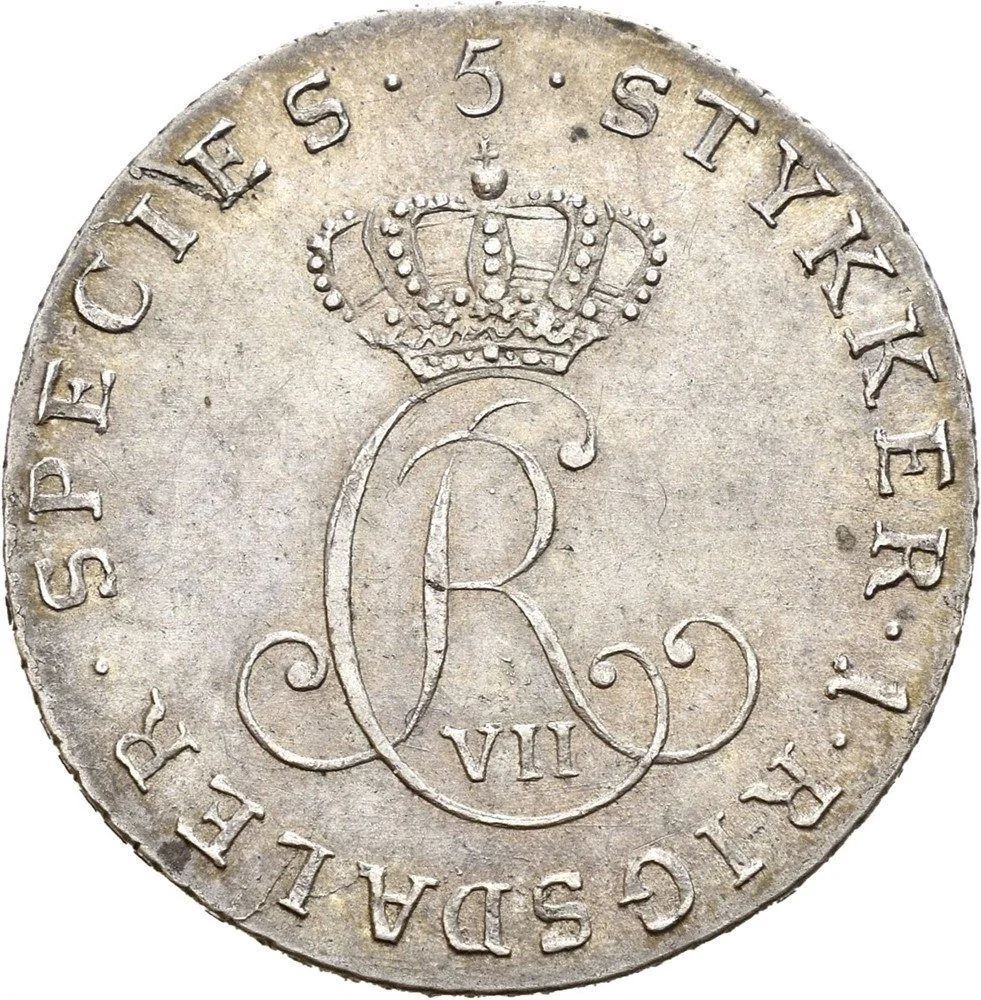
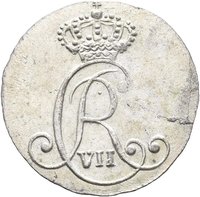
Obverse
Description:
Christian VII crowned monogram within inscription.
Inscription:
5 · STYKKER · 1 · RIGSDALER · SPECIES ·
CR VII
CR VII
Script: Latin
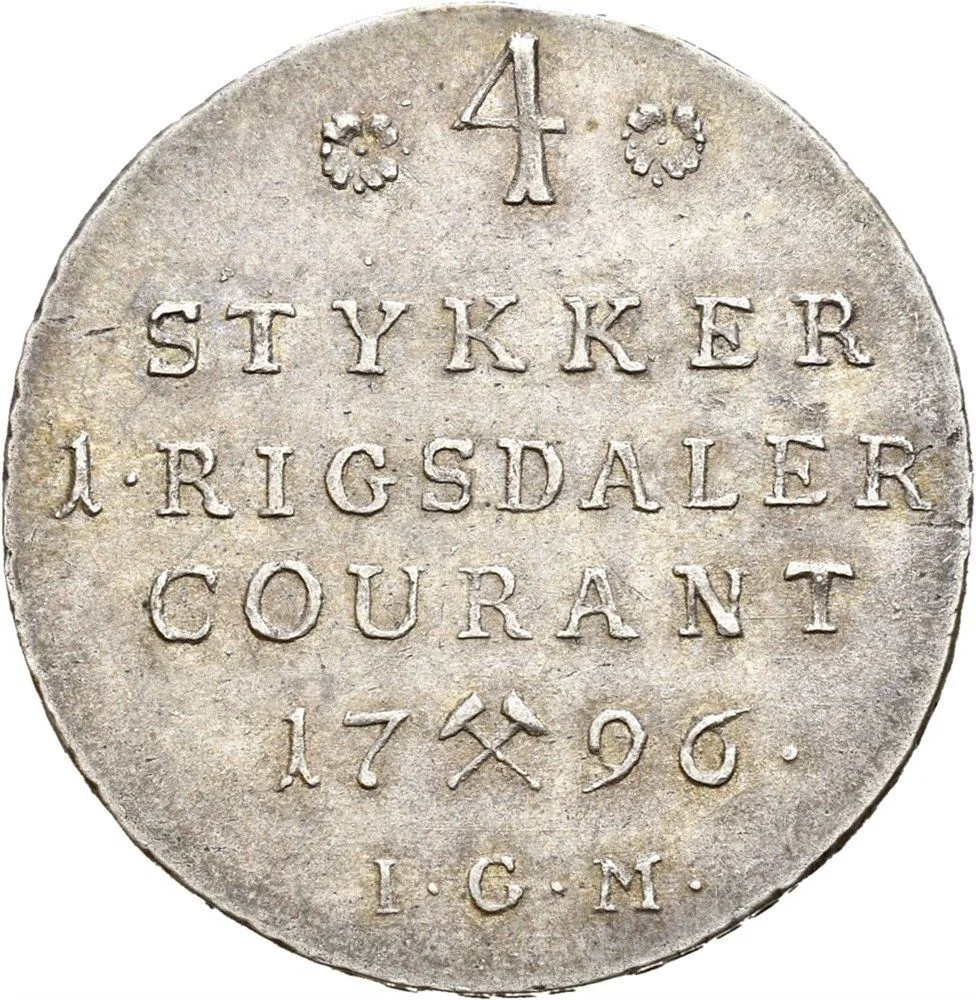
Reverse
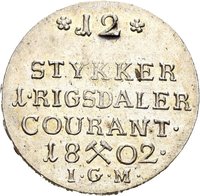
Description:
Value and date in four lines.
Date split by mintmark.
Mintmaster initials below.
Date split by mintmark.
Mintmaster initials below.
Inscription:
❀ 4 ❀
STYKKER
1·RIGSDALER
COURANT·
17⚒96·
I·G·M·
STYKKER
1·RIGSDALER
COURANT·
17⚒96·
I·G·M·
Script: Latin
Edge
Mints
| Name | Mark |
|---|---|
| Norwegian Mint | — |
Mintings
| Year | Mint Mark | Mintage | Quality | Collection |
|---|---|---|---|---|
| 1796 | — | — | ||
| 1797 | — | 192,100 | ||
| 1798 | — | 188,500 | ||
| 1799 | — | 157,500 | ||
| 1800 | — | 125,100 | ||
| 1801 | — | 162,500 | ||
| 1803 | — | 92,000 |
Historical background
In 1796, Norway, then in a union with Denmark under the Danish crown, operated within a complex and strained monetary system. The official currency was the Danish rigsdaler, but the circulating medium was a chaotic mix of physical coins, paper notes, and credit instruments. A severe shortage of small change plagued everyday commerce, leading to widespread use of fragmented coins, private token coins issued by merchants and mines, and even makeshift notes. This fragmentation undermined trust and efficiency in the economy, creating a persistent problem for both the public and authorities.
The underlying strain was exacerbated by the broader European conflicts of the period, particularly the French Revolutionary Wars. Denmark-Norway's neutral trade was highly profitable but also a target, leading to significant state expenditure on naval convoys and military preparedness. This, combined with the Bank of Copenhagen's (the only note-issuing bank) practice of financing state deficits, placed the monetary system under inflationary pressure. The value of paper notes began to depreciate against silver, sowing seeds of distrust in the paper currency that would erupt into a full crisis a decade later.
Consequently, 1796 represents a point of simmering tension within Norway's currency regime. While the formal union with Denmark provided the framework, the practical reality was one of local improvisation and growing systemic weakness. The scarcity of sound coinage hindered daily transactions, while the over-issuance of paper money to fund state needs quietly devalued the currency, setting the stage for the major monetary reforms and eventual establishment of a separate Norwegian central bank (Norges Bank) in 1816, after the union with Denmark was dissolved.
The underlying strain was exacerbated by the broader European conflicts of the period, particularly the French Revolutionary Wars. Denmark-Norway's neutral trade was highly profitable but also a target, leading to significant state expenditure on naval convoys and military preparedness. This, combined with the Bank of Copenhagen's (the only note-issuing bank) practice of financing state deficits, placed the monetary system under inflationary pressure. The value of paper notes began to depreciate against silver, sowing seeds of distrust in the paper currency that would erupt into a full crisis a decade later.
Consequently, 1796 represents a point of simmering tension within Norway's currency regime. While the formal union with Denmark provided the framework, the practical reality was one of local improvisation and growing systemic weakness. The scarcity of sound coinage hindered daily transactions, while the over-issuance of paper money to fund state needs quietly devalued the currency, setting the stage for the major monetary reforms and eventual establishment of a separate Norwegian central bank (Norges Bank) in 1816, after the union with Denmark was dissolved.
✨ Legendary