

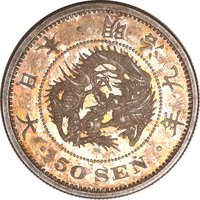
Obverse
Description:
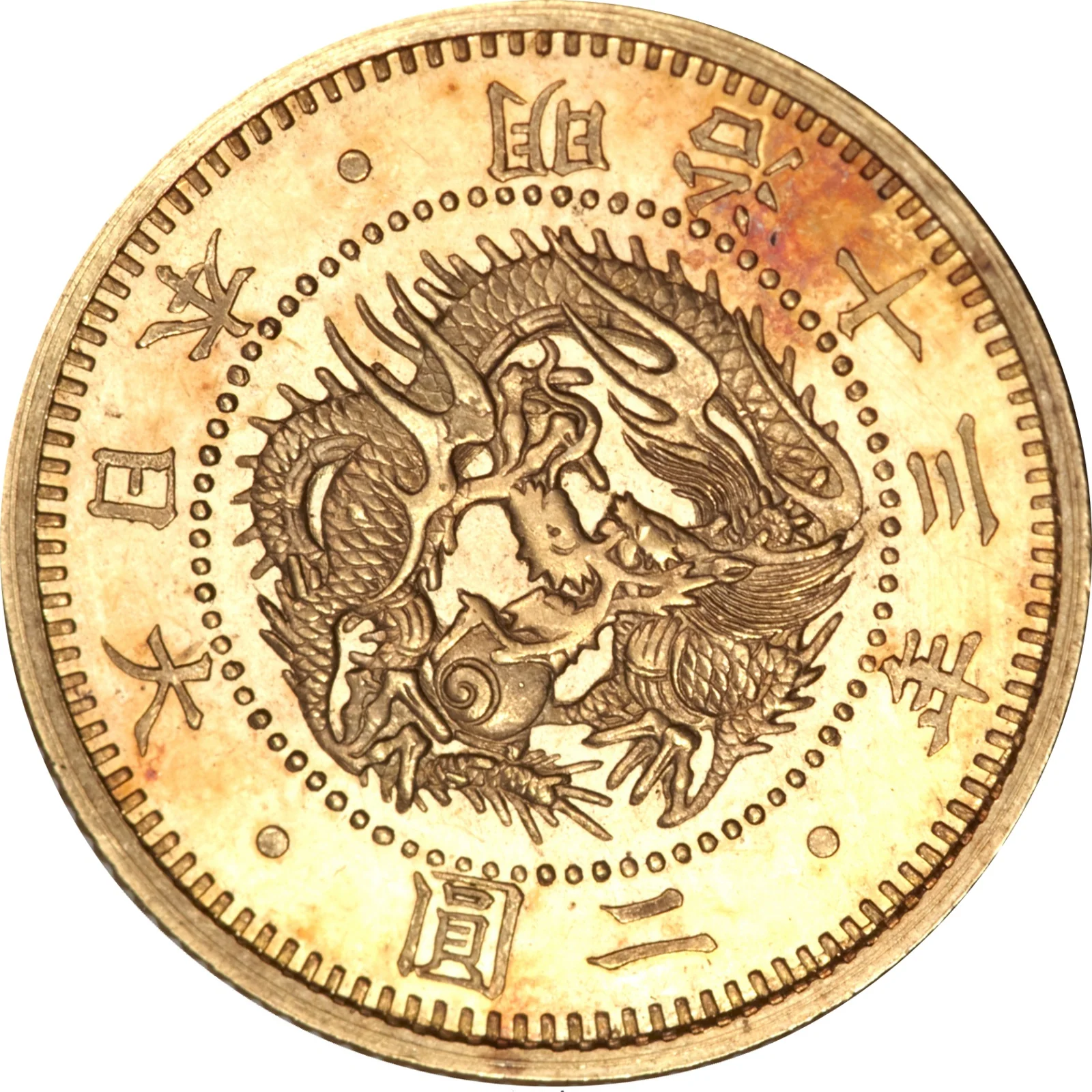
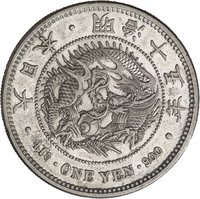
Dragon encircled by beads, legend above, value below.
Inscription:
年 三 十 治 明 · 本 日 大
· 圓 二 ·
· 圓 二 ·
Translation:
The thirty years of enlightened rule; Great Japan;
Two yen.
Two yen.
Language: Chinese
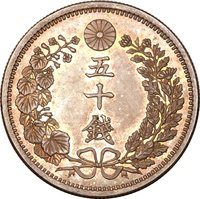
Reverse
Description:
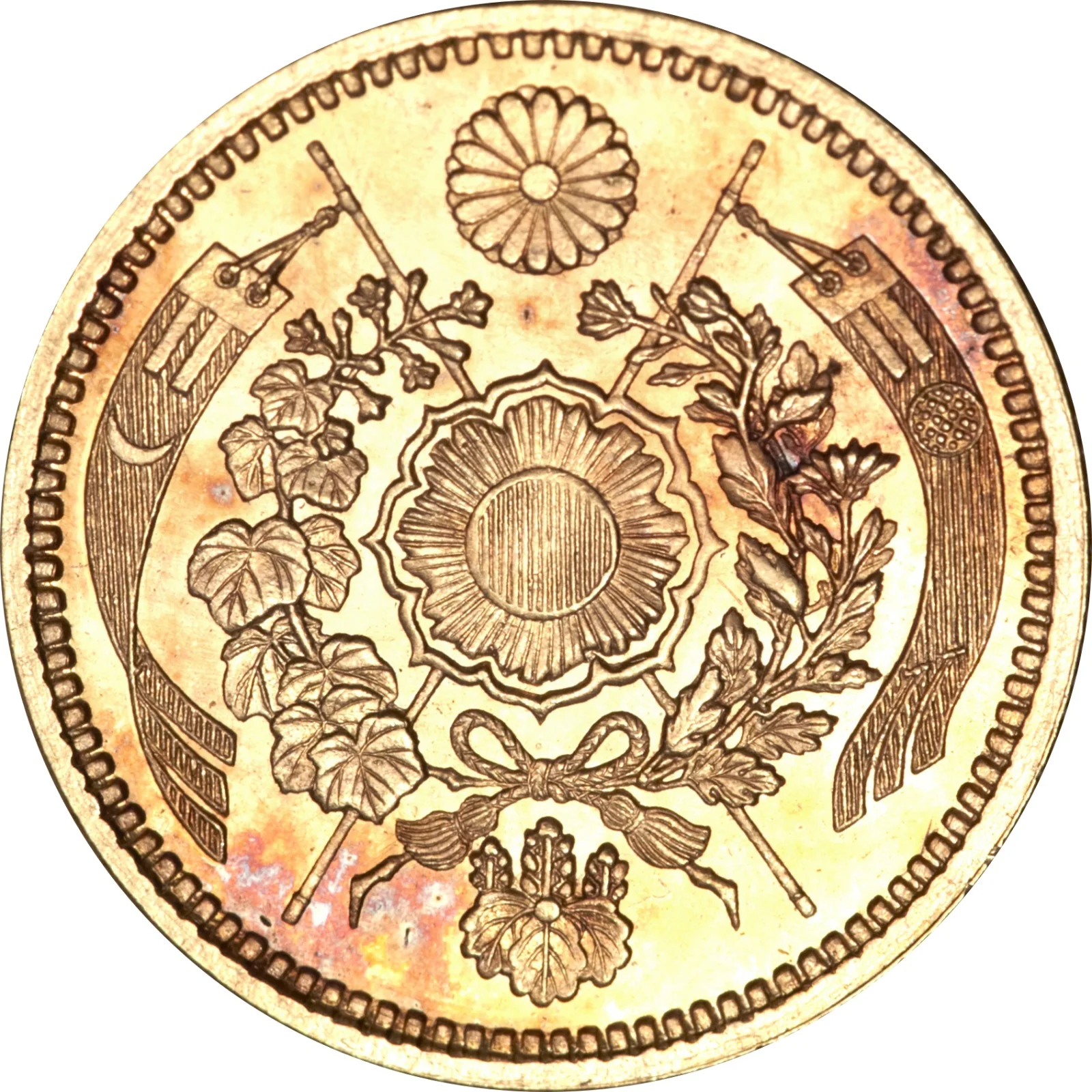
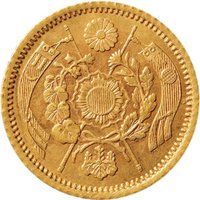
Sunburst crest on a sacred mirror, between banners, with chrysanthemum above and paulownia below.
Edge
Reeded
Categories
| Mythology> Fantastic animal |
| Symbol> Flag |
| Plants> Flower |
| Symbol> Sun |
| Symbol> Wreath |
| Symbols> Coat of Arms |
Mints
| Name | Mark |
|---|---|
| Japan Mint | — |
Mintings
| Year | Mint Mark | Mintage | Quality | Collection |
|---|---|---|---|---|
| 1874 | — | — | ||
| 1876 | — | 39 | ||
| 1877 | — | 178 | ||
| 1880 | — | 87 | ||
| 1892 | — | 2 |
Historical background
In 1874, Japan was in the midst of the profound economic and social transformation of the Meiji Restoration, having formally abandoned the feudal bakufu system just six years prior. The new government faced the urgent task of unifying a chaotic monetary landscape, where various feudal domain notes, gold, silver, and copper coins of multiple standards circulated alongside foreign trade coins. To establish a modern, centralized economy capable of engaging with Western powers, the Meiji government had already taken a decisive step in 1871 by promulgating the New Currency Act, which established the yen (¥) as the nation's decimal-based unit of currency, on a gold standard. However, the full implementation of this system was still very much a work in progress in 1874.
The situation on the ground remained complex. While new national banknotes and yen-denominated coins (the sen and rin) were being introduced, they coexisted with older forms of money, leading to confusion and localized inflation. A critical problem was the inconvertibility of government paper notes; the new fiat currency, the Dajōkansatsu (government notes), was not yet fully trusted by the public and often traded at a discount to specie (gold and silver). Furthermore, Japan's limited gold reserves, strained by domestic modernization costs and foreign indemnity payments, made maintaining the declared gold standard precarious, creating pressure that would eventually lead to its suspension.
Thus, 1874 represents a pivotal transitional year. The framework for a modern monetary system was legislatively in place, but the government was actively grappling with the practical challenges of enforcement, public acceptance, and specie management. The financial authorities, notably the newly founded Ministry of Finance, were laying the groundwork for the eventual consolidation of currency issuance and the stabilization of value, essential preconditions for Japan's rapid industrial and military rise in the coming decades.
The situation on the ground remained complex. While new national banknotes and yen-denominated coins (the sen and rin) were being introduced, they coexisted with older forms of money, leading to confusion and localized inflation. A critical problem was the inconvertibility of government paper notes; the new fiat currency, the Dajōkansatsu (government notes), was not yet fully trusted by the public and often traded at a discount to specie (gold and silver). Furthermore, Japan's limited gold reserves, strained by domestic modernization costs and foreign indemnity payments, made maintaining the declared gold standard precarious, creating pressure that would eventually lead to its suspension.
Thus, 1874 represents a pivotal transitional year. The framework for a modern monetary system was legislatively in place, but the government was actively grappling with the practical challenges of enforcement, public acceptance, and specie management. The financial authorities, notably the newly founded Ministry of Finance, were laying the groundwork for the eventual consolidation of currency issuance and the stabilization of value, essential preconditions for Japan's rapid industrial and military rise in the coming decades.
✨ Legendary