

100 yen – Japan
Add to wishlist
Circulating commemorative coins
Commemoration: Akita Line
Japan
Context
Year: 2016
Japanese - Heisei era Year:: 28
Issuer: Japan
Ruler: Heisei
Currency:
(since 1871)
Total mintage: 2,984,000
Material
References
Y: #
Numista: #85808
Value
Exchange value: 100 JPY
Inflation-adjusted value: 110.72 JPY
Obverse
Description:
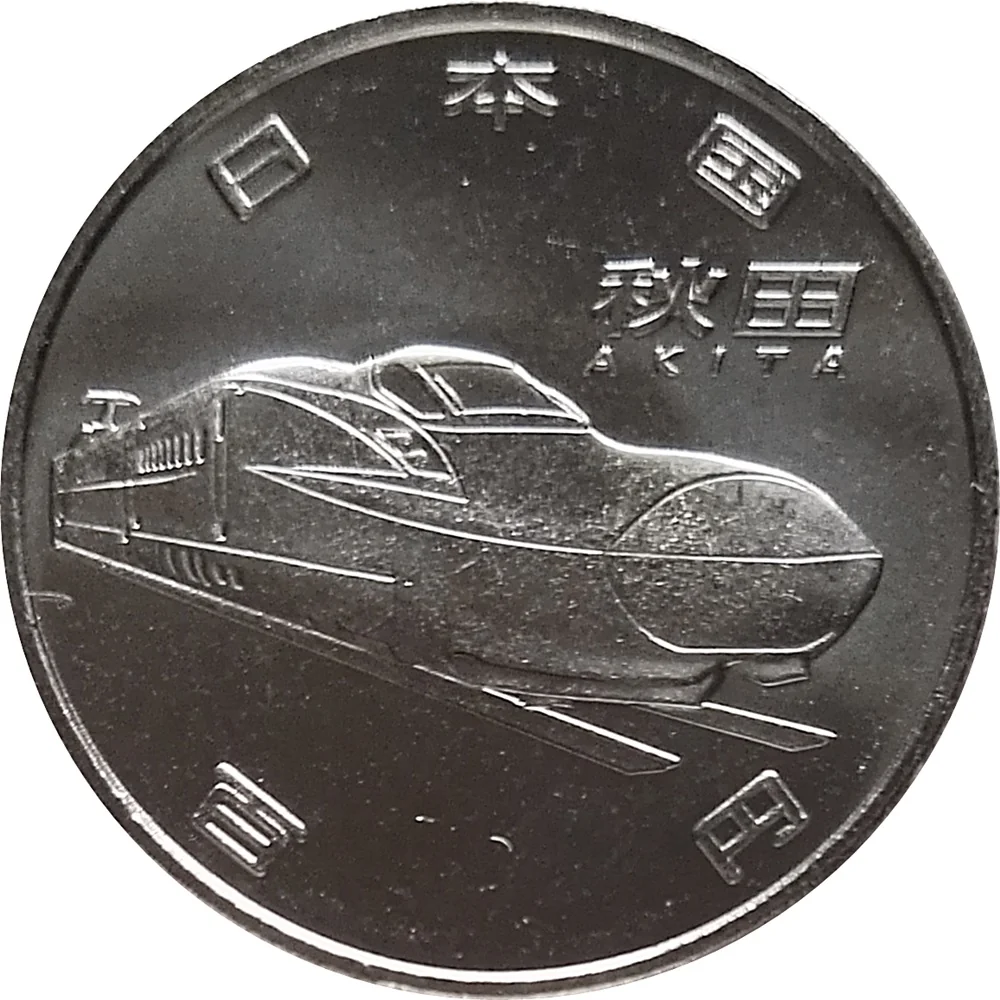
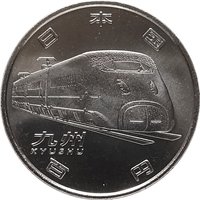
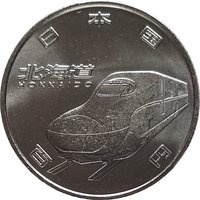
Akita Shinkansen E6 Series.
Inscription:
日 本 国
秋田
AKITA
百 円
秋田
AKITA
百 円
Translation:
JAPAN
Akita
AKITA
One Hundred Yen
Akita
AKITA
One Hundred Yen
Language: Japanese
Reverse
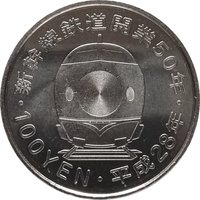
Description:
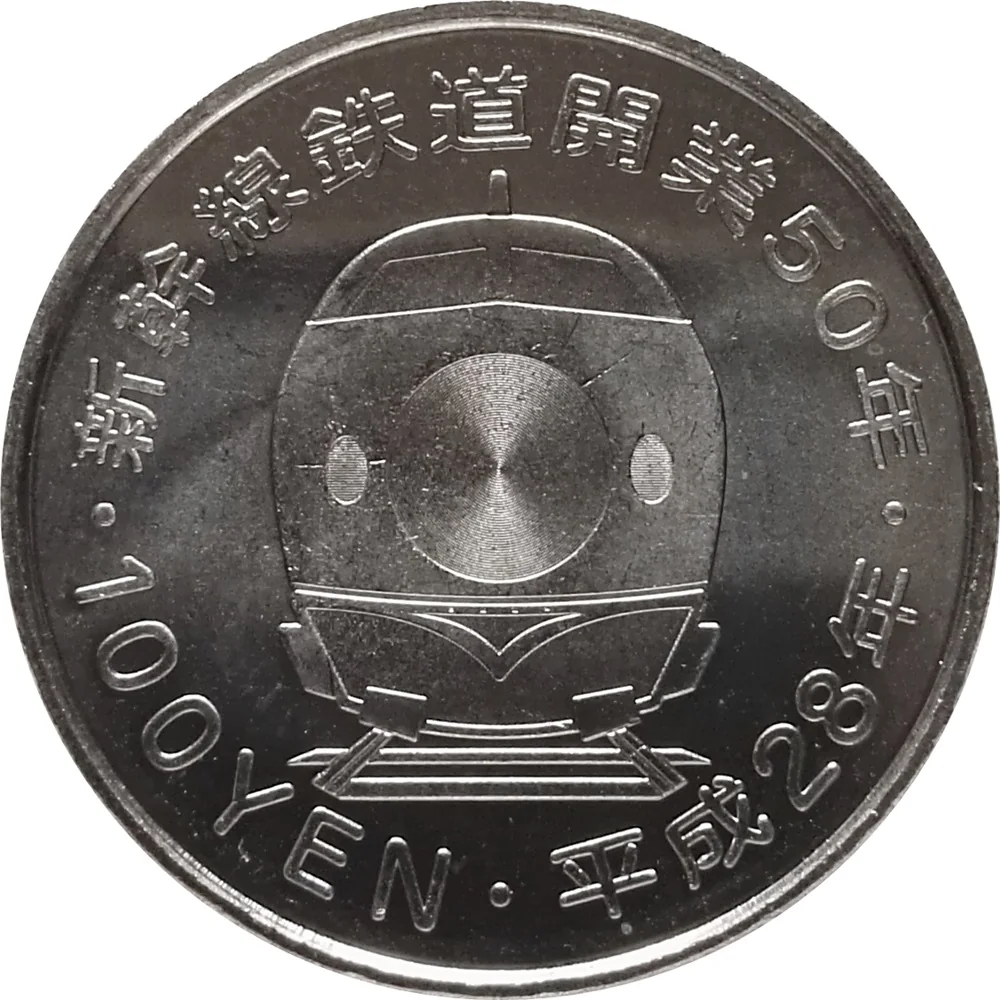
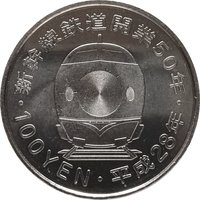
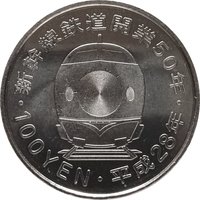
0-series Shinkansen with Kanji characters.
Inscription:
· 新幹線鉄道開業50年 ·
100 YEN · 平成28年
100 YEN · 平成28年
Translation:
50th Anniversary of the Shinkansen Railway Opening
100 YEN · Heisei 28
100 YEN · Heisei 28
Language: Japanese
Edge
Slanted reeding
Categories
| Transportation> Train |
Mints
| Name | Mark |
|---|---|
| Japan Mint | — |
Mintings
| Year | Mint Mark | Mintage | Quality | Collection |
|---|---|---|---|---|
| 2016 | — | 2,984,000 |
Historical background
In 2016, Japan's currency situation was dominated by the persistent strength of the yen (JPY) and the ongoing struggle against deflationary pressures. The year began with a surge in the yen's value, which appreciated sharply against the US dollar in the first half, driven by global financial turmoil and a "flight to safety" following concerns over China's economy and a collapse in oil prices. This appreciation was a significant headwind for Japan's export-dependent economy, as it made Japanese goods more expensive overseas and squeezed corporate profits, threatening the progress of "Abenomics"—the economic revival program centered on aggressive monetary easing, fiscal stimulus, and structural reforms.
The primary policy response came from the Bank of Japan (BOJ), which, in a surprising move in January, adopted a negative interest rate policy (-0.1%) on certain bank reserves. This was an attempt to combat deflation by further easing monetary conditions, discouraging banks from hoarding cash, and weakening the yen. However, the policy had mixed results; while it initially pushed the yen lower, its effectiveness was limited and contributed to volatility in financial markets. The yen's strength only began to reverse in the latter part of 2016, particularly after the US presidential election in November, when expectations of expansive fiscal policy and higher US interest rates under the incoming Trump administration drove the US dollar broadly higher, pushing the USD/JPY rate above 118 by year-end from lows near 100 in mid-year.
Overall, 2016 was a year of defensive monetary action and external forces dictating the yen's trajectory. The BOJ's struggle to sustainably achieve its 2% inflation target continued, as weak domestic consumption and falling energy prices kept core inflation in negative territory for most of the year. The currency's volatility underscored the limitations of unilateral monetary policy in a globally interconnected economy, setting the stage for the BOJ's subsequent shift in 2016 to a policy of "yield curve control," which it formally adopted in September, aiming to keep 10-year government bond yields around zero percent while maintaining its negative short-term rate.
The primary policy response came from the Bank of Japan (BOJ), which, in a surprising move in January, adopted a negative interest rate policy (-0.1%) on certain bank reserves. This was an attempt to combat deflation by further easing monetary conditions, discouraging banks from hoarding cash, and weakening the yen. However, the policy had mixed results; while it initially pushed the yen lower, its effectiveness was limited and contributed to volatility in financial markets. The yen's strength only began to reverse in the latter part of 2016, particularly after the US presidential election in November, when expectations of expansive fiscal policy and higher US interest rates under the incoming Trump administration drove the US dollar broadly higher, pushing the USD/JPY rate above 118 by year-end from lows near 100 in mid-year.
Overall, 2016 was a year of defensive monetary action and external forces dictating the yen's trajectory. The BOJ's struggle to sustainably achieve its 2% inflation target continued, as weak domestic consumption and falling energy prices kept core inflation in negative territory for most of the year. The currency's volatility underscored the limitations of unilateral monetary policy in a globally interconnected economy, setting the stage for the BOJ's subsequent shift in 2016 to a policy of "yield curve control," which it formally adopted in September, aiming to keep 10-year government bond yields around zero percent while maintaining its negative short-term rate.




🌱 Fairly Common