

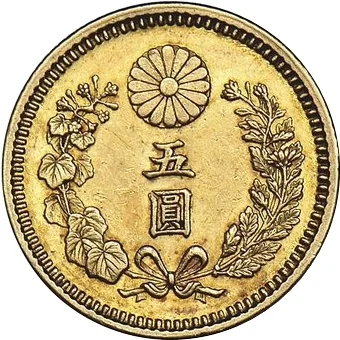
Obverse
Description:
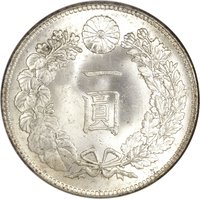
Chrysanthemum crest with paulownia and chrysanthemum branches flanking the value.
Inscription:
五
圓
圓
Translation:
Five
Dollars
Dollars
Language: Chinese
Reverse
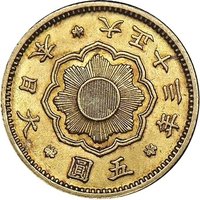
Description:
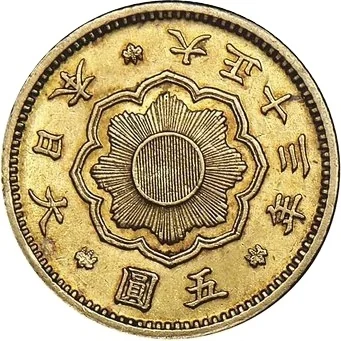
Radiant sun in a floral cartouche, encircled by text divided by small Paulownia flower seals.
Inscription:
年三十正大 · 本 日 大
· 圓 五 ·
· 圓 五 ·
Translation:
Thirty Years, Zhengda; Ben; Day;
Yuan Five.
Yuan Five.
Language: Chinese
Edge
Reeded
Mints
| Name | Mark |
|---|---|
| Japan Mint | — |
Mintings
| Year | Mint Mark | Mintage | Quality | Collection |
|---|---|---|---|---|
| 1913 | — | 89,820 | ||
| 1924 | — | 76,037 |
Historical background
In 1913, Japan's currency system was firmly on the gold standard, a position it had adopted in 1897 following its victory in the First Sino-Japanese War. This move, backed by substantial war indemnity payments received in gold sterling, was a strategic effort to integrate with the Western-dominated international financial order, stabilize exchange rates, and foster foreign trade and investment. The yen was defined as 0.75 grams of pure gold, creating a fixed parity with other gold-backed currencies like the US dollar and British pound. This stability was crucial for a rapidly industrializing nation heavily reliant on importing raw materials and exporting finished goods, particularly silk and cotton textiles.
However, the system's rigidity also presented challenges. Japan's balance of payments was often precarious, with trade deficits frequently offset by invisible earnings from shipping and overseas investments. The requirement to maintain gold reserves to back the yen limited the government's ability to expand the money supply for domestic development. Furthermore, the nation's economic growth, especially the military buildup and industrial expansion following the Russo-Japanese War (1904-05), had been financed by significant foreign loans denominated in gold. This created a persistent pressure to maintain international confidence to avoid gold outflows, which could force a painful contraction of the domestic economy.
Consequently, by 1913, Japan's financial authorities were operating within a constrained framework, prioritizing external stability over domestic flexibility. The system functioned but was sensitive to shifts in international confidence and trade balances. This delicate equilibrium would be profoundly tested just a year later with the outbreak of World War I, an event that would lead to a suspension of the gold standard, a massive export boom, and a dramatic transformation of Japan from a debtor to a creditor nation, fundamentally altering the financial landscape established in the pre-war era.
However, the system's rigidity also presented challenges. Japan's balance of payments was often precarious, with trade deficits frequently offset by invisible earnings from shipping and overseas investments. The requirement to maintain gold reserves to back the yen limited the government's ability to expand the money supply for domestic development. Furthermore, the nation's economic growth, especially the military buildup and industrial expansion following the Russo-Japanese War (1904-05), had been financed by significant foreign loans denominated in gold. This created a persistent pressure to maintain international confidence to avoid gold outflows, which could force a painful contraction of the domestic economy.
Consequently, by 1913, Japan's financial authorities were operating within a constrained framework, prioritizing external stability over domestic flexibility. The system functioned but was sensitive to shifts in international confidence and trade balances. This delicate equilibrium would be profoundly tested just a year later with the outbreak of World War I, an event that would lead to a suspension of the gold standard, a massive export boom, and a dramatic transformation of Japan from a debtor to a creditor nation, fundamentally altering the financial landscape established in the pre-war era.
✨ Legendary