

10 Sb Fen – Kweichow Province
China
Context
Year: 1931
Chinese republican Year: 20
Country: China 
Issuer: Kweichow Province
Period:
(1912—1949)
Currency:
(1888—1949)
Subdivision: 10 Sb Fen = ¼ Fen
Demonetized: Yes
Material
References
Y: #Click to copy to clipboard429
Numista: #42344
Obverse
Description:
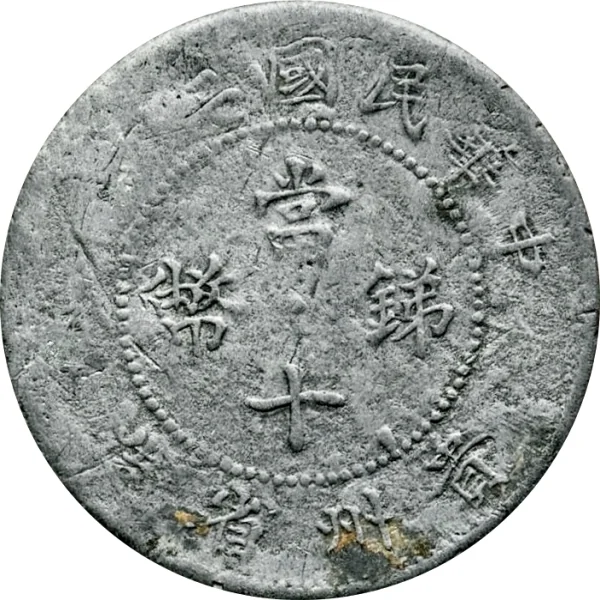
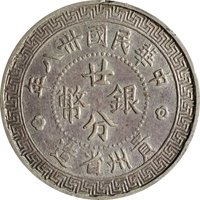
Four Chinese ideograms, read right to left and top to bottom, encircled by more characters.
Inscription:
年十二國民華中
當
幣銻
十
造省州貴
當
幣銻
十
造省州貴
Translation:
REPUBLIC OF CHINA
12th YEAR
GUIZHOU PROVINCE
TEN CASH
ANTIMONY COIN
12th YEAR
GUIZHOU PROVINCE
TEN CASH
ANTIMONY COIN
Language: Chinese
Reverse
Description:
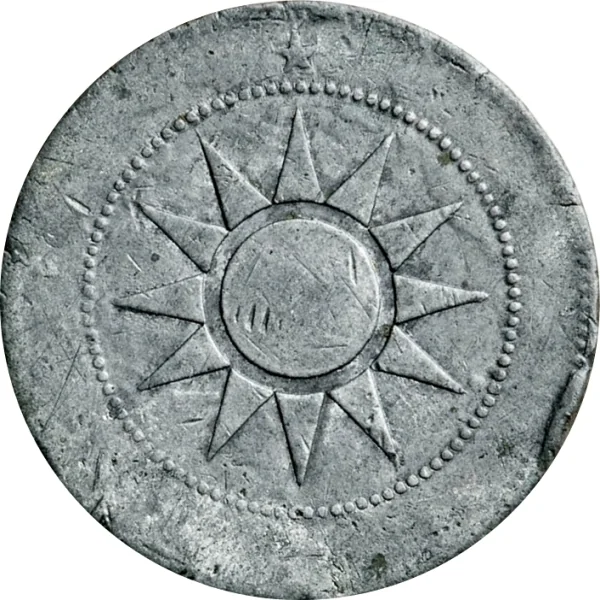
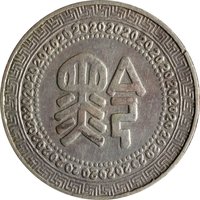
Sun with twelve rays.
Edge
Mintings
| Year | Mint Mark | Mintage | Quality | Collection |
|---|---|---|---|---|
| 1931 | — | — |
Historical background
In 1931, Kweichow (Guizhou) Province was mired in a complex and debilitating currency crisis, characteristic of China's "warlord era." The provincial economy operated under a fragmented and chaotic monetary system, dominated by the circulation of low-value copper coins (tongyuan) and a flood of unbacked paper notes. The most notorious of these were the "Guizhou Province Bank" notes, first issued by warlord Zhou Xicheng and continued by his successors. These notes were printed with little to no silver reserve backing, leading to severe and rapid depreciation. By 1931, their value had collapsed to a small fraction of their face value, creating widespread distrust and hardship among the local population.
This hyperinflationary environment was exacerbated by Kweichow's isolation, poverty, and lack of integrated national infrastructure. The provincial economy was essentially cut off from the stabilizing influence of the silver yuan-based financial system that the Nanjing government was attempting to establish in coastal regions. Furthermore, local militarists and merchants often issued their own private scrip to pay soldiers and conduct trade, adding further layers of confusion and instability. The result was a multi-tiered currency system where silver coins (both foreign and domestic) were hoarded for their intrinsic value, while the devalued paper notes and copper coins were used for daily, devalued transactions.
The situation in 1931 reflected the near-total absence of central government monetary authority in the region. While the Nationalist government had nominally unified China, provinces like Kweichow remained under the de facto control of local militarists who used currency issuance as a tool for wartime finance and personal enrichment. This monetary anarchy stifled commerce, eroded savings, and placed the heaviest burden on peasants and laborers. It was a stark example of the broader economic disintegration plaguing interior China, which would persist until the 1935 Nationalist currency reforms began to impose a more unified system, albeit with limited immediate effect in remote Kweichow.
This hyperinflationary environment was exacerbated by Kweichow's isolation, poverty, and lack of integrated national infrastructure. The provincial economy was essentially cut off from the stabilizing influence of the silver yuan-based financial system that the Nanjing government was attempting to establish in coastal regions. Furthermore, local militarists and merchants often issued their own private scrip to pay soldiers and conduct trade, adding further layers of confusion and instability. The result was a multi-tiered currency system where silver coins (both foreign and domestic) were hoarded for their intrinsic value, while the devalued paper notes and copper coins were used for daily, devalued transactions.
The situation in 1931 reflected the near-total absence of central government monetary authority in the region. While the Nationalist government had nominally unified China, provinces like Kweichow remained under the de facto control of local militarists who used currency issuance as a tool for wartime finance and personal enrichment. This monetary anarchy stifled commerce, eroded savings, and placed the heaviest burden on peasants and laborers. It was a stark example of the broader economic disintegration plaguing interior China, which would persist until the 1935 Nationalist currency reforms began to impose a more unified system, albeit with limited immediate effect in remote Kweichow.

✨ Legendary