

½ jiao – Yunnan Province
Add to wishlist
China
Context
Year: 1923
Chinese republican Year:: 12
Country: China
Issuer: Yunnan Province
Period:
(1912—1949)
Currency:
(1908—1949)
Demonetized: Yes
Material
Diameter: 16 mm
Weight: 2.9 g
Shape: Round
Composition: Copper-nickel
Technique: Milled
Alignment: Medal alignment
flip
References
Y: #
Numista: #36554
Obverse
Description:
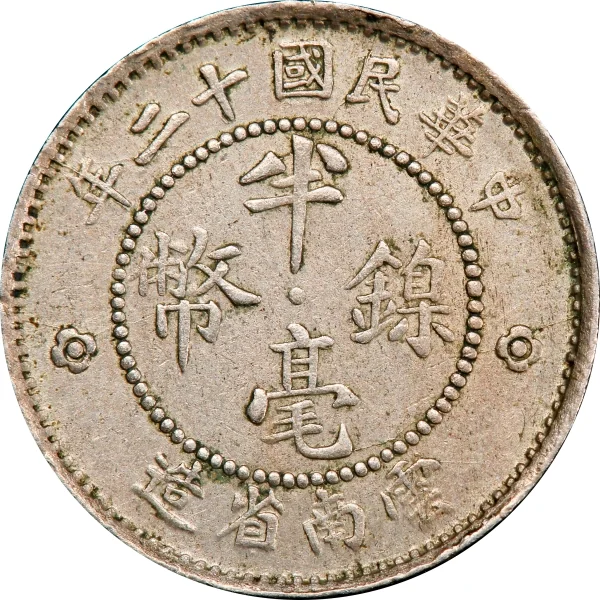
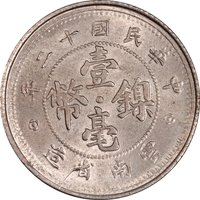
Four ideograms read vertically, right to left, encircled by more characters.
Inscription:
年二十國民華中
半
幣鎳
毫
造省南雲
半
幣鎳
毫
造省南雲
Translation:
Twenty-first year of the Republic of China
Yunnan Province
Nickel Coin
Ten Cents
Yunnan Province
Nickel Coin
Ten Cents
Language: Chinese
Reverse
Description:
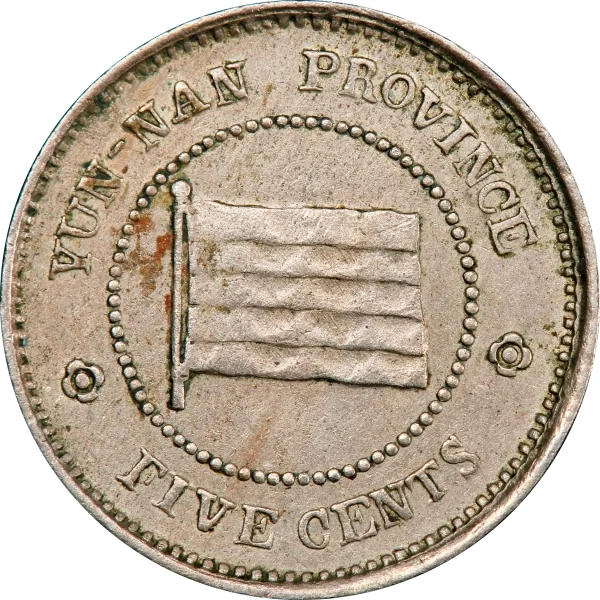
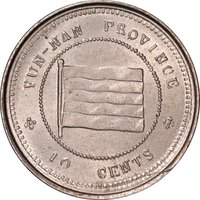
Flag encircled by English text.
Inscription:
YUN-NAN PROVINCE
FIVE CENTS
FIVE CENTS
Edge
Mintings
| Year | Mint Mark | Mintage | Quality | Collection |
|---|---|---|---|---|
| 1923 | — | — |
Historical background
In 1923, Yunnan Province operated within a complex and fragmented monetary system, a direct legacy of the Warlord Era. While nominally part of the Republic of China, the province was under the autonomous control of the Yunnan clique, led by Tang Jiyao. This autonomy extended to finance, meaning central government regulations and the official currency, the Yuan Shikai silver dollar, held little practical authority. Instead, the primary circulating medium was the Yunnan silver dollar, a provincial coin minted in Kunming with a lower silver content than national standards, which caused it to trade at a discount outside the region.
Alongside this debased silver coinage, a chaotic mix of older currencies remained in use, including full-weight silver sycee (shoe-shaped ingots), copper cash coins, and a growing volume of paper notes. The most critical issue was the over-issuance of banknotes by both the provincial government and local banks, particularly the Yunnan Provincial Bank. These notes, theoretically convertible to silver, were issued in excess of reserves to fund Tang Jiyao's military expenditures and administrative costs. This led to a severe loss of public confidence, resulting in frequent bank runs and rapid depreciation of the paper currency, especially in more remote areas.
Consequently, the economy of Yunnan in 1923 was characterized by severe monetary instability. Exchange rates between silver, copper, and various paper issues fluctuated wildly between cities and markets, hindering trade and imposing a heavy burden on peasants and merchants. The currency chaos reflected the province's political isolation and the fiscal pressures of warlord rule, creating a precarious financial environment that would persist until the nominal reunification of China under the Nationalist government later in the decade.
Alongside this debased silver coinage, a chaotic mix of older currencies remained in use, including full-weight silver sycee (shoe-shaped ingots), copper cash coins, and a growing volume of paper notes. The most critical issue was the over-issuance of banknotes by both the provincial government and local banks, particularly the Yunnan Provincial Bank. These notes, theoretically convertible to silver, were issued in excess of reserves to fund Tang Jiyao's military expenditures and administrative costs. This led to a severe loss of public confidence, resulting in frequent bank runs and rapid depreciation of the paper currency, especially in more remote areas.
Consequently, the economy of Yunnan in 1923 was characterized by severe monetary instability. Exchange rates between silver, copper, and various paper issues fluctuated wildly between cities and markets, hindering trade and imposing a heavy burden on peasants and merchants. The currency chaos reflected the province's political isolation and the fiscal pressures of warlord rule, creating a precarious financial environment that would persist until the nominal reunification of China under the Nationalist government later in the decade.
💎 Extremely Rare