

2 jiao – Kwangsi Province
Add to wishlist
China
Context
Year: 1949
Chinese republican Year:: 38
Country: China
Issuer: Kwangsi Province
Period:
(1912—1949)
Currency:
(1905—1949)
Demonetized: Yes
Material
References
Y: #
Numista: #36551
Value
Bullion value: $13.54
Obverse
Description:
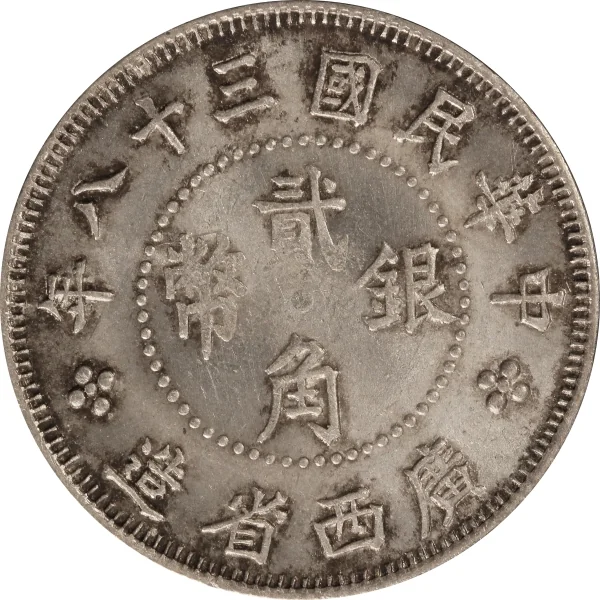
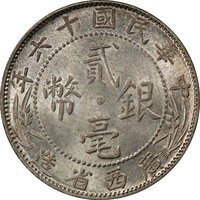
Four ideograms read vertically, right to left, encircled by more characters.
Inscription:
八十三國民華中
貳
幣銀
角
造省西廣
貳
幣銀
角
造省西廣
Translation:
EIGHTY-THIRD YEAR OF THE REPUBLIC
TWO
SILVER COIN
JIAO
GUANGXI PROVINCE MINT
TWO
SILVER COIN
JIAO
GUANGXI PROVINCE MINT
Language: Chinese
Reverse
Description:
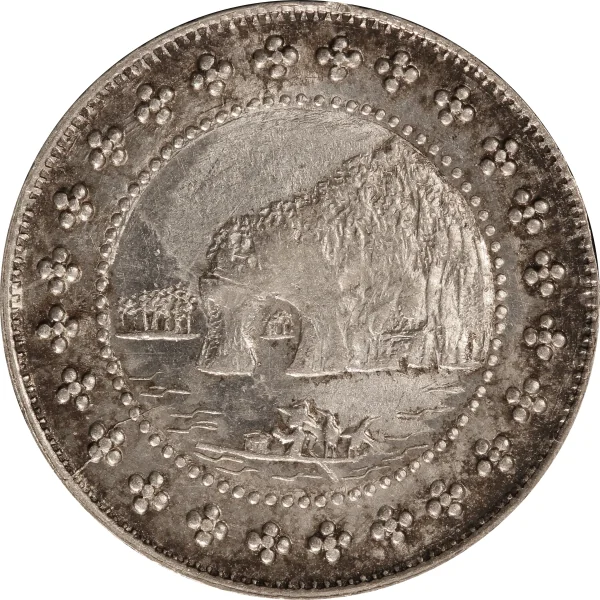
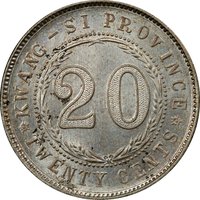
Elephant Nose Rock in Kueilin with a boat, trees, and a dot-cross pattern background.
Edge
Reeded.
Categories
| Geography> Sea |
| Geography> Beach |
| Plant> Tree |
| Transportation> Watercraft |
Mintings
| Year | Mint Mark | Mintage | Quality | Collection |
|---|---|---|---|---|
| 1949 | — | — |
Historical background
In 1949, Kwangsi (Guangxi) Province was a region in severe monetary chaos, caught in the final convulsions of the Chinese Civil War. As the People's Liberation Army (PLA) advanced southward, the Nationalist (Kuomintang) government's financial system was in total collapse. The national currency, the Gold Yuan, introduced in 1948 to replace the hyperinflated Fabi, had itself succumbed to catastrophic hyperinflation. By mid-1949, it was virtually worthless in Kwangsi, with prices escalating by the hour and notes being rejected by merchants and the public alike.
This vacuum led to a fragmented and desperate currency environment. Older Fabi notes, silver dollars (both foreign and Chinese "yuan"), and even physical silver and gold bullion circulated as preferred mediums of exchange. Barter became widespread for everyday transactions. Furthermore, local authorities, military units, and even large merchants issued their own private scrip or promissory notes in attempts to facilitate local trade, adding to the confusion. The provincial capital, Kweilin (Guilin), and the major commercial center of Liuzhou saw particularly acute instability, with multiple currencies competing and values shifting wildly.
The situation began to resolve only with the PLA's capture of the province in November and December 1949. The new Communist authorities moved swiftly to impose financial order, first by allowing the temporary use of silver dollars to stabilize markets, and then by introducing the new national currency, the Renminbi (RMB). However, distrust of paper money remained high among the Kwangsi populace. The complete suppression of old currencies and the establishment of the RMB as the sole legal tender was a gradual and enforced process that extended well into 1950, marking the end of Kwangsi's period of monetary anarchy and its integration into the socialist financial system.
This vacuum led to a fragmented and desperate currency environment. Older Fabi notes, silver dollars (both foreign and Chinese "yuan"), and even physical silver and gold bullion circulated as preferred mediums of exchange. Barter became widespread for everyday transactions. Furthermore, local authorities, military units, and even large merchants issued their own private scrip or promissory notes in attempts to facilitate local trade, adding to the confusion. The provincial capital, Kweilin (Guilin), and the major commercial center of Liuzhou saw particularly acute instability, with multiple currencies competing and values shifting wildly.
The situation began to resolve only with the PLA's capture of the province in November and December 1949. The new Communist authorities moved swiftly to impose financial order, first by allowing the temporary use of silver dollars to stabilize markets, and then by introducing the new national currency, the Renminbi (RMB). However, distrust of paper money remained high among the Kwangsi populace. The complete suppression of old currencies and the establishment of the RMB as the sole legal tender was a gradual and enforced process that extended well into 1950, marking the end of Kwangsi's period of monetary anarchy and its integration into the socialist financial system.
💎 Very Rare