

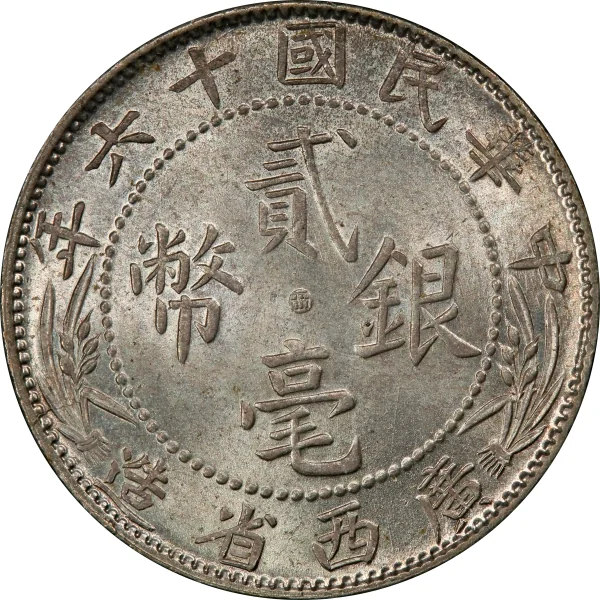
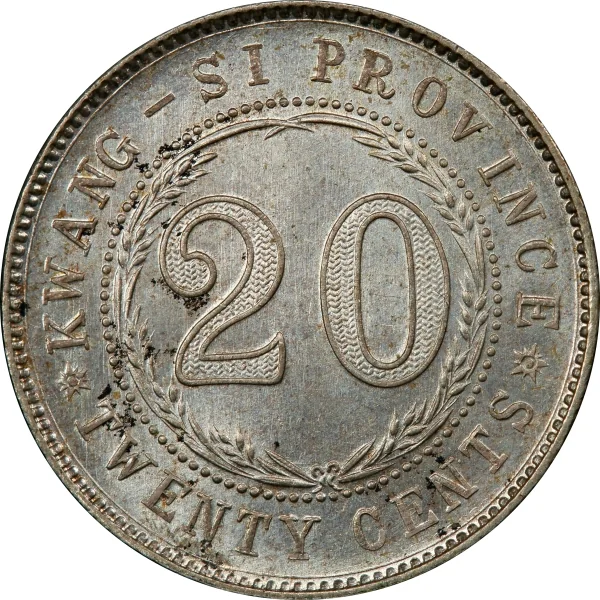
2 jiao – Kwangsi Province
Add to wishlist
China
Context
Years: 1926–1927
Country: China
Issuer: Kwangsi Province
Period:
(1912—1949)
Currency:
(1905—1949)
Demonetized: Yes
Material
References
Y: #
Numista: #36541
Value
Bullion value: $13.54
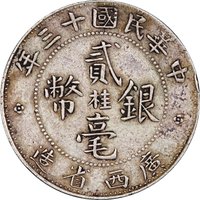
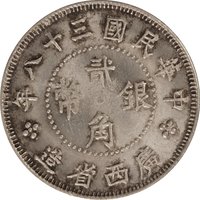
Obverse
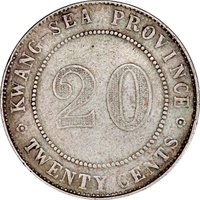
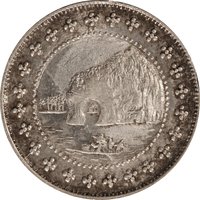
Reverse
Edge
Reeded.
Mintings
| Year | Mint Mark | Mintage | Quality | Collection |
|---|---|---|---|---|
| 1926 | — | — | ||
| 1927 | — | — |
Historical background
In 1926, Kwangsi (modern Guangxi) Province was a militarized zone under the control of the Guangxi Clique, a powerful regional faction that operated with considerable autonomy from the beleaguered Nationalist government in Canton. The province's economy and currency were deeply fragmented, reflecting its political decentralization. While the Chinese silver dollar (yuan) and subsidiary copper coins remained in circulation, their value and acceptance were unstable. More significantly, a multitude of military scrip, provincial banknotes, and promissory notes issued by local commanders and garrison offices flooded the market, creating a chaotic monetary environment.
This proliferation of unbacked paper was driven by the Clique's constant need to finance its substantial army, a key source of its political power. As military expenditures soared, these local authorities issued currency with little to no specie reserve, leading to severe and rapid depreciation. The situation was exacerbated by the fact that notes issued in one district were often worthless in another, severely disrupting intra-provincial trade and burdening the peasantry, who were frequently forced to accept the devalued scrip for taxes and goods.
The currency chaos in Kwangsi was a direct microcosm of the wider "warlord era" in China, where a lack of central monetary authority led to regional instability. It undermined economic development, fostered corruption, and eroded public trust. This financial disarray would persist until the Guangxi Clique's formal alignment with Chiang Kai-shek's Northern Expedition in 1926-27, after which slow and uneven efforts toward monetary integration with the Nationalist system began, though provincial distinctiveness remained.
This proliferation of unbacked paper was driven by the Clique's constant need to finance its substantial army, a key source of its political power. As military expenditures soared, these local authorities issued currency with little to no specie reserve, leading to severe and rapid depreciation. The situation was exacerbated by the fact that notes issued in one district were often worthless in another, severely disrupting intra-provincial trade and burdening the peasantry, who were frequently forced to accept the devalued scrip for taxes and goods.
The currency chaos in Kwangsi was a direct microcosm of the wider "warlord era" in China, where a lack of central monetary authority led to regional instability. It undermined economic development, fostered corruption, and eroded public trust. This financial disarray would persist until the Guangxi Clique's formal alignment with Chiang Kai-shek's Northern Expedition in 1926-27, after which slow and uneven efforts toward monetary integration with the Nationalist system began, though provincial distinctiveness remained.
💎 Very Rare