

500 yen – Japan
Add to wishlist
Japan
Context
Material
Diameter: 26.5 mm
Weight: 7.2 g
Thickness: 1.85 mm
Shape: Round
Composition: Copper-nickel
Technique: Milled
Alignment: Medal alignment
flip
References
Y: #
Numista: #3504
Value
Exchange value: 500 JPY
Inflation-adjusted value: 708.54 JPY
Obverse
Description:
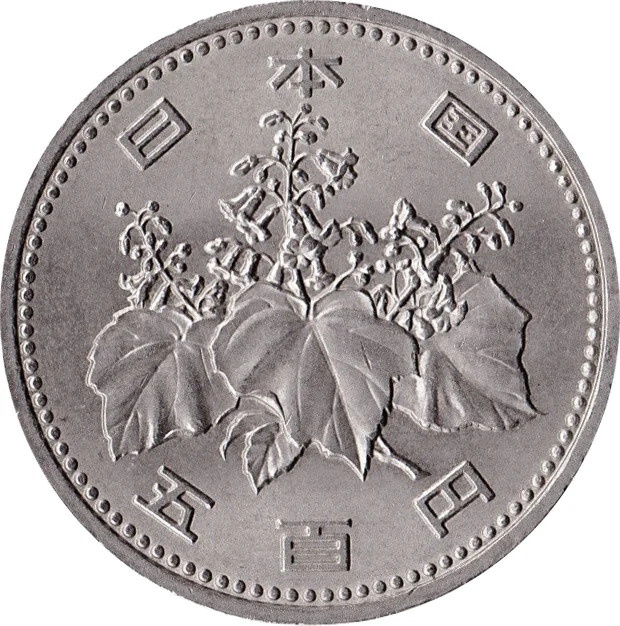
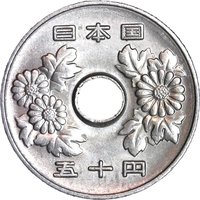
Paulownia: authority above, value below.
Inscription:
日 本 国
五 百 円
五 百 円
Translation:
Japan
500 Yen
500 Yen
Language: Japanese
Reverse
Description:
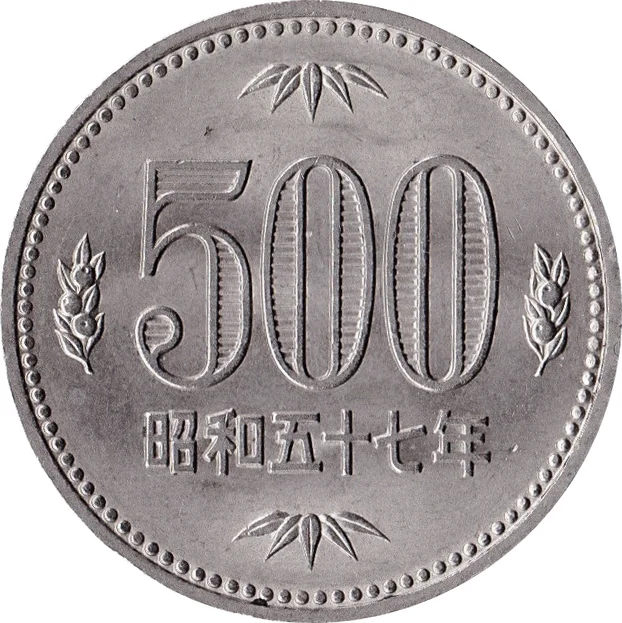
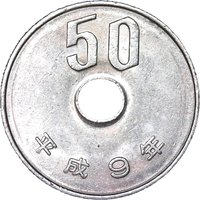
Large mandarin oranges flanked by bamboo leaves.
Inscription:
500
昭和五十七年
昭和五十七年
Translation:
Five Hundred Yen
1982
1982
Language: Japanese
Mintings
| Year | Mint Mark | Mintage | Quality | Collection |
|---|---|---|---|---|
| 1982 | — | 300,000,000 | ||
| 1983 | — | 240,000,000 | ||
| 1984 | — | 342,850,000 | ||
| 1985 | — | 97,150,000 | ||
| 1986 | — | 49,960,000 | ||
| 1987 | — | 2,545,000 | ||
| 1987 | — | 230,000 | Proof | |
| 1988 | — | 140,018,000 | ||
| 1988 | — | 200,000 | Proof | |
| 1989 | — | 16,042,000 |
Historical background
In 1982, Japan's currency situation was defined by the early stages of the yen's dramatic ascent, set against a backdrop of robust economic growth and rising trade tensions. Following the collapse of the Bretton Woods system a decade earlier, the yen had already appreciated significantly, but it was now being shaped by a strong current account surplus fueled by the global success of its automotive and electronics exports. This surplus created persistent upward pressure on the yen, a trend viewed with concern by both Japanese policymakers and trading partners, particularly the United States, which faced a growing bilateral trade deficit. Domestically, the Bank of Japan maintained a relatively tight monetary policy to control inflation, which had moderated after the oil shocks of the 1970s, further supporting the currency's strength.
The government and the Ministry of Finance were actively engaged in managing the exchange rate, frequently intervening in foreign exchange markets to smooth volatility and occasionally curb the yen's rise to protect export competitiveness. However, these efforts were increasingly challenged by market forces and international pressure for Japan to liberalize its financial markets and allow the yen to better reflect its economic fundamentals. This period saw incremental steps toward financial deregulation, including the revision of the Foreign Exchange and Foreign Trade Control Law in 1980, which shifted from a system of "prohibition in principle" to "free in principle," gradually increasing capital flows.
Looking ahead, the dynamics of 1982 were a prelude to the monumental shifts that would follow. The sustained trade imbalances and foreign pressure would culminate just three years later in the Plaza Accord of 1985, an international agreement designed to deliberately depreciate the US dollar against the yen and other currencies. Therefore, 1982 represents a critical juncture where the foundations were being laid for the yen's forced, rapid appreciation in the mid-1980s, an event that would profoundly reshape Japan's economy and usher in the asset price bubble of the late 1980s.
The government and the Ministry of Finance were actively engaged in managing the exchange rate, frequently intervening in foreign exchange markets to smooth volatility and occasionally curb the yen's rise to protect export competitiveness. However, these efforts were increasingly challenged by market forces and international pressure for Japan to liberalize its financial markets and allow the yen to better reflect its economic fundamentals. This period saw incremental steps toward financial deregulation, including the revision of the Foreign Exchange and Foreign Trade Control Law in 1980, which shifted from a system of "prohibition in principle" to "free in principle," gradually increasing capital flows.
Looking ahead, the dynamics of 1982 were a prelude to the monumental shifts that would follow. The sustained trade imbalances and foreign pressure would culminate just three years later in the Plaza Accord of 1985, an international agreement designed to deliberately depreciate the US dollar against the yen and other currencies. Therefore, 1982 represents a critical juncture where the foundations were being laid for the yen's forced, rapid appreciation in the mid-1980s, an event that would profoundly reshape Japan's economy and usher in the asset price bubble of the late 1980s.
🌱 Very Common