

Obverse
Description:
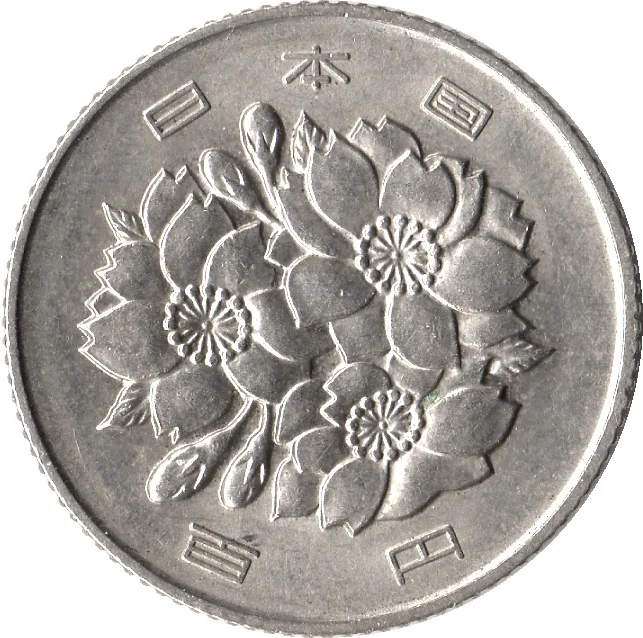
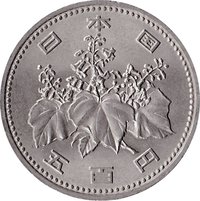
Authority above, value below—cherry blossoms.
Inscription:
日 本 国
百 円
百 円
Translation:
Japan
100 Yen
100 Yen
Language: Japanese
Reverse
Description:
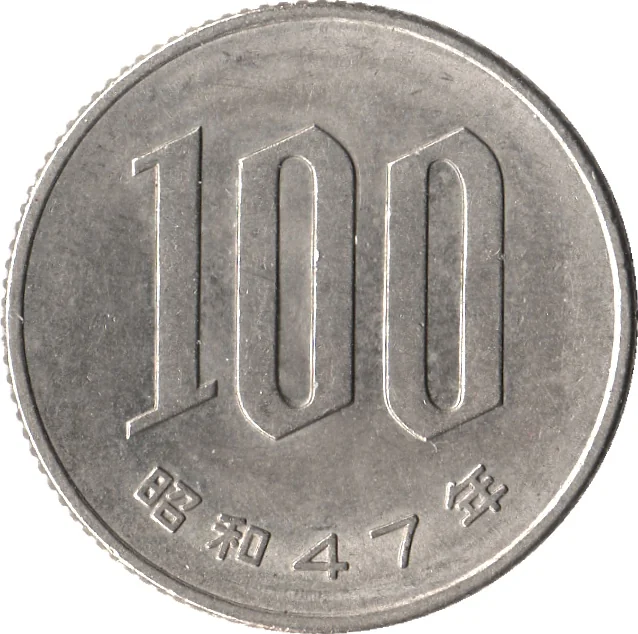
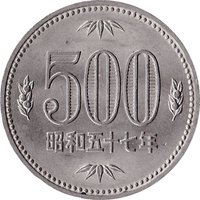
Central value, date beneath.
Inscription:
100
昭和47年
昭和47年
Translation:
1972
Language: Japanese
Edge
Reeded
Mints
| Name | Mark |
|---|---|
| Japan Mint | — |
Mintings
| Year | Mint Mark | Mintage | Quality | Collection |
|---|---|---|---|---|
| 1967 | — | 432,200,000 | ||
| 1968 | — | 471,000,000 | ||
| 1969 | — | 323,700,000 | ||
| 1970 | — | 237,100,000 | ||
| 1971 | — | 481,050,000 | ||
| 1972 | — | 468,950,000 | ||
| 1973 | — | 680,000,000 | ||
| 1974 | — | 660,000,000 | ||
| 1975 | — | 437,160,000 | ||
| 1976 | — | 322,840,000 | ||
| 1977 | — | 440,000,000 | ||
| 1978 | — | 292,000,000 | ||
| 1979 | — | 382,000,000 | ||
| 1980 | — | 588,000,000 | ||
| 1981 | — | 348,000,000 | ||
| 1982 | — | 110,000,000 | ||
| 1983 | — | 50,000,000 | ||
| 1984 | — | 41,850,000 | ||
| 1985 | — | 58,150,000 | ||
| 1986 | — | 99,960,000 | ||
| 1987 | — | 193,545,000 | ||
| 1987 | — | 230,000 | Proof | |
| 1988 | — | 362,912,000 | ||
| 1988 | — | 200,000 | Proof |
Historical background
In 1967, Japan's currency situation was characterized by a fixed exchange rate system under the Bretton Woods agreement, with the yen pegged at 360 yen to the US dollar. This stability, established in 1949, provided a crucial foundation for the nation's remarkable post-war economic growth, known as the "Japanese Economic Miracle." The fixed rate facilitated export-led expansion by giving Japanese industries like automotive and electronics predictable international pricing, fueling a sustained period of double-digit GDP growth. However, this very success began to create underlying pressures, as Japan's growing trade surpluses, particularly with the United States, started to suggest the yen was artificially undervalued.
Domestically, the economy was booming, but the currency regime required the Bank of Japan to maintain strict control over capital flows. To defend the 360:1 peg, the authorities actively intervened in foreign exchange markets, buying dollars and selling yen to prevent appreciation. This contributed to a rapid accumulation of foreign reserves. While the system worked to support industrial policy, it also limited monetary policy autonomy and necessitated capital controls to prevent speculative flows, insulating Japan's financial system from global markets but also delaying its liberalization.
By the late 1960s, the pressures on the fixed-rate system were becoming increasingly apparent. The sustained US trade deficit and Japan's surplus, exacerbated by the costs of the Vietnam War, led to growing international criticism, particularly from Washington, that the yen was too weak. Although the formal revaluation of the yen would not occur until 1971 (the Nixon Shock), 1967 stood as the final full year of unquestioned confidence in the 360-yen peg. The currency situation was thus one of surface stability masking gathering international economic tensions that would soon force a dramatic shift in Japan's monetary policy and usher in an era of floating exchange rates.
Domestically, the economy was booming, but the currency regime required the Bank of Japan to maintain strict control over capital flows. To defend the 360:1 peg, the authorities actively intervened in foreign exchange markets, buying dollars and selling yen to prevent appreciation. This contributed to a rapid accumulation of foreign reserves. While the system worked to support industrial policy, it also limited monetary policy autonomy and necessitated capital controls to prevent speculative flows, insulating Japan's financial system from global markets but also delaying its liberalization.
By the late 1960s, the pressures on the fixed-rate system were becoming increasingly apparent. The sustained US trade deficit and Japan's surplus, exacerbated by the costs of the Vietnam War, led to growing international criticism, particularly from Washington, that the yen was too weak. Although the formal revaluation of the yen would not occur until 1971 (the Nixon Shock), 1967 stood as the final full year of unquestioned confidence in the 360-yen peg. The currency situation was thus one of surface stability masking gathering international economic tensions that would soon force a dramatic shift in Japan's monetary policy and usher in an era of floating exchange rates.
🌱 Very Common