

20 fen – Chekiang Province
Add to wishlist
China
Context
Years: 1896–1897
Country: China
Issuer: Chekiang Province
Ruler: Guangxu
Currency:
(1896—1940)
Demonetized: Yes
Material
References
Y: #
Numista: #34862
Value
Bullion value: $11.31
Obverse
Description:
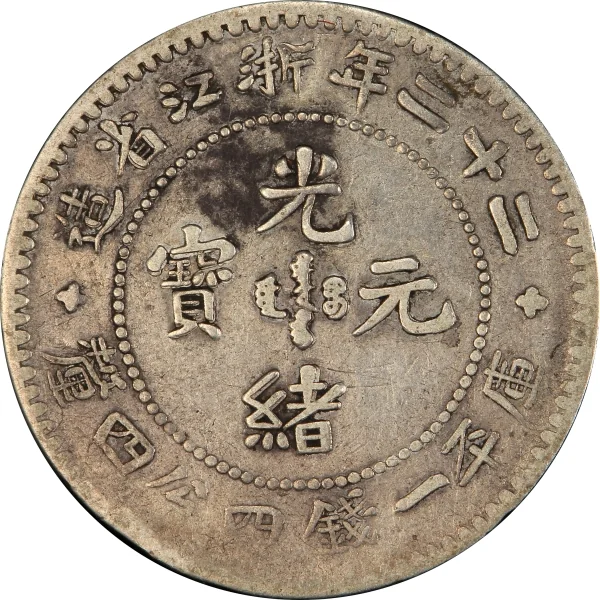
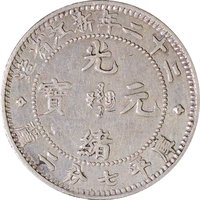
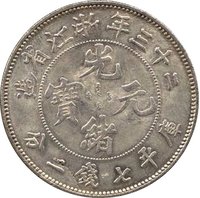
Chinese ideograms top to bottom, right to left, with central Manchu text, all encircled by more Chinese characters.
Inscription:
造省江浙年三十二
光
ᠪᠠᡩᠠᡵᠠᠩᡤᠠ
寶 ᠶᡠᠸᠠᠨ ᠪᠣᠣ 元
ᡩᠣᡵᠣ
緒
釐四分四錢一平庫
光
ᠪᠠᡩᠠᡵᠠᠩᡤᠠ
寶 ᠶᡠᠸᠠᠨ ᠪᠣᠣ 元
ᡩᠣᡵᠣ
緒
釐四分四錢一平庫
Translation:
Made by Jiangsu and Zhejiang Provinces, Year 32 [of the Guangxu reign]
Guangxu
Badarangga Doro [Manchu for "Guangxu"]
Yuan Bao [Silver Ingot]
One Pingku [Tael] Four Mace Four Candareens
Guangxu
Badarangga Doro [Manchu for "Guangxu"]
Yuan Bao [Silver Ingot]
One Pingku [Tael] Four Mace Four Candareens
Scripts: Chinese, Mongolian / Manchu
Languages: Manchu, Classical Chinese
Reverse
Description:
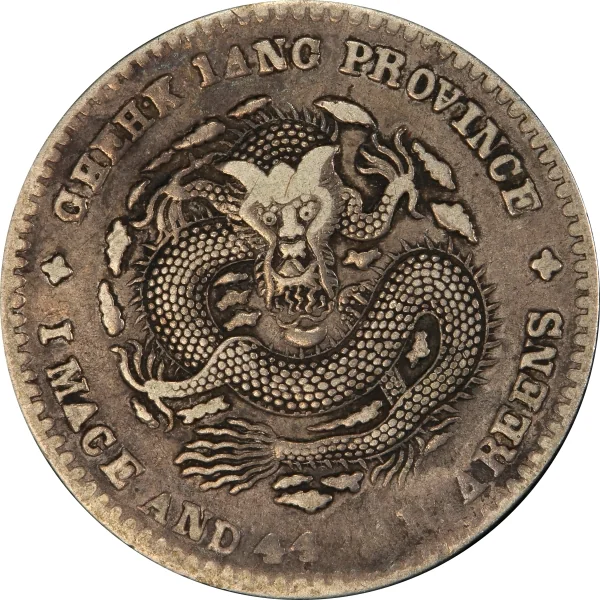
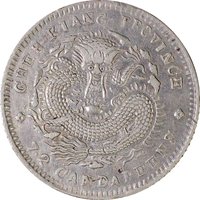
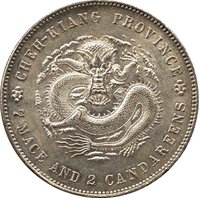
Dragon encircling a pearl, surrounded by English text.
Inscription:
CHEH-KIANG PROVINCE
1 MACE AND 4.4 CANDAREENS
1 MACE AND 4.4 CANDAREENS
Script: Latin
Edge
Reeded.
Categories
| Mythology> Fantastic animal |
Mintings
| Year | Mint Mark | Mintage | Quality | Collection |
|---|---|---|---|---|
| 1896 | — | — | ||
| 1897 | — | — |
Historical background
In 1896, the currency situation in Chekiang (Zhejiang) Province was a complex and chaotic reflection of China's broader monetary disintegration in the late Qing Dynasty. The province operated within a multi-layered system where official Qing coinage, including silver sycee (measured in taels) and copper-alloy cash coins with square holes, circulated alongside a vast array of privately minted and often debased local coins. The intrinsic value of silver, both in bullion and foreign-minted silver dollars (like the Mexican "Eagle" dollar), made it the preferred medium for large transactions and tax payments, while copper cash served daily small-scale commerce. This created a fluctuating and regionally specific exchange rate between silver and copper, a constant source of hardship for peasants who earned in copper but owed taxes calculated in silver.
A critical factor in Chekiang's specific monetary landscape was the pervasive influence of qianzhuang (native banks). These local financial institutions issued their own private paper notes, denominated in either taels of silver or strings of copper cash, which circulated widely in commercial centers like Ningbo and Hangzhou. While facilitating trade, this practice further fragmented the money supply, as the credibility of these notes depended entirely on the reputation and solvency of the issuing qianzhuang. Counterfeiting of both coins and notes was rampant, and the provincial authorities struggled to enforce standards, leading to frequent disputes and a general erosion of public trust in the currency.
This monetary disorder was exacerbated by the Qing government's fiscal crises following the First Sino-Japanese War (1894-1895). The massive indemnity owed to Japan, payable in foreign silver, drained hard currency from the economy and increased the tax burden on provinces like Chekiang. While imperial efforts at monetary reform were being debated in Beijing, including potential standardization and introduction of a national silver coin, these had not yet materialized in Chekiang by 1896. Consequently, the province's economy functioned with a fragile and inefficient system, vulnerable to manipulation and localized crises, which hindered commerce and underscored the weakening administrative control of the central state.
A critical factor in Chekiang's specific monetary landscape was the pervasive influence of qianzhuang (native banks). These local financial institutions issued their own private paper notes, denominated in either taels of silver or strings of copper cash, which circulated widely in commercial centers like Ningbo and Hangzhou. While facilitating trade, this practice further fragmented the money supply, as the credibility of these notes depended entirely on the reputation and solvency of the issuing qianzhuang. Counterfeiting of both coins and notes was rampant, and the provincial authorities struggled to enforce standards, leading to frequent disputes and a general erosion of public trust in the currency.
This monetary disorder was exacerbated by the Qing government's fiscal crises following the First Sino-Japanese War (1894-1895). The massive indemnity owed to Japan, payable in foreign silver, drained hard currency from the economy and increased the tax burden on provinces like Chekiang. While imperial efforts at monetary reform were being debated in Beijing, including potential standardization and introduction of a national silver coin, these had not yet materialized in Chekiang by 1896. Consequently, the province's economy functioned with a fragile and inefficient system, vulnerable to manipulation and localized crises, which hindered commerce and underscored the weakening administrative control of the central state.
💎 Extremely Rare