

1 Yuan – Chekiang Province
China
Context
Year: 1897
Chinese - Guangxu era Year: 23
Country: China 
Issuer: Chekiang Province
Ruler: Guangxu
Currency:
(1896—1940)
Demonetized: Yes
Material
References
Y: #Click to copy to clipboard56
Numista: #16001
Value
Bullion value: $69.66
Obverse
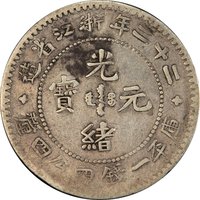
Description:
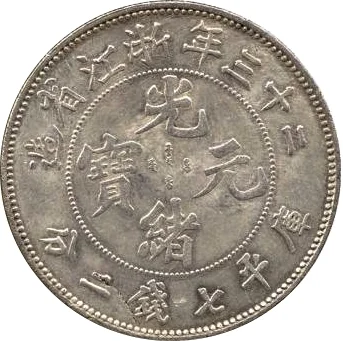
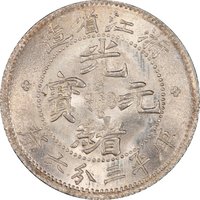
Chinese ideograms top to bottom, right to left, with central Manchu text, all encircled by more Chinese characters.
Inscription:
造省江浙年三十二
光
ᠪᠠᡩᠠᡵᠠᠩᡤᠠ
寶 ᠶᡠᠸᠠᠨ ᠪᠣᠣ 元
ᡩᠣᡵᠣ
緒
分二錢七平庫
光
ᠪᠠᡩᠠᡵᠠᠩᡤᠠ
寶 ᠶᡠᠸᠠᠨ ᠪᠣᠣ 元
ᡩᠣᡵᠣ
緒
分二錢七平庫
Translation:
Made by the Jiang-Zhe Mint in the 32nd Year [of the Guangxu reign]
Badarangga
Yuan Bao [Currency of the Great Qing Empire]
Doro [Virtue]
Guangxu
7 Mace and 2 Candareens [Standard Treasury Weight]
Badarangga
Yuan Bao [Currency of the Great Qing Empire]
Doro [Virtue]
Guangxu
7 Mace and 2 Candareens [Standard Treasury Weight]
Scripts: Chinese, Mongolian / Manchu
Languages: Manchu, Classical Chinese
Reverse
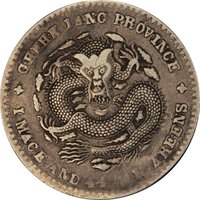
Description:
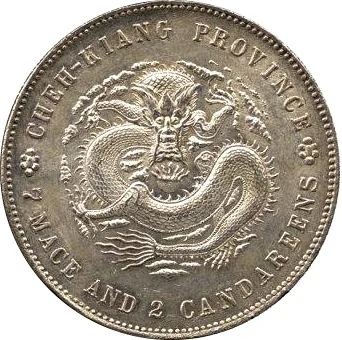
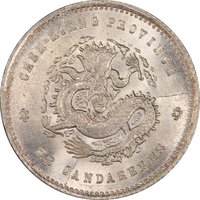
Dragon encircling a pearl, surrounded by English text.
Inscription:
CHEH-KIANG PROVINCE
7 MACE AND 2 CANDAREENS
7 MACE AND 2 CANDAREENS
Script: Latin
Edge
Reeded.
Categories
| Mythology> Fantastic animal |
Mintings
| Year | Mint Mark | Mintage | Quality | Collection |
|---|---|---|---|---|
| 1897 | — | — |
Historical background
In 1897, Chekiang (Zhejiang) Province, like much of late Qing China, operated within a complex and fragmented monetary system. The primary currencies in circulation were the silver tael (a unit of weight, not a coin), foreign silver dollars (notably the Mexican "Eagle" dollar and the British trade dollar), and a vast array of copper cash coins. Provincial mints, including the one in Hangzhou, produced their own silver and copper coinage, but their weight, purity, and value were not always standardized, leading to local and regional exchange rate disparities. This multi-currency environment created significant challenges for taxation, inter-provincial trade, and daily commerce, as merchants and peasants constantly had to negotiate exchange rates and assess the authenticity of coins.
The period was marked by increasing economic pressure from foreign trade and the inflow of foreign silver, which exacerbated the existing instability. Crucially, the 1890s saw a severe depreciation of copper cash against silver, a phenomenon known as qianhuang (錢荒). As the intrinsic metal value of the debased copper coins fell, it inflicted hardship on the peasantry and wage earners who were paid in copper but often had to pay taxes and rents reckoned in silver. This monetary distress contributed to social unrest and highlighted the Qing central government's weakening control over provincial finances.
Against this backdrop, 1897 was a year of attempted reform within the province, part of broader, if disjointed, national efforts to modernize the currency system. Following the establishment of the Imperial Chinese Mint in Tianjin in 1896, there was a push for provincial mints to adopt more standardized machinery and practices. In Chekiang, authorities grappled with managing the local mint's output and responding to the copper-silver crisis, all while navigating the growing influence of foreign banks in Shanghai, which heavily influenced the regional financial market. Thus, the currency situation in Chekiang in 1897 was one of entrenched complexity, acute strain on the common population, and fledgling, yet struggling, efforts at monetary centralization and standardization.
The period was marked by increasing economic pressure from foreign trade and the inflow of foreign silver, which exacerbated the existing instability. Crucially, the 1890s saw a severe depreciation of copper cash against silver, a phenomenon known as qianhuang (錢荒). As the intrinsic metal value of the debased copper coins fell, it inflicted hardship on the peasantry and wage earners who were paid in copper but often had to pay taxes and rents reckoned in silver. This monetary distress contributed to social unrest and highlighted the Qing central government's weakening control over provincial finances.
Against this backdrop, 1897 was a year of attempted reform within the province, part of broader, if disjointed, national efforts to modernize the currency system. Following the establishment of the Imperial Chinese Mint in Tianjin in 1896, there was a push for provincial mints to adopt more standardized machinery and practices. In Chekiang, authorities grappled with managing the local mint's output and responding to the copper-silver crisis, all while navigating the growing influence of foreign banks in Shanghai, which heavily influenced the regional financial market. Thus, the currency situation in Chekiang in 1897 was one of entrenched complexity, acute strain on the common population, and fledgling, yet struggling, efforts at monetary centralization and standardization.
💎 Extremely Rare