

20 Fen – Anhwei Province
China
Context
Years: 1897–1898
Country: China 
Issuer: Anhwei Province
Ruler: Guangxu
Currency:
(1897—1949)
Demonetized: Yes
Material
References
Y: #Click to copy to clipboard43.2-43.4
Numista: #34854
Value
Bullion value: $12.44
Obverse
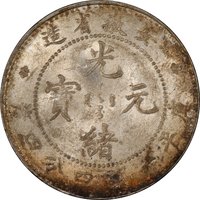
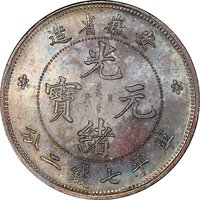
Description:
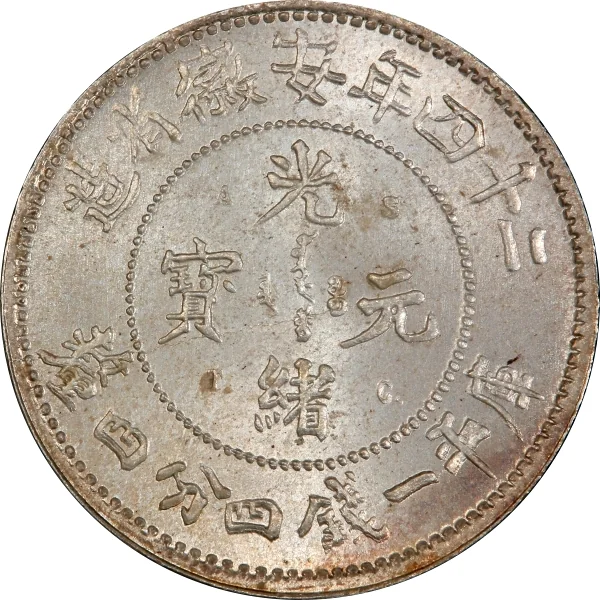
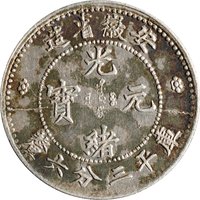
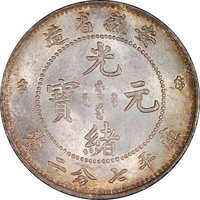
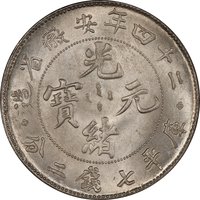
Chinese ideograms top to bottom, right to left, with central Manchu text, all encircled by more Chinese characters.
Inscription:
造省徽安年四十二
光
ᠪᠠᡩᠠᡵᠠᠩᡤᠠ
寶 ᠶᡠᠸᠠᠨ ᠪᠣᠣ 元
ᡩᠣᡵᠣ
緒
釐四分四錢一平庫
光
ᠪᠠᡩᠠᡵᠠᠩᡤᠠ
寶 ᠶᡠᠸᠠᠨ ᠪᠣᠣ 元
ᡩᠣᡵᠣ
緒
釐四分四錢一平庫
Translation:
Made by the Board of Revenue in the 42nd year of the Guangxu era.
Badarangga
Yuan Bao
Doro
One Kuping tael, four mace, four candareens.
Badarangga
Yuan Bao
Doro
One Kuping tael, four mace, four candareens.
Scripts: Chinese, Mongolian / Manchu
Languages: Manchu, Classical Chinese
Reverse
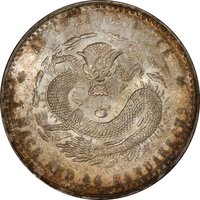
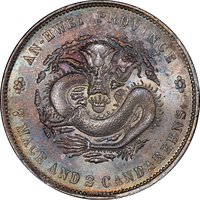
Description:
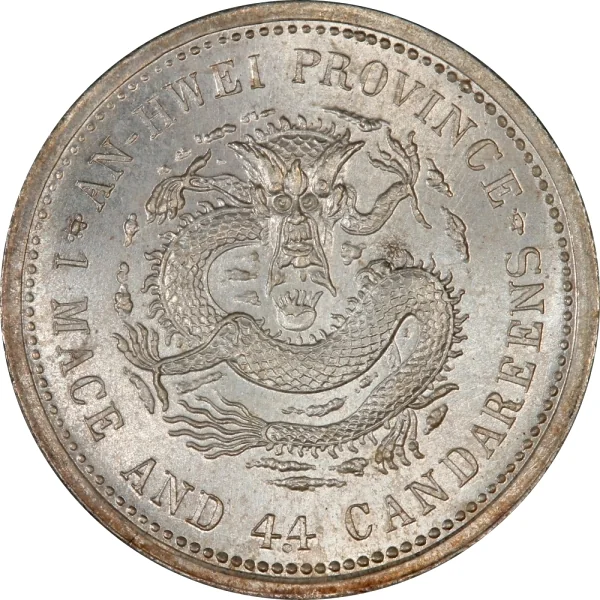
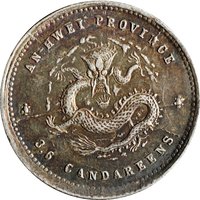
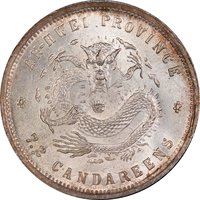
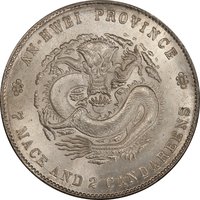
Dragon encircling a pearl, surrounded by English text.
Inscription:
AN-HWEI PROVINCE
1 MACE AND 4.4 CANDAREENS
1 MACE AND 4.4 CANDAREENS
Script: Latin
Edge
Reeded.
Categories
| Mythology> Fantastic animal |
Mintings
| Year | Mint Mark | Mintage | Quality | Collection |
|---|---|---|---|---|
| 1897 | — | — | ||
| 1898 | — | — |
Historical background
In 1897, the currency situation in Anhwei (Anhui) Province was a complex and chaotic reflection of China's broader monetary disintegration in the late Qing Dynasty. The province operated under a multi-layered system where silver, in the form of sycee (shoe-shaped ingots), was the official tax standard, but its weight and purity varied from one prefecture to another, causing significant complications for trade and taxation. Concurrently, a vast quantity of copper cash coins, the everyday currency for the populace, was in circulation, but their exchange rate against silver was highly unstable and subject to local manipulation. This bimetallic system, without standardized units, created a fertile ground for currency speculators and exacerbated economic uncertainty for both peasants and merchants.
The period was further defined by the creeping influx of foreign silver dollars, particularly Mexican "Eagle" dollars and later British trade dollars, which entered via coastal trade and the Yangtze River. These coins were prized for their uniform weight and fineness, and they began to circulate at a premium in commercial centers like Wuhu, undermining the authority of the official Qing coinage. While not yet dominant in rural hinterlands, their presence highlighted the inefficiency of the indigenous system. Additionally, the scarcity of government-minted copper cash led to widespread circulation of privately minted and often debased copper coins, as well as "big cash" with inflated face values, which further eroded public trust in the currency.
This monetary disorder was intrinsically linked to Anhwei's fiscal woes. Provincial authorities struggled to meet central government tax quotas, which were demanded in silver, while local economies functioned on a devalued copper base. The instability hindered commercial development and increased the tax burden on peasants, as fluctuating exchange rates were exploited by tax collectors. The situation in 1897 was thus a state of entrenched confusion, serving as a microcosm of the Qing's failing monetary sovereignty, which would eventually spur late reforms like the provincial minting of silver yuan in the following years, albeit with limited success in creating a unified system.
The period was further defined by the creeping influx of foreign silver dollars, particularly Mexican "Eagle" dollars and later British trade dollars, which entered via coastal trade and the Yangtze River. These coins were prized for their uniform weight and fineness, and they began to circulate at a premium in commercial centers like Wuhu, undermining the authority of the official Qing coinage. While not yet dominant in rural hinterlands, their presence highlighted the inefficiency of the indigenous system. Additionally, the scarcity of government-minted copper cash led to widespread circulation of privately minted and often debased copper coins, as well as "big cash" with inflated face values, which further eroded public trust in the currency.
This monetary disorder was intrinsically linked to Anhwei's fiscal woes. Provincial authorities struggled to meet central government tax quotas, which were demanded in silver, while local economies functioned on a devalued copper base. The instability hindered commercial development and increased the tax burden on peasants, as fluctuating exchange rates were exploited by tax collectors. The situation in 1897 was thus a state of entrenched confusion, serving as a microcosm of the Qing's failing monetary sovereignty, which would eventually spur late reforms like the provincial minting of silver yuan in the following years, albeit with limited success in creating a unified system.
💎 Extremely Rare