

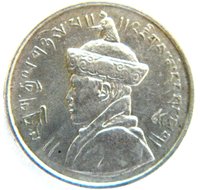
Obverse
Description:
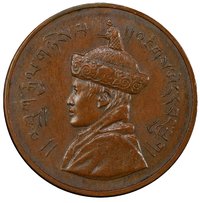
King Jigme Wangchuck left-facing crowned bust.
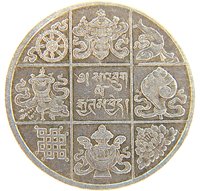
Reverse
Description:
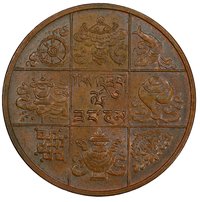
Nine sections: eight outer panels display the Ashtamangala symbols, with a three-line legend in the center. The symbols, clockwise from top left, are: Dharma Wheel, sovereignty umbrella, golden fish, conch shell, lotus, treasure vase, endless knot, and victory banner.
Edge
Mints
| Name | Mark |
|---|---|
| Kolkata / Calcutta / Murshidabad | — |
Mintings
| Year | Mint Mark | Mintage | Quality | Collection |
|---|---|---|---|---|
| 1931 | — | 10,000 |
Historical background
In 1931, Bhutan's currency situation was characterized by a dual system, deeply intertwined with its political and economic relationship with British India. The country had no independent, nationally minted currency in circulation. Instead, the primary medium of exchange was the Indian Rupee, which flowed into Bhutan through trade, subsidies, and payments to officials. This practical adoption was a direct consequence of the 1910 Treaty of Punakha, which made Bhutan a British protectorate, guiding its foreign relations and firmly anchoring its economy to India's monetary sphere.
Alongside the rupee, a traditional barter economy and the use of commodity money remained significant, especially in remote areas. The most notable traditional currency was the Maartrum (or "Ma-trum"), a stamped silver bullion piece that was not a standardized coin but a weight of silver (approximately 11-12 grams). These were often used for larger transactions, savings, and religious offerings. Furthermore, other precious metals, grain, and textiles served as common means of exchange, reflecting a subsistence agricultural economy not yet fully monetized.
This period represented a quiet prelude to monetary reform. The dual system functioned but was inefficient for growing administrative and trade needs. The stability provided by the Indian rupee facilitated cross-border commerce, yet the lack of a sovereign currency was a marker of Bhutan's limited economic autonomy. The situation would remain largely unchanged until 1954, when the first official Bhutanese coin, the Chetrum, was introduced under the Third King, Jigme Dorji Wangchuck, initiating the path toward a modern national currency.
Alongside the rupee, a traditional barter economy and the use of commodity money remained significant, especially in remote areas. The most notable traditional currency was the Maartrum (or "Ma-trum"), a stamped silver bullion piece that was not a standardized coin but a weight of silver (approximately 11-12 grams). These were often used for larger transactions, savings, and religious offerings. Furthermore, other precious metals, grain, and textiles served as common means of exchange, reflecting a subsistence agricultural economy not yet fully monetized.
This period represented a quiet prelude to monetary reform. The dual system functioned but was inefficient for growing administrative and trade needs. The stability provided by the Indian rupee facilitated cross-border commerce, yet the lack of a sovereign currency was a marker of Bhutan's limited economic autonomy. The situation would remain largely unchanged until 1954, when the first official Bhutanese coin, the Chetrum, was introduced under the Third King, Jigme Dorji Wangchuck, initiating the path toward a modern national currency.
💎 Extremely Rare