

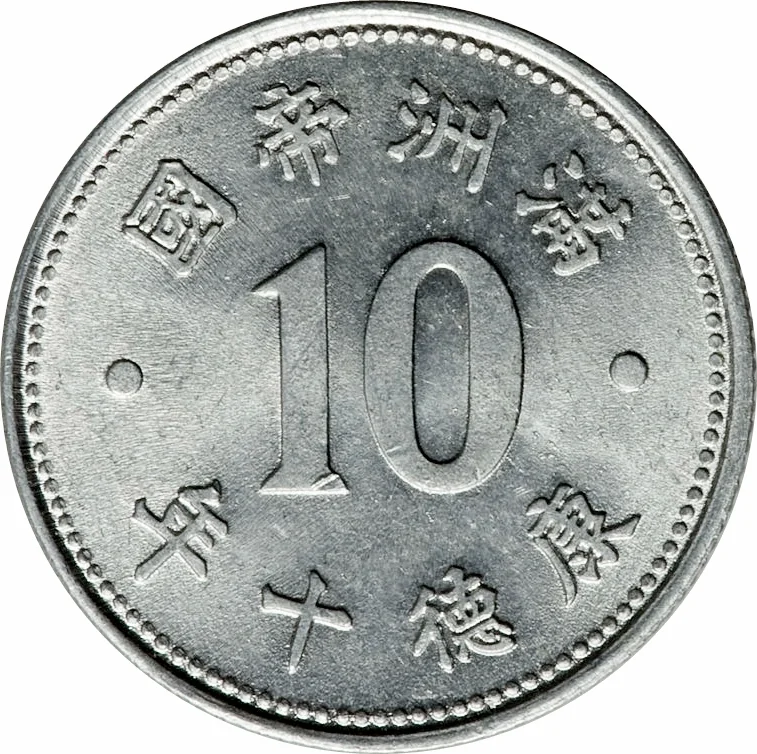

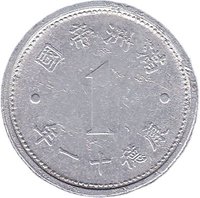
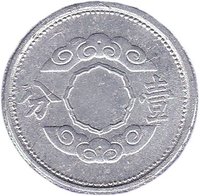
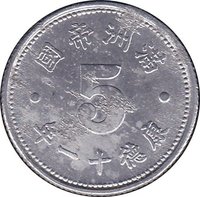
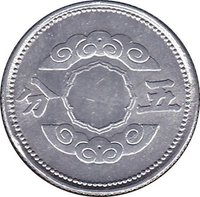
Obverse
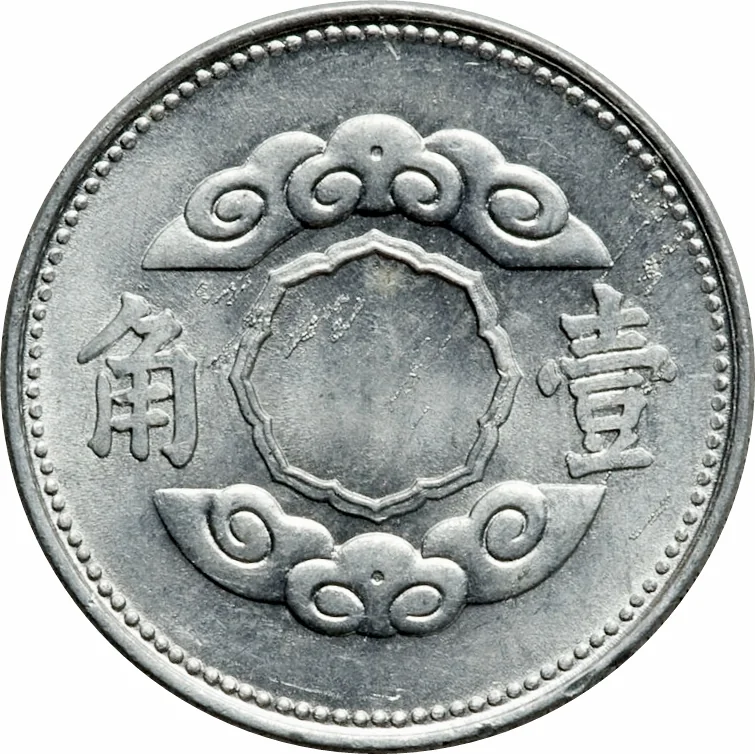
Reverse
Edge
Reeded
Mintings
| Year | Mint Mark | Mintage | Quality | Collection |
|---|---|---|---|---|
| 1943 | — | — |
Historical background
By 1943, the currency situation in Manchukuo was one of severe strain and accelerating inflation, directly tied to the deteriorating fortunes of its imperial patron, Japan. The Manchukuo yuan, issued by the Central Bank of Manchukuo, was fundamentally a satellite currency of the Japanese yen, operating within the Yen Bloc. Its value and stability were entirely dependent on Japanese economic and military success, which by this mid-war period were in sharp decline. The Japanese government, facing immense wartime expenditures across the Asia-Pacific theater, compelled Manchukuo to provide vast quantities of raw materials, food, and industrial goods, while also forcing the Central Bank to extend massive credits to Japanese-controlled enterprises and the Kwantung Army. This led to unrestrained currency issuance to cover the deficits, flooding the economy with paper money not backed by sufficient goods or reserves.
The result was rampant inflation, which severely impacted the standard of living for the Han Chinese majority and other residents. Prices for basic necessities like food and cloth soared as the war distorted the economy toward heavy industry and military production at the expense of consumer goods. This inflation was exacerbated by growing shortages, as Allied blockades and the shifting war front disrupted supplies. The Japanese authorities attempted to impose strict price controls and rationing, but these measures were largely ineffective and led to a thriving black market where goods traded for many times their official prices. The currency's value eroded both domestically and internationally, surviving only through coercive measures that mandated its use and prohibited other currencies.
Ultimately, the 1943 currency crisis was a clear symptom of Manchukuo's colonial exploitation and its inextricable link to Japan's faltering war effort. The financial system was not designed for the sovereignty or economic health of the region, but as a mechanism to extract resources and fund Japan's military ambitions. As Japan's situation grew more desperate, so did the fiscal demands placed on Manchukuo, guaranteeing hyperinflation and economic hardship. The deteriorating currency foreshadowed the imminent collapse of the puppet state, which would dissolve entirely with Japan's surrender in 1945, leaving behind a legacy of economic dislocation and a worthless monetary system.
The result was rampant inflation, which severely impacted the standard of living for the Han Chinese majority and other residents. Prices for basic necessities like food and cloth soared as the war distorted the economy toward heavy industry and military production at the expense of consumer goods. This inflation was exacerbated by growing shortages, as Allied blockades and the shifting war front disrupted supplies. The Japanese authorities attempted to impose strict price controls and rationing, but these measures were largely ineffective and led to a thriving black market where goods traded for many times their official prices. The currency's value eroded both domestically and internationally, surviving only through coercive measures that mandated its use and prohibited other currencies.
Ultimately, the 1943 currency crisis was a clear symptom of Manchukuo's colonial exploitation and its inextricable link to Japan's faltering war effort. The financial system was not designed for the sovereignty or economic health of the region, but as a mechanism to extract resources and fund Japan's military ambitions. As Japan's situation grew more desperate, so did the fiscal demands placed on Manchukuo, guaranteeing hyperinflation and economic hardship. The deteriorating currency foreshadowed the imminent collapse of the puppet state, which would dissolve entirely with Japan's surrender in 1945, leaving behind a legacy of economic dislocation and a worthless monetary system.
⭐ Somewhat Rare