

100 Cash – Honan Province
China
Context
Year: 1931
Chinese republican Year: 20
Country: China 
Issuer: Honan Province
Period:
(1912—1949)
Currency:
(1905—1949)
Demonetized: Yes
Material
References
Y: #Click to copy to clipboard398
Numista: #31883
Obverse
Description:
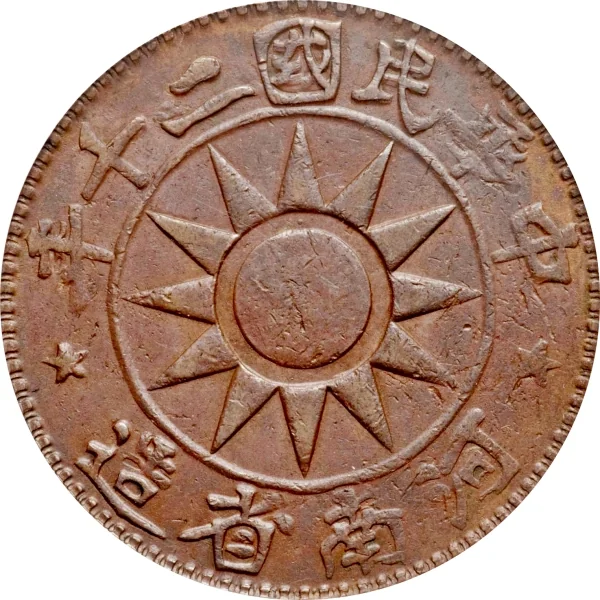
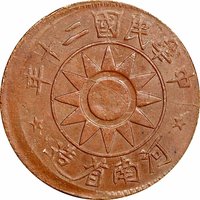
Sun encircled by twelve rays and Chinese characters.
Inscription:
年十二國民華中
造省南河
造省南河
Translation:
Twelfth Year of the Republic of China,
Made in Henan Province.
Made in Henan Province.
Language: Chinese
Reverse
Description:
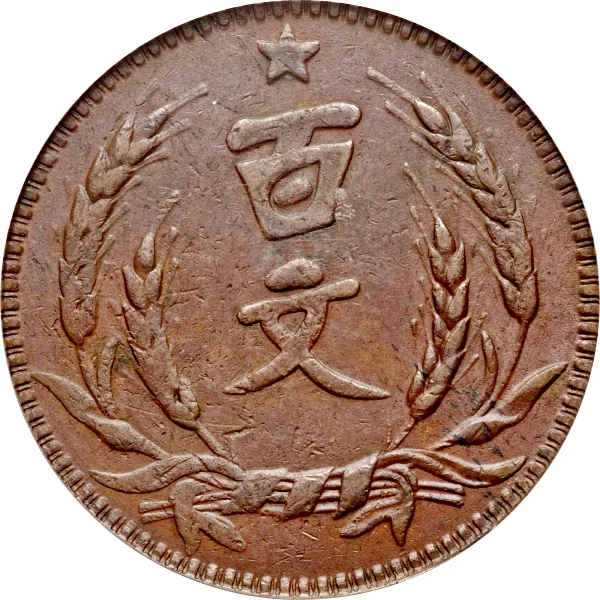
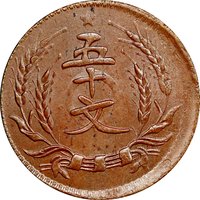
Three Chinese characters inside a wreath, topped by a star.
Inscription:
百
文
文
Translation:
One hundred cash.
Language: Chinese
Edge
Plain
Mintings
| Year | Mint Mark | Mintage | Quality | Collection |
|---|---|---|---|---|
| 1931 | — | — |
Historical background
In 1931, Honan Province was engulfed in a severe and multifaceted currency crisis, symptomatic of China's broader financial disintegration during the Nanjing Decade. The national currency, the silver yuan, circulated unevenly alongside a chaotic mix of local banknotes, military scrip, and traditional copper cash. This fragmentation was exacerbated by the political reality of the period; while nominally under the control of the Nationalist government, Honan was effectively dominated by regional militarists like Liu Zhi, who often financed their armies by compelling local banks to issue unbacked paper notes. Consequently, public trust in any paper currency was extremely low, leading to frequent discounting and wild fluctuations in exchange rates between silver, copper, and various notes.
The situation was critically worsened by natural disaster. The catastrophic Yellow River floods of 1931, which inundated vast areas of Honan, devastated the agricultural economy and destroyed harvests. This disaster shattered local credit systems and caused a severe shortage of physical currency, particularly the copper cash used in everyday rural transactions. With trade paralyzed and savings wiped out, many areas reverted to barter. Meanwhile, the silver yuan, the most stable store of value, began to be hoarded by those who could afford it, leading to a crippling deflation for the silver-denominated debts of peasants and a further contraction of the already crippled rural economy.
Ultimately, the currency chaos in Honan was a direct cause and effect of profound human suffering. The lack of a reliable medium of exchange hampered famine relief efforts and economic recovery after the floods, deepening the province's destitution. This environment of economic collapse and governmental weakness created fertile ground for social unrest and would soon contribute to the growing appeal of alternative political forces, including the Chinese Communist Party, within the rural population. The crisis underscored the inability of both central and provincial authorities to provide monetary stability, revealing the fundamental link between sound currency and basic governance.
The situation was critically worsened by natural disaster. The catastrophic Yellow River floods of 1931, which inundated vast areas of Honan, devastated the agricultural economy and destroyed harvests. This disaster shattered local credit systems and caused a severe shortage of physical currency, particularly the copper cash used in everyday rural transactions. With trade paralyzed and savings wiped out, many areas reverted to barter. Meanwhile, the silver yuan, the most stable store of value, began to be hoarded by those who could afford it, leading to a crippling deflation for the silver-denominated debts of peasants and a further contraction of the already crippled rural economy.
Ultimately, the currency chaos in Honan was a direct cause and effect of profound human suffering. The lack of a reliable medium of exchange hampered famine relief efforts and economic recovery after the floods, deepening the province's destitution. This environment of economic collapse and governmental weakness created fertile ground for social unrest and would soon contribute to the growing appeal of alternative political forces, including the Chinese Communist Party, within the rural population. The crisis underscored the inability of both central and provincial authorities to provide monetary stability, revealing the fundamental link between sound currency and basic governance.

💎 Extremely Rare