

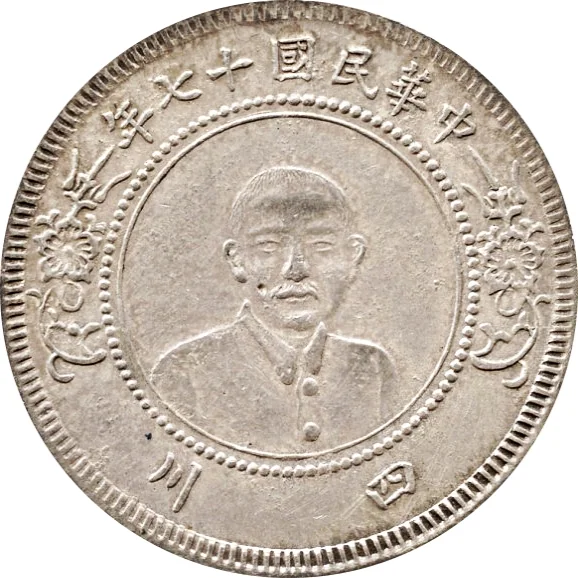
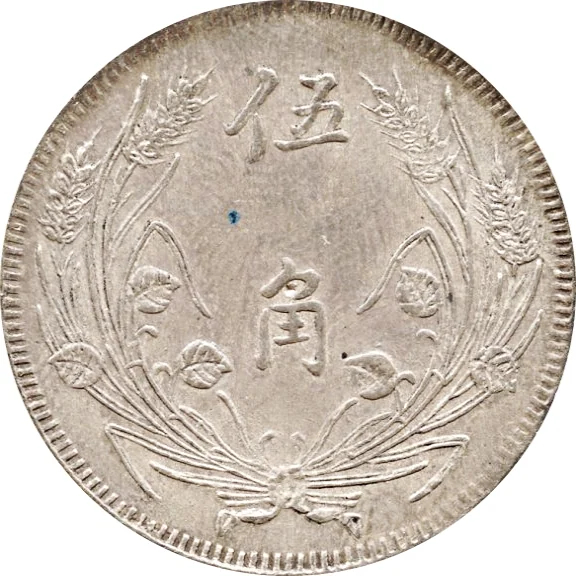
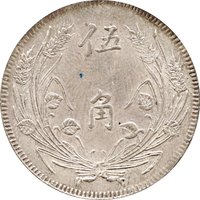
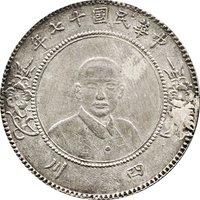
5 Jiao – Szechuan Province
China
Context
Year: 1928
Chinese republican Year: 17
Country: China 
Issuer: Szechuan Province
Period:
(1912—1949)
Currency:
(1897—1949)
Demonetized: Yes
Material
References
Y: #Click to copy to clipboard473
Numista: #297067
Value
Bullion value: $30.27
Obverse
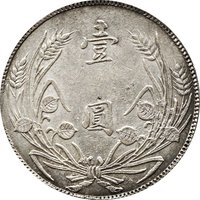
Reverse
Edge
Reeded.
Categories
| Person> Politician |
| Mustache/Beard |
| Plants> Flower |
| Symbol> Wreath |
Mintings
| Year | Mint Mark | Mintage | Quality | Collection |
|---|---|---|---|---|
| 1928 | — | — |
Historical background
In 1928, Szechuan (Sichuan) Province was mired in a severe and chaotic currency crisis, emblematic of the wider political fragmentation of China during the Warlord Era. The province was effectively controlled by competing regional militarists, each seeking to finance their armies and administrations through the unrestrained issuance of local currency. The primary circulating medium was the Szechuan Silver Dollar, but its value and silver content varied wildly between different military minting operations in cities like Chengtu (Chengdu) and Chungking (Chongqing). More debilitating was the flood of Szechuan Copper Cash Notes, irredeemable paper tokens printed in massive volumes by warlord banks and even commercial establishments, leading to rampant inflation and a complete loss of public confidence.
This monetary anarchy was compounded by the continued circulation of older imperial-era coins, foreign silver dollars (particularly Mexican "Eagle" dollars), and notes from the now-distant central government banks. The critical problem was the lack of any unified monetary authority or standard. Warlords routinely forced merchants and the public to accept their depreciating notes, while taxes were often demanded in stable silver coinage, creating a ruinous system that siphoned real wealth from the local economy. The result was a complex and predatory hierarchy of currencies, where exchange rates fluctuated not only by market but by the military fortunes of the issuing warlord.
Consequently, the currency situation stifled economic development, crippled inter-regional trade within the province, and inflicted significant hardship on the populace. Daily transactions were fraught with uncertainty and discounting, undermining basic commerce. This financial disarray persisted until the mid-1930s, when the gradual military and political consolidation of the province by the Nationalist Government (Kuomintang) from Nanjing began to impose a degree of monetary order, eventually replacing the local issues with central bank currency, though not without continued resistance from local powers.
This monetary anarchy was compounded by the continued circulation of older imperial-era coins, foreign silver dollars (particularly Mexican "Eagle" dollars), and notes from the now-distant central government banks. The critical problem was the lack of any unified monetary authority or standard. Warlords routinely forced merchants and the public to accept their depreciating notes, while taxes were often demanded in stable silver coinage, creating a ruinous system that siphoned real wealth from the local economy. The result was a complex and predatory hierarchy of currencies, where exchange rates fluctuated not only by market but by the military fortunes of the issuing warlord.
Consequently, the currency situation stifled economic development, crippled inter-regional trade within the province, and inflicted significant hardship on the populace. Daily transactions were fraught with uncertainty and discounting, undermining basic commerce. This financial disarray persisted until the mid-1930s, when the gradual military and political consolidation of the province by the Nationalist Government (Kuomintang) from Nanjing began to impose a degree of monetary order, eventually replacing the local issues with central bank currency, though not without continued resistance from local powers.
✨ Legendary