

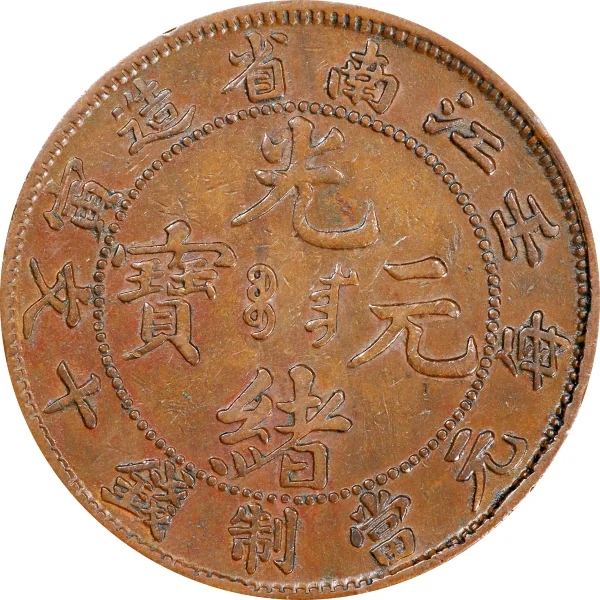
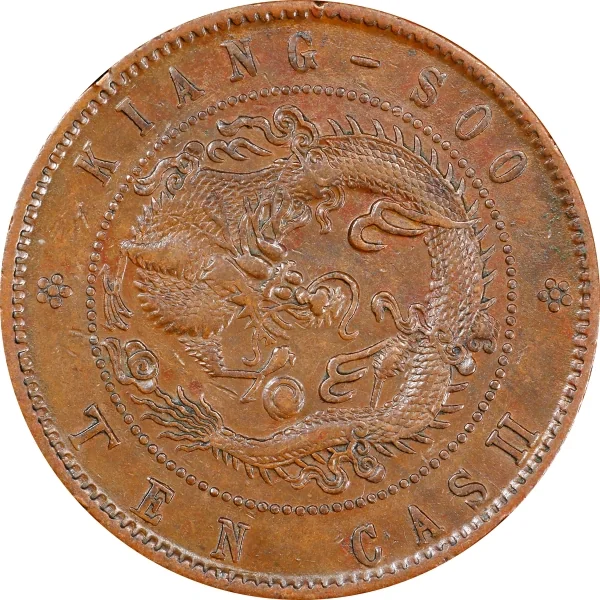
10 Cash – Kiangnan Province
China
Context
Year: 1902
Country: China 
Issuer: Kiangnan Province
Ruler: Guangxu
Currency:
(1898—1949)
Demonetized: Yes
Material
References
Y: #Click to copy to clipboardC140
Numista: #296991
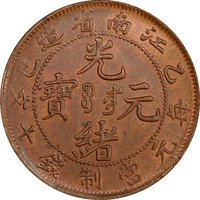
Obverse
Description:
Four Chinese ideograms read vertically, right to left, with Manchu text in the center, encircled by more ideograms.
Inscription:
造省南江
寅壬
光
寶 ᠪᠣᠣ ᠨᡳᠩ 元
緒
文十錢制當元每
寅壬
光
寶 ᠪᠣᠣ ᠨᡳᠩ 元
緒
文十錢制當元每
Translation:
Made in the Southern Jiangxi Province.
Ren Yin year.
Guangxu era.
Treasure. Boo ning. Yuan.
Ten cash coin, equivalent to one yuan each.
Ren Yin year.
Guangxu era.
Treasure. Boo ning. Yuan.
Ten cash coin, equivalent to one yuan each.
Scripts: Chinese, Mongolian / Manchu
Languages: Manchu, Classical Chinese
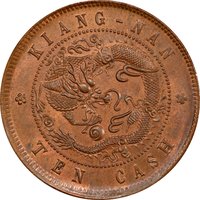
Reverse
Description:
Dragon encircling a pearl, surrounded by English text.
Inscription:
KIANG-SOO
TWENTY CASH
TWENTY CASH
Script: Latin
Edge
Plain
Categories
| Mythology> Fantastic animal |
Mintings
| Year | Mint Mark | Mintage | Quality | Collection |
|---|---|---|---|---|
| 1902 | — | — |
Historical background
In 1902, Kiangnan Province (centered on Shanghai and encompassing parts of modern Jiangsu and Anhui) was a vortex of monetary complexity, reflecting China's semi-colonial condition and economic transition. The official currency remained the silver tael, a unit of weight rather than a coin, leading to a bewildering array of local tael standards like the Kuping tael for official revenue and the Shanghai tael or "tael of account" for native banking and trade. This system was cumbersome, requiring constant assay and calculation, and was paralleled by a flood of circulating silver dollars, primarily Mexican "Eagle" dollars and later British Trade dollars, which were valued by weight and purity against the tael standard.
Compounding this metallic chaos was the proliferation of paper and subsidiary coinage. Foreign banks, chiefly the British-chartered Hongkong and Shanghai Banking Corporation (HSBC), issued their own banknotes, which circulated with authority in the treaty ports. Meanwhile, Chinese qianzhuang (native banks) and piaohao (remittance shops) issued cash notes and drafts, their value dependent on the issuer's reputation. Copper cash coins, the everyday money of the populace, suffered from severe debasement and regional inconsistency, causing hardship for peasants and laborers as their real wages eroded. The Qing government's own attempts at monetary reform, including minting provincial silver and copper coins, added to rather than reduced the variety.
This fragmented system severely hampered commerce and state finance. Merchants bore significant exchange risks, while the provincial authorities struggled to reconcile tax receipts in myriad forms. The situation was a direct result of weakened imperial sovereignty, as foreign currencies and financial institutions operated with extraterritorial privilege. Consequently, Kiangnan in 1902 stood as China's most vital economic hub yet was crippled by a monetary anarchy that would fuel continued calls for standardization, culminating later in the decade with the establishment of the Imperial Bank of China and, ultimately, the abortive currency reforms of the late Qing.
Compounding this metallic chaos was the proliferation of paper and subsidiary coinage. Foreign banks, chiefly the British-chartered Hongkong and Shanghai Banking Corporation (HSBC), issued their own banknotes, which circulated with authority in the treaty ports. Meanwhile, Chinese qianzhuang (native banks) and piaohao (remittance shops) issued cash notes and drafts, their value dependent on the issuer's reputation. Copper cash coins, the everyday money of the populace, suffered from severe debasement and regional inconsistency, causing hardship for peasants and laborers as their real wages eroded. The Qing government's own attempts at monetary reform, including minting provincial silver and copper coins, added to rather than reduced the variety.
This fragmented system severely hampered commerce and state finance. Merchants bore significant exchange risks, while the provincial authorities struggled to reconcile tax receipts in myriad forms. The situation was a direct result of weakened imperial sovereignty, as foreign currencies and financial institutions operated with extraterritorial privilege. Consequently, Kiangnan in 1902 stood as China's most vital economic hub yet was crippled by a monetary anarchy that would fuel continued calls for standardization, culminating later in the decade with the establishment of the Imperial Bank of China and, ultimately, the abortive currency reforms of the late Qing.

💎 Extremely Rare