

1 Yuan – Kiangnan Province
China
Context
Year: 1904
Country: China 
Issuer: Kiangnan Province
Ruler: Guangxu
Currency:
(1898—1949)
Demonetized: Yes
Material

References
Y: #Click to copy to clipboard145a.19
Numista: #296915
Value
Bullion value: $68.10
Obverse
Description:
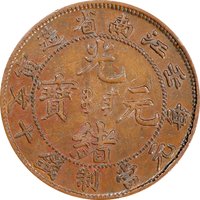
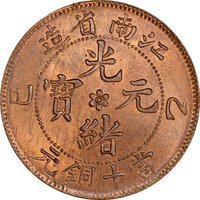
Four Chinese ideograms, read top to bottom and right to left, surrounded by more ideograms.
Inscription:
造省南江
辰甲
光
寶 元
緒
分二錢七平库
辰甲
光
寶 元
緒
分二錢七平库
Translation:
Made in the Southern Jiang Province.
Chenjia
Guang
Baoyuan
Xu
7 Fen 2 Qian, Pingku Standard.
Chenjia
Guang
Baoyuan
Xu
7 Fen 2 Qian, Pingku Standard.
Language: Chinese
Reverse
Description:
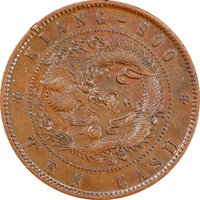
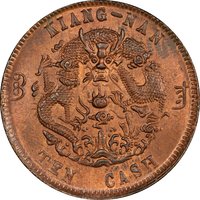
Dragon encircling a pearl, surrounded by English text.
Inscription:
KIANG NAN PROVINCE
7 MACE AND 2 CANDAREENS
7 MACE AND 2 CANDAREENS
Edge
Reeded.
Categories
| Mythology> Fantastic animal |
Mintings
| Year | Mint Mark | Mintage | Quality | Collection |
|---|---|---|---|---|
| 1904 | — | — |
Historical background
In 1904, the monetary landscape of Kiangnan Province (centered on Shanghai and the lower Yangtze Delta) was a chaotic and multilayered system, reflecting China's semi-colonial condition and its struggle to modernize. The province, as the commercial and financial heart of late Qing China, did not have a single, unified currency. Instead, its economy operated on a complex hierarchy of metallic and paper money. The foundation was a bimetallic system of silver taels (by weight and purity) and copper cash coins for daily small transactions. However, the primary silver coin in circulation was the Mexican silver dollar, introduced via foreign trade, alongside a growing number of British trade dollars and Japanese yen. Chinese-minted silver coins, like the Dragon Dollar, competed for acceptance but lacked uniform standards.
This metallic jungle was compounded by a precarious paper money system. Various entities issued banknotes with differing credibility: the Imperial Bank of China and the newly established (1905) Board of Revenue Bank issued official notes; numerous native Chinese private banks (qianzhuang) circulated their own notes, redeemable only at the issuing institution; and, most influentially, foreign banks—notably the Hongkong and Shanghai Banking Corporation (HSBC)—issued their own banknotes, which were widely trusted and became a de facto reserve currency in Shanghai's International Settlement. This proliferation led to frequent discounting, counterfeiting, and bank runs, creating significant friction for trade and daily commerce.
The currency situation was a direct source of economic weakness and national humiliation in the eyes of reformist officials. The reliance on foreign silver dollars and banknotes underscored the Qing government's inability to assert monetary sovereignty, while the tael's complexity hindered modern accounting and revenue collection. Consequently, 1904 fell within a period of intense debate and experimentation, just one year before the Qing court would finally attempt a centralized solution by establishing a national mint in Tianjin and officially promoting the silver yuan as a standard unit—a reform that would take years to meaningfully penetrate the entrenched financial ecosystem of Kiangnan.
This metallic jungle was compounded by a precarious paper money system. Various entities issued banknotes with differing credibility: the Imperial Bank of China and the newly established (1905) Board of Revenue Bank issued official notes; numerous native Chinese private banks (qianzhuang) circulated their own notes, redeemable only at the issuing institution; and, most influentially, foreign banks—notably the Hongkong and Shanghai Banking Corporation (HSBC)—issued their own banknotes, which were widely trusted and became a de facto reserve currency in Shanghai's International Settlement. This proliferation led to frequent discounting, counterfeiting, and bank runs, creating significant friction for trade and daily commerce.
The currency situation was a direct source of economic weakness and national humiliation in the eyes of reformist officials. The reliance on foreign silver dollars and banknotes underscored the Qing government's inability to assert monetary sovereignty, while the tael's complexity hindered modern accounting and revenue collection. Consequently, 1904 fell within a period of intense debate and experimentation, just one year before the Qing court would finally attempt a centralized solution by establishing a national mint in Tianjin and officially promoting the silver yuan as a standard unit—a reform that would take years to meaningfully penetrate the entrenched financial ecosystem of Kiangnan.
✨ Legendary