

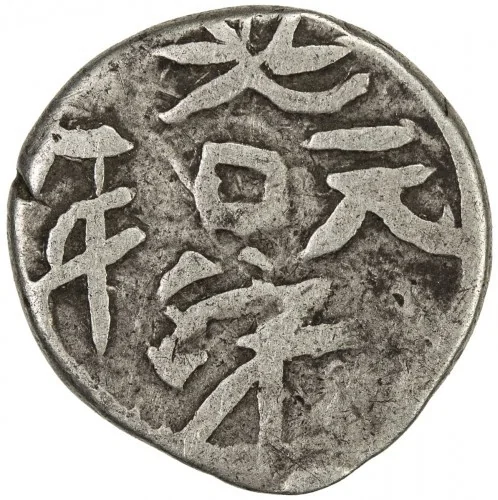
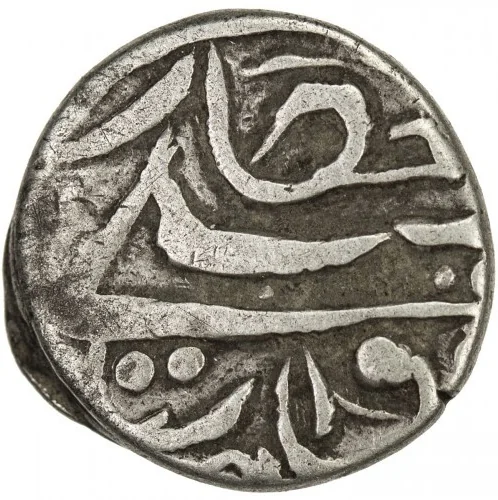
½ Miscal / 5 Fen – Sinkiang Province
China
Context
Year: 1875
Chinese - Guangxu era Year: 1
Country: China 
Issuer: Sinkiang Province
Ruler: Guangxu
Demonetized: Yes
Material
Diameter: 13 mm
Weight: 1.51 g
Silver weight: 1.51 g
Thickness: 1.4 mm
Shape: Irregular round
Composition: Silver
Magnetic: No
References
Y: #Click to copy to clipboardA7.14 var.
Numista: #296630
Value
Bullion value: $4.39
Obverse
Description:
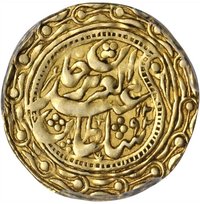
Four Chinese characters arranged around a central square, read top-down, right-left.
Inscription:
光
年 元
緒
年 元
緒
Translation:
Guangxu Yuan Nian
Language: Chinese
Reverse
Edge
Plain
Mintings
| Year | Mint Mark | Mintage | Quality | Collection |
|---|---|---|---|---|
| 1875 | — | — |
Historical background
In 1875, the currency situation in Sinkiang (Xinjiang) was chaotic and fragmented, reflecting the region's political instability following the collapse of Yakub Beg's Kokand-based regime and the ongoing Qing reconquest under Zuo Zongtang. The province was a mosaic of competing currencies: Yakub Beg's recently defunct government had issued its own silver tanga coins, while older Qing pul copper coins and even Kashmiri and Russian rubles circulated alongside raw silver ingots (yambu) and traditional zhang paper notes from earlier Chinese administrations. This multiplicity created severe confusion in trade, with exchange rates fluctuating wildly between different districts and currencies, severely hampering economic recovery.
The primary economic driver was the ongoing military campaign, as Qing forces advanced to reassert control. This meant that the most reliable currency was often that which supplied the massive Qing armies—primarily silver sourced from inland China. However, logistical challenges and the vast distances involved made the supply of standardized Qing coinage scarce and irregular. In the power vacuum, barter remained a common practice, and the value of any coin was heavily dependent on its intrinsic silver or copper content rather than any stable, government-backed guarantee.
Ultimately, the currency disorder of 1875 was a symptom of the struggle for sovereignty over the region. The Qing victory at Turfan later that year marked a decisive turn, setting the stage for monetary consolidation. Following full reconquest, the Qing state would move systematically to suppress local coinage and re-impose a unified currency system based on the silver tael and standardized copper cash, aiming to integrate Xinjiang's economy firmly into the imperial administration. Thus, 1875 represented the chaotic final chapter of an interregnum, immediately preceding a forceful reassertion of centralized monetary control.
The primary economic driver was the ongoing military campaign, as Qing forces advanced to reassert control. This meant that the most reliable currency was often that which supplied the massive Qing armies—primarily silver sourced from inland China. However, logistical challenges and the vast distances involved made the supply of standardized Qing coinage scarce and irregular. In the power vacuum, barter remained a common practice, and the value of any coin was heavily dependent on its intrinsic silver or copper content rather than any stable, government-backed guarantee.
Ultimately, the currency disorder of 1875 was a symptom of the struggle for sovereignty over the region. The Qing victory at Turfan later that year marked a decisive turn, setting the stage for monetary consolidation. Following full reconquest, the Qing state would move systematically to suppress local coinage and re-impose a unified currency system based on the silver tael and standardized copper cash, aiming to integrate Xinjiang's economy firmly into the imperial administration. Thus, 1875 represented the chaotic final chapter of an interregnum, immediately preceding a forceful reassertion of centralized monetary control.
✨ Legendary