

200 Cash – Szechuan Province
China
Context
Year: 1913
Chinese republican Year: 2
Country: China 
Issuer: Szechuan Province
Period:
(1912—1949)
Currency:
(1897—1949)
Demonetized: Yes
Material
References
Y: #Click to copy to clipboard459
Numista: #27897
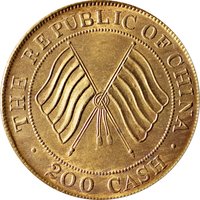
Obverse
Description:
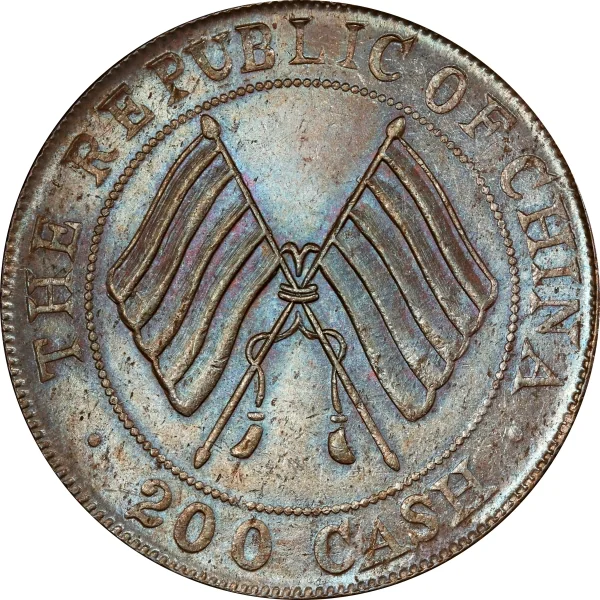
Crossed flags with English text.
Inscription:
THE REPUBLIC OF CHINA
200 CASH
200 CASH
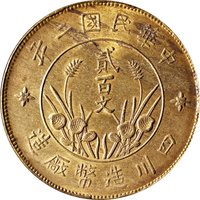
Reverse
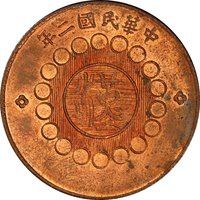
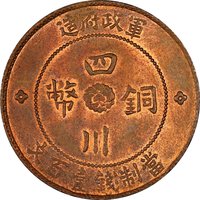
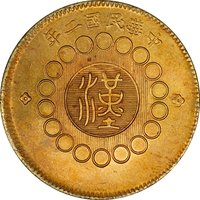
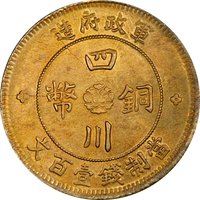
Description:
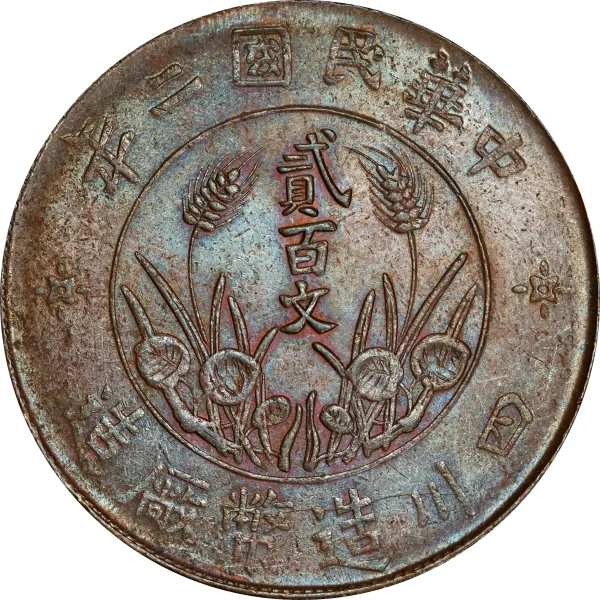
Three floral-framed ideograms encircled by more characters.
Inscription:
年二國民華中
貳
百
文
造廠幣造川四
貳
百
文
造廠幣造川四
Translation:
REPUBLIC OF CHINA YEAR 2
200
CASH
SZECHUAN MINT
200
CASH
SZECHUAN MINT
Language: Chinese
Edge
Plain
Mintings
| Year | Mint Mark | Mintage | Quality | Collection |
|---|---|---|---|---|
| 1913 | — | — |
Historical background
In 1913, Szechuan (Sichuan) Province was mired in profound monetary chaos, a direct legacy of the 1911 Revolution and the collapse of the Qing dynasty. The province, geographically isolated and under the control of competing militarists, operated with a fractured economy. The primary circulating medium was the "Szechuan Copper Coin" (Sichuan tongyuan), but its value had collapsed due to rampant over-issuance by various military authorities to fund their regimes. This devaluation was exacerbated by a severe shortage of standard silver yuan, which were hoarded or flowed out of the province, creating a crippling dual-currency system where the exchange rate between debased copper coins and silver swung wildly.
The situation was further complicated by the circulation of a vast array of older Qing-era coins, privately minted tokens, and promissory notes from local banks and pawnshops. Most disruptive were the "Military Silver Notes" (junpiao), a form of scrip forcibly issued by local warlords to pay troops and expenses. These notes were rarely backed by reserves and quickly depreciated, becoming a tool of extraction from the local populace, who were compelled to accept them for taxes and transactions. Consequently, merchants and the public faced nightmarish calculations for simple trade, with multiple, unstable exchange rates between copper, silver, and various paper claims.
This monetary anarchy severely hampered inter-regional commerce, fostered hyper-localized economies, and fueled inflation, particularly in basic goods priced in copper. The instability in Szechuan was a microcosm of China's broader post-imperial fragmentation, demonstrating how the absence of a central political authority directly manifested as a breakdown in the most fundamental institution of a unified market: a reliable currency. The chaos of 1913 would persist and evolve, setting the stage for even more severe monetary experiments and crises in the province throughout the warlord era.
The situation was further complicated by the circulation of a vast array of older Qing-era coins, privately minted tokens, and promissory notes from local banks and pawnshops. Most disruptive were the "Military Silver Notes" (junpiao), a form of scrip forcibly issued by local warlords to pay troops and expenses. These notes were rarely backed by reserves and quickly depreciated, becoming a tool of extraction from the local populace, who were compelled to accept them for taxes and transactions. Consequently, merchants and the public faced nightmarish calculations for simple trade, with multiple, unstable exchange rates between copper, silver, and various paper claims.
This monetary anarchy severely hampered inter-regional commerce, fostered hyper-localized economies, and fueled inflation, particularly in basic goods priced in copper. The instability in Szechuan was a microcosm of China's broader post-imperial fragmentation, demonstrating how the absence of a central political authority directly manifested as a breakdown in the most fundamental institution of a unified market: a reliable currency. The chaos of 1913 would persist and evolve, setting the stage for even more severe monetary experiments and crises in the province throughout the warlord era.
⭐ Somewhat Rare