

1 yuan – Kirin Province
Add to wishlist
China
Context
Year: 1908
Country: China
Issuer: Kirin Province
Ruler: Guangxu
Currency:
(1898—1909)
Demonetized: Yes
Material
References
Y: #
Numista: #274768
Value
Bullion value: $65.14
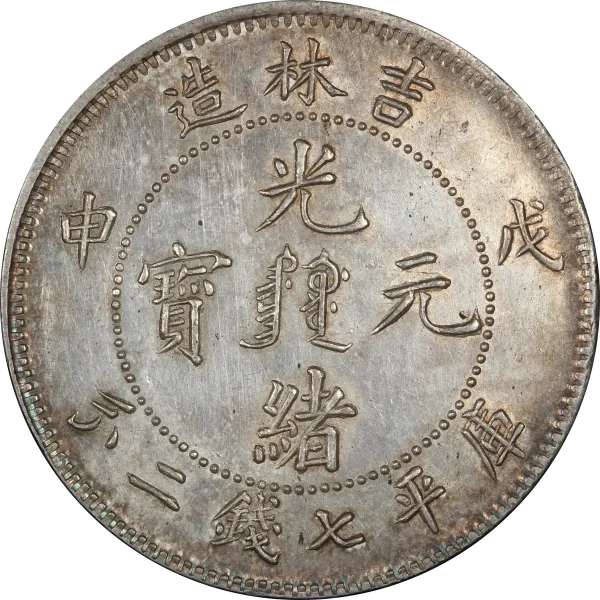
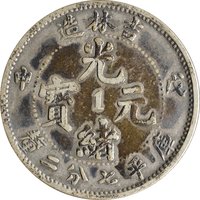
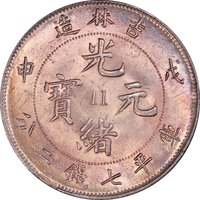
Obverse
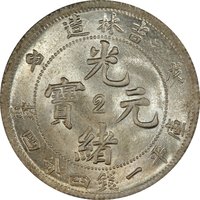
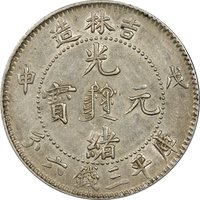
Description:
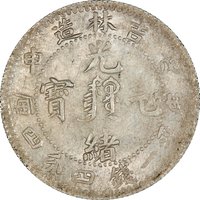
Manchu words flanked by Chinese characters, all arranged vertically, right to left.
Inscription:
造林吉
申戊
光
寶 ᡩᠠᡳᠴᡳᠩ ᡤᡠᡵᡠᠨ 元
緒
分二錢七平庫
申戊
光
寶 ᡩᠠᡳᠴᡳᠩ ᡤᡠᡵᡠᠨ 元
緒
分二錢七平庫
Translation:
Zao Lin Ji
Shen Wu
Guang
[Manchu: Daicing Gurun] Great Qing Dynasty Yuan
Xu
Fen Er Qian Qi Ping Ku
Shen Wu
Guang
[Manchu: Daicing Gurun] Great Qing Dynasty Yuan
Xu
Fen Er Qian Qi Ping Ku
Scripts: Chinese, Mongolian / Manchu
Languages: Manchu, Classical Chinese
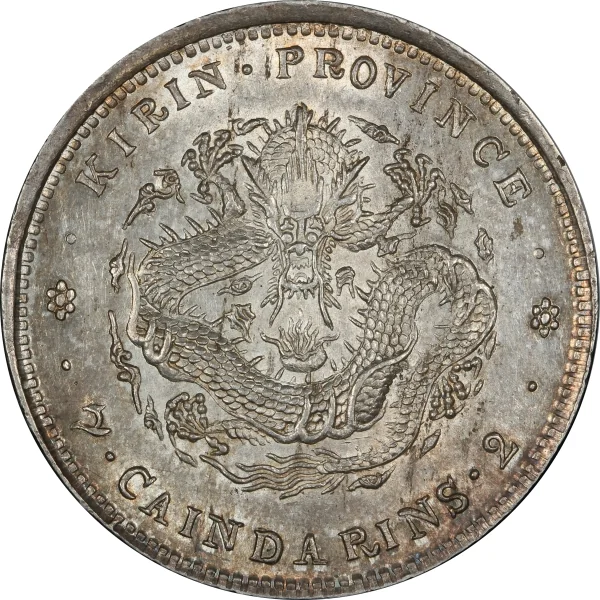
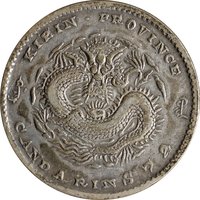
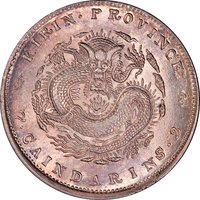
Reverse
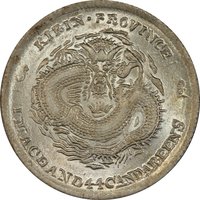
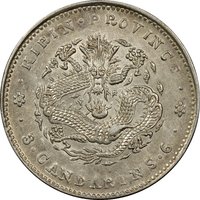
Description:
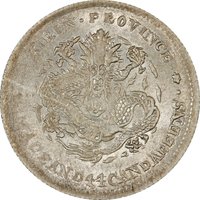
Dragon encircling a pearl, surrounded by English text.
Inscription:
KIRIN PROVINCE
7 CAINARDINS 2
7 CAINARDINS 2
Script: Latin
Edge
Reeded.
Categories
| Mythology> Fantastic animal |
Mintings
| Year | Mint Mark | Mintage | Quality | Collection |
|---|---|---|---|---|
| 1908 | — | — |
Historical background
In 1908, Kirin Province (present-day Jilin, China) existed within a complex and fragmented monetary landscape, characteristic of the late Qing Dynasty's waning years. The province did not have a unified currency; instead, circulation was a chaotic mix of traditional Chinese coinage, foreign silver dollars, and privately issued notes. The official currency was the silver tael, a unit of weight rather than a minted coin, leading to inconsistencies as the tael's exact weight and purity varied between regions and even individual banks. Alongside these, Mexican Silver Dollars, Japanese Yen, and Russian Rubles circulated freely, especially in northern areas influenced by the Russian-controlled Chinese Eastern Railway and growing Japanese commercial interests in southern Manchuria.
This monetary disorder was exacerbated by the widespread issuance of tiao-piao (exchange notes) or ch’ien-p’iao (cash notes) by local native banks, pawnshops, and even large merchants. These privately issued paper notes, theoretically redeemable for copper cash or silver, provided essential liquidity but were highly unstable. Their value depended entirely on the credibility of the issuer, leading to frequent defaults, counterfeiting, and localized inflation. The provincial government itself struggled to assert monetary authority, and the imperial court's efforts at centralization, including the establishment of the Ta-Ch’ing Bank (precursor to the Bank of China) in 1905, had yet to consolidate control in this frontier region.
The currency situation in Kirin in 1908 thus reflected the broader political and economic vulnerabilities of the Qing state. It was a system marked by competing sovereignties, where foreign economic powers and local private interests held more practical monetary power than the distant central government. This financial instability hindered commercial development, complicated tax collection, and created an environment ripe for exploitation, foreshadowing the greater turmoil that would engulf the region following the dynasty's collapse just three years later.
This monetary disorder was exacerbated by the widespread issuance of tiao-piao (exchange notes) or ch’ien-p’iao (cash notes) by local native banks, pawnshops, and even large merchants. These privately issued paper notes, theoretically redeemable for copper cash or silver, provided essential liquidity but were highly unstable. Their value depended entirely on the credibility of the issuer, leading to frequent defaults, counterfeiting, and localized inflation. The provincial government itself struggled to assert monetary authority, and the imperial court's efforts at centralization, including the establishment of the Ta-Ch’ing Bank (precursor to the Bank of China) in 1905, had yet to consolidate control in this frontier region.
The currency situation in Kirin in 1908 thus reflected the broader political and economic vulnerabilities of the Qing state. It was a system marked by competing sovereignties, where foreign economic powers and local private interests held more practical monetary power than the distant central government. This financial instability hindered commercial development, complicated tax collection, and created an environment ripe for exploitation, foreshadowing the greater turmoil that would engulf the region following the dynasty's collapse just three years later.
✨ Legendary