

20 jiao – Fukien Province
Add to wishlist
China
Context
Year: 1924
Chinese republican Year:: 13
Country: China
Issuer: Fukien Province
Period:
(1912—1949)
Currency:
(1896—1949)
Demonetized: Yes
Material
References
Y: #
Numista: #274714
Value
Bullion value: $14.23
Obverse
Description:
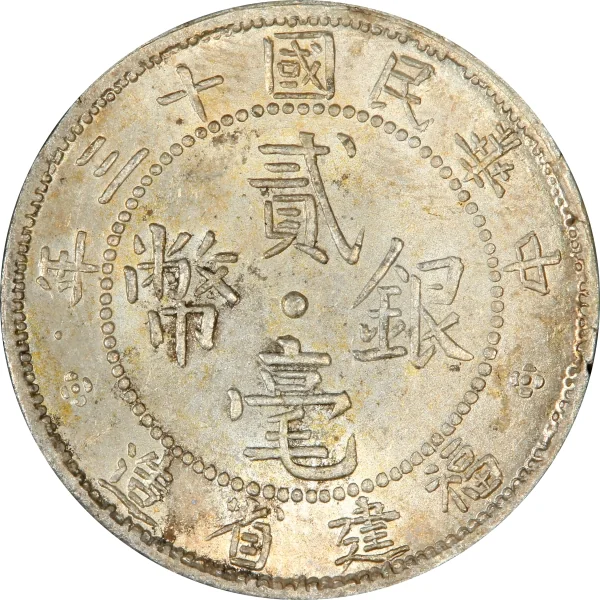
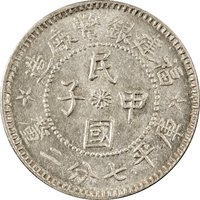
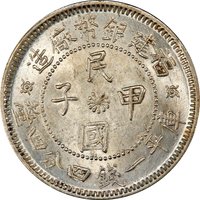
Four ideograms read vertically, right to left, encircled by more characters.
Inscription:
年三十國民華中
貳
幣銀
毫
造省建福
貳
幣銀
毫
造省建福
Translation:
THIRTIETH YEAR OF THE REPUBLIC OF CHINA
TWO
SILVER COIN
10 CENTS
MINTED BY FUJIAN PROVINCE
TWO
SILVER COIN
10 CENTS
MINTED BY FUJIAN PROVINCE
Language: Chinese
Reverse
Description:
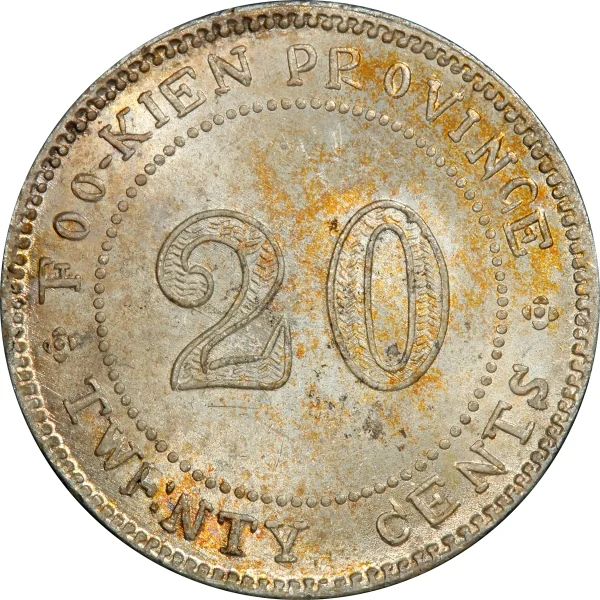
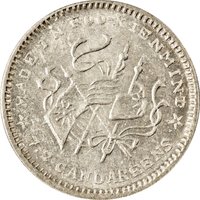
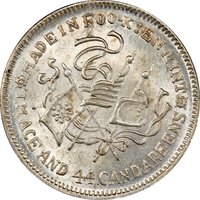
Value with English legend.
Inscription:
FOO-KIEN PROVINCE
20
TWENTY CENTS
20
TWENTY CENTS
Edge
Reeded.
Mintings
| Year | Mint Mark | Mintage | Quality | Collection |
|---|---|---|---|---|
| 1924 | — | — |
Historical background
In 1924, the currency situation in Fukien (Fujian) Province was chaotic and fragmented, reflecting the broader political disintegration of China during the Warlord Era. The province was under the unstable control of the Fujian Clique, led by Sun Chuanfang, who operated with significant autonomy from the weak central government in Beijing. This political fragmentation directly translated into monetary disorder, as multiple authorities issued currency without unified backing or regulation. The primary circulating mediums included silver dollars (yuan), copper coins, and a vast array of paper notes issued not only by provincial banks but also by local military commanders, commercial banks, and even large merchant firms.
The most prominent official currency was the note issued by the Bank of China and the Bank of Communications, which theoretically carried national credibility. However, their value and acceptance were inconsistent. More pervasive in daily trade were the notes issued by the Fujian Provincial Bank, established in 1920, and the flood of military scrip issued by local warlords to fund their armies. These local notes were often over-issued, inadequately reserved, and subject to rapid depreciation. The result was a hierarchy of currencies where notes from stronger, more reputable banks traded at a premium, while notes from minor military commanders might be heavily discounted or refused outside their immediate area of control.
This monetary patchwork created severe hardships for merchants and the populace, who faced constant uncertainty about the value of their money and the risk of holding notes that could become worthless overnight. Counterfeiting was rampant, and exchange rates between silver, copper, and the various paper issues fluctuated wildly. The system stifled economic development and inter-regional trade within the province. Ultimately, the currency chaos of 1924 was a direct symptom of Fukien's lack of political unity, demonstrating how warlordism corroded the very foundations of a modern integrated economy.
The most prominent official currency was the note issued by the Bank of China and the Bank of Communications, which theoretically carried national credibility. However, their value and acceptance were inconsistent. More pervasive in daily trade were the notes issued by the Fujian Provincial Bank, established in 1920, and the flood of military scrip issued by local warlords to fund their armies. These local notes were often over-issued, inadequately reserved, and subject to rapid depreciation. The result was a hierarchy of currencies where notes from stronger, more reputable banks traded at a premium, while notes from minor military commanders might be heavily discounted or refused outside their immediate area of control.
This monetary patchwork created severe hardships for merchants and the populace, who faced constant uncertainty about the value of their money and the risk of holding notes that could become worthless overnight. Counterfeiting was rampant, and exchange rates between silver, copper, and the various paper issues fluctuated wildly. The system stifled economic development and inter-regional trade within the province. Ultimately, the currency chaos of 1924 was a direct symptom of Fukien's lack of political unity, demonstrating how warlordism corroded the very foundations of a modern integrated economy.
✨ Legendary