Logo Title
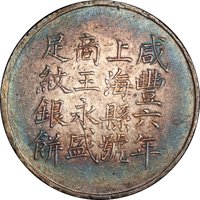
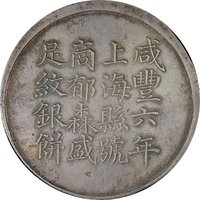
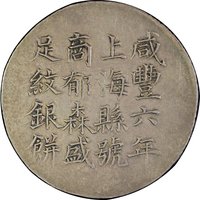
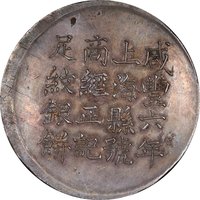
obverse
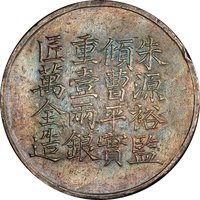
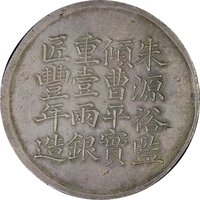
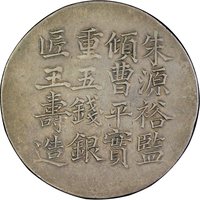
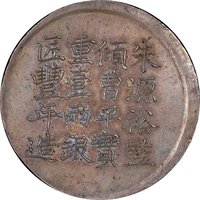
reverse
PCGS
Context
Year: 1856
Country: China Country flag
Ruler: Xianfeng
Currency:
(since 1856)
Demonetized: Yes
Material
Weight: 36.7 g
Silver weight: 36.70 g
Shape: Round
Composition: Silver
Magnetic: No
Alignment: Medal alignment
Obverse
OBVERSE ↑
flip
Reverse
REVERSE ↑
References
Numista: #274616
Value
Bullion value: $103.81

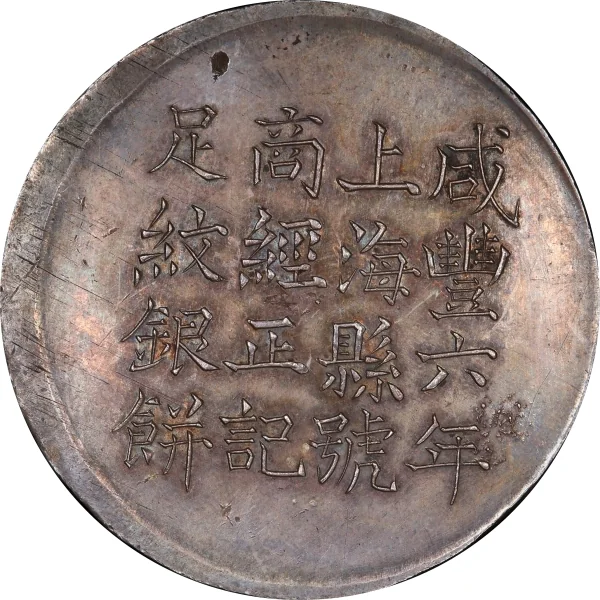
Obverse

Description:
Four columns of four characters each, read right to left.
Inscription:
足商上咸

紋經海豐

銀正縣六

餅記號年
Translation:
Shangxian Foot Merchant Tonghai Feng Silver Cake, Zhengyi County, Sixth Year.
Script: Chinese
Language: Chinese
Engraver: Feng-nien

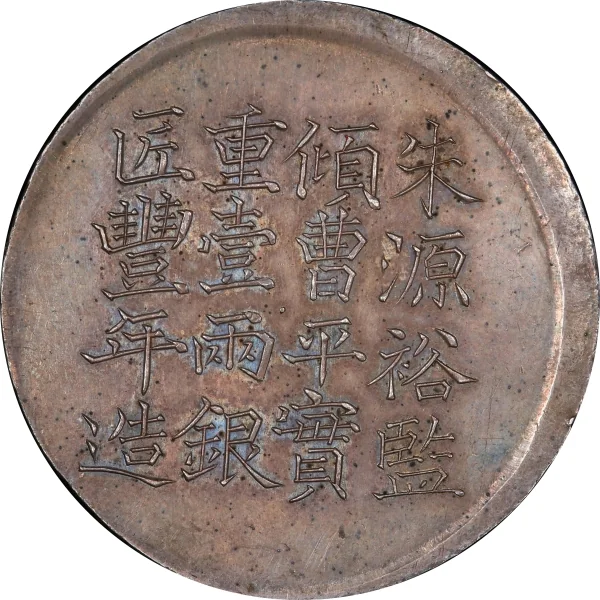
Reverse

Description:
Four columns of four characters each, read right to left.
Inscription:
匠重傾朱

豐壹曹源

年兩平裕

造銀實監
Translation:
Cast in the second year of the Qianlong era,
by the Board of Revenue,
pure silver,
one tael,
by the artisan Zhu Zhongqing.
The Board of Works supervises the reliable source.
Script: Chinese
Engraver: Feng-nien

Edge

Mintings

YearMint MarkMintageQualityCollection
1856

Historical background

In 1856, Shanghai's currency situation was a complex and volatile reflection of the city's unique status as a treaty port. Following the 1842 Treaty of Nanjing, the city was divided into foreign-controlled concessions and the traditional Chinese city. This political fragmentation led to a parallel monetary fragmentation. The primary circulating mediums were silver sycee (taels) by weight for large transactions and copper-alloy cash coins (wen) for daily small trade, but their exchange rates fluctuated wildly based on purity, weight, and local demand. Furthermore, a profusion of privately minted "sycee shoes" from different native banks (qianzhuang) and varying local tael standards (like the Shanghai tael or Jiuping tael) created a bewildering landscape for commerce, ripe for arbitrage and confusion.

Complicating this further was the increasing influx of foreign silver coins, most notably the Spanish Carolus dollar and the newer Mexican "eagle" dollar, which circulated widely due to their standardized weight and fineness. These coins were often preferred for inter-port trade and were frequently "chopmarked" by Chinese merchants to guarantee their authenticity, adding another layer of verification to transactions. The foreign banks, established in the concessions, began to issue their own paper notes, denominated in dollars, which added a modern but unstable credit instrument into the mix. This created a multi-tiered system where large international trade was conducted in silver dollars, regional trade in silver taels, and local wages and goods in copper cash, with no fixed exchange between them.

The inherent instability of this system was a constant source of friction and financial risk. Exchange rates between silver and copper were particularly sensitive, often manipulated by powerful qianzhuang or influenced by seasonal agricultural tax payments, which required peasants to convert copper to silver. This environment necessitated a sophisticated network of money changers and native banks to facilitate trade, but it also made Shanghai vulnerable to shocks. Speculation, counterfeit coins, and the sheer complexity of calculations acted as a drag on commerce, highlighting the pressing need for the standardized currency and banking reforms that would begin to emerge in the coming decades.

Series: 1856 City of Shanghai circulation coins

1 Tael obverse
1 Tael reverse
1 Tael
1856
1 Tael obverse
1 Tael reverse
1 Tael
1856
1 Tael obverse
1 Tael reverse
1 Tael
1856
1 Tael obverse
1 Tael reverse
1 Tael
1856
5 Mace obverse
5 Mace reverse
5 Mace
1856
5 Mace obverse
5 Mace reverse
5 Mace
1856
5 Mace obverse
5 Mace reverse
5 Mace
1856
Legendary