

2 Jiao – Republic of China
China
Context
Years: 1914–1920
Country: China 
Issuer: Republic of China
Period:
(1912—1949)
Currency:
(1912—1948)
Demonetized: Yes
Material
References
Y: #Click to copy to clipboard327
Numista: #27398
Value
Bullion value: $10.75
Obverse
Description:
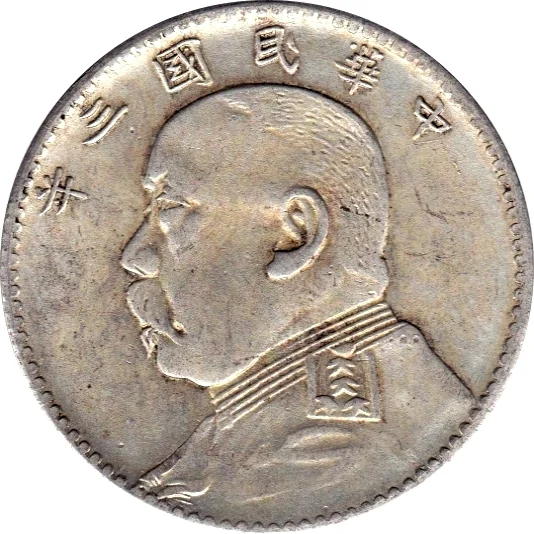
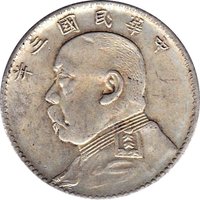
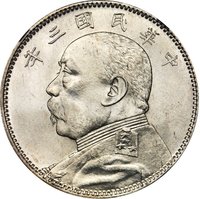
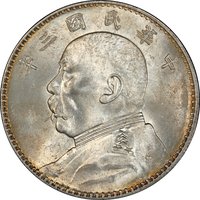
Yuan Shikai bust facing left, Chinese characters above.
Inscription:
年三國民華中
Translation:
Year 3 of the Republic of China
Script: Chinese
Language: Chinese
Engraver: Luigi Giorgi
Reverse
Description:
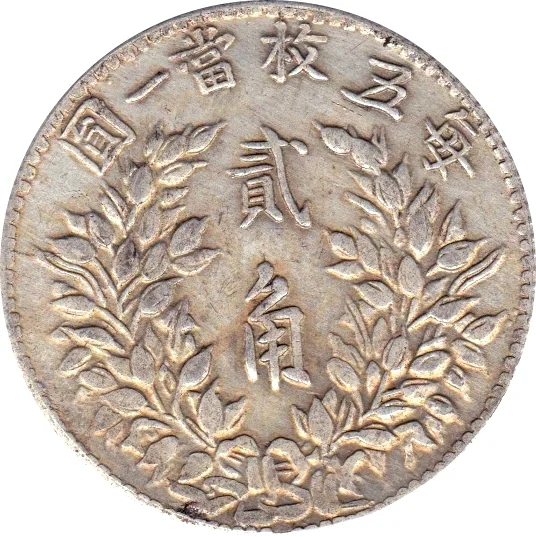
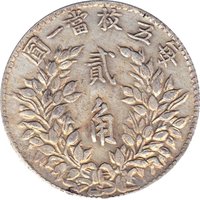
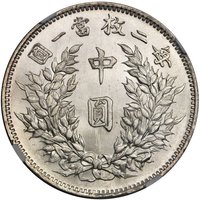
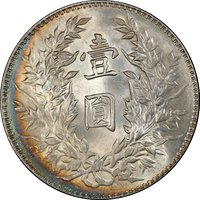
Chinese ideograms in wreath, more above.
Inscription:
圓一當枚五每
貳
角
貳
角
Translation:
One yuan equals five pieces, two jiao each.
Script: Chinese
Language: Chinese
Engraver: Luigi Giorgi
Edge
Reeded.
Categories
| Person> Politician |
| Mustache/Beard |
| Symbol> Wreath |
Mintings
| Year | Mint Mark | Mintage | Quality | Collection |
|---|---|---|---|---|
| 1914 | — | — | ||
| 1916 | — | — | ||
| 1920 | — | — |
Historical background
In 1914, the Republic of China, under the nascent presidency of Yuan Shikai, faced a profoundly complex and fragmented currency situation. The country lacked a unified national monetary system, a legacy of the fallen Qing dynasty and the ensuing regional instability following the 1911 Revolution. The monetary landscape was a chaotic mix of traditional silver sycee (measured in taels), various silver and copper coinages from Chinese and foreign mints, and a proliferation of paper notes issued by multiple entities. These included the Central Government’s Bank of China and Bank of Communications, provincial banks, private commercial banks, and even foreign banks operating within the treaty ports. This multiplicity led to wildly fluctuating exchange rates between different forms of money, crippling domestic trade and central government fiscal authority.
The primary unit of account for large transactions remained the silver tael, but its weight and purity varied from region to region, with distinct standards like the Shanghai tael and the Kuping tael. For everyday use, a dizzying array of silver dollars (like the Mexican "Eagle" dollar, the British trade dollar, and emerging Chinese yuan coins) and copper cash coins circulated, their value subject to local acceptance and speculation. Crucially, the paper notes issued by many institutions were not always fully convertible to silver, leading to frequent discounts and loss of public confidence. This environment facilitated arbitrage and hampered the central government's ability to collect taxes and administer its finances effectively, as revenues were collected in a myriad of local forms.
Recognizing this monetary chaos as a threat to national consolidation and modern state-building, the Yuan Shikai government made a significant attempt at reform in 1914 with the promulgation of the "National Currency Act." This law aimed to establish a new standard silver dollar, the Yuan Shikai Dollar (featuring the President's portrait), as the unified national currency. It defined a pure silver standard, with the dollar to be minted by the central government's Tianjin Mint. While this coin would eventually become one of the most famous and widely circulated in Chinese history, its impact in 1914 was limited. The government's political and military weaknesses prevented immediate, nationwide enforcement, and the entrenched systems of local notes and sycee continued to dominate for years. Thus, 1914 represents a pivotal but transitional moment—a year of official recognition of the currency crisis and a legislative attempt at unification, yet still mired in the tangible reality of profound monetary disarray.
The primary unit of account for large transactions remained the silver tael, but its weight and purity varied from region to region, with distinct standards like the Shanghai tael and the Kuping tael. For everyday use, a dizzying array of silver dollars (like the Mexican "Eagle" dollar, the British trade dollar, and emerging Chinese yuan coins) and copper cash coins circulated, their value subject to local acceptance and speculation. Crucially, the paper notes issued by many institutions were not always fully convertible to silver, leading to frequent discounts and loss of public confidence. This environment facilitated arbitrage and hampered the central government's ability to collect taxes and administer its finances effectively, as revenues were collected in a myriad of local forms.
Recognizing this monetary chaos as a threat to national consolidation and modern state-building, the Yuan Shikai government made a significant attempt at reform in 1914 with the promulgation of the "National Currency Act." This law aimed to establish a new standard silver dollar, the Yuan Shikai Dollar (featuring the President's portrait), as the unified national currency. It defined a pure silver standard, with the dollar to be minted by the central government's Tianjin Mint. While this coin would eventually become one of the most famous and widely circulated in Chinese history, its impact in 1914 was limited. The government's political and military weaknesses prevented immediate, nationwide enforcement, and the entrenched systems of local notes and sycee continued to dominate for years. Thus, 1914 represents a pivotal but transitional moment—a year of official recognition of the currency crisis and a legislative attempt at unification, yet still mired in the tangible reality of profound monetary disarray.
🌟 Uncommon