

1 Yuan – Republic of China
Circulating commemorative coins
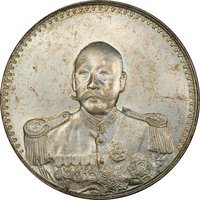
Commemoration: Inauguration of President Xu Shichang
China
Context
Year: 1921
Chinese republican Year: 10
Country: China 
Issuer: Republic of China
Period:
(1912—1949)
Currency:
(1912—1948)
Subdivision: 1 Yuan = 1 Dollar
Demonetized: Yes
Material
References
Y: #Click to copy to clipboard–
Numista: #27330
Value
Bullion value: $75.80
Obverse
Description:
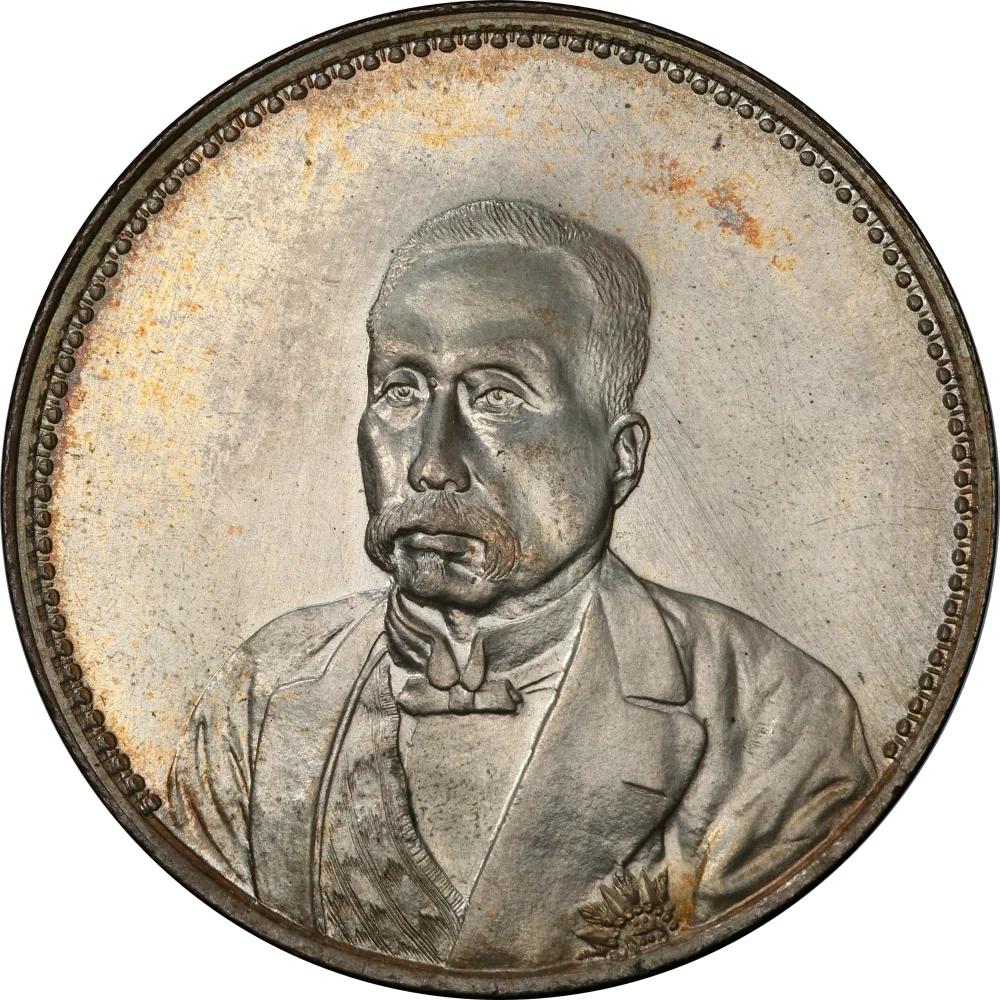
Bust of Xu Shichang, facing left.
Reverse
Description:
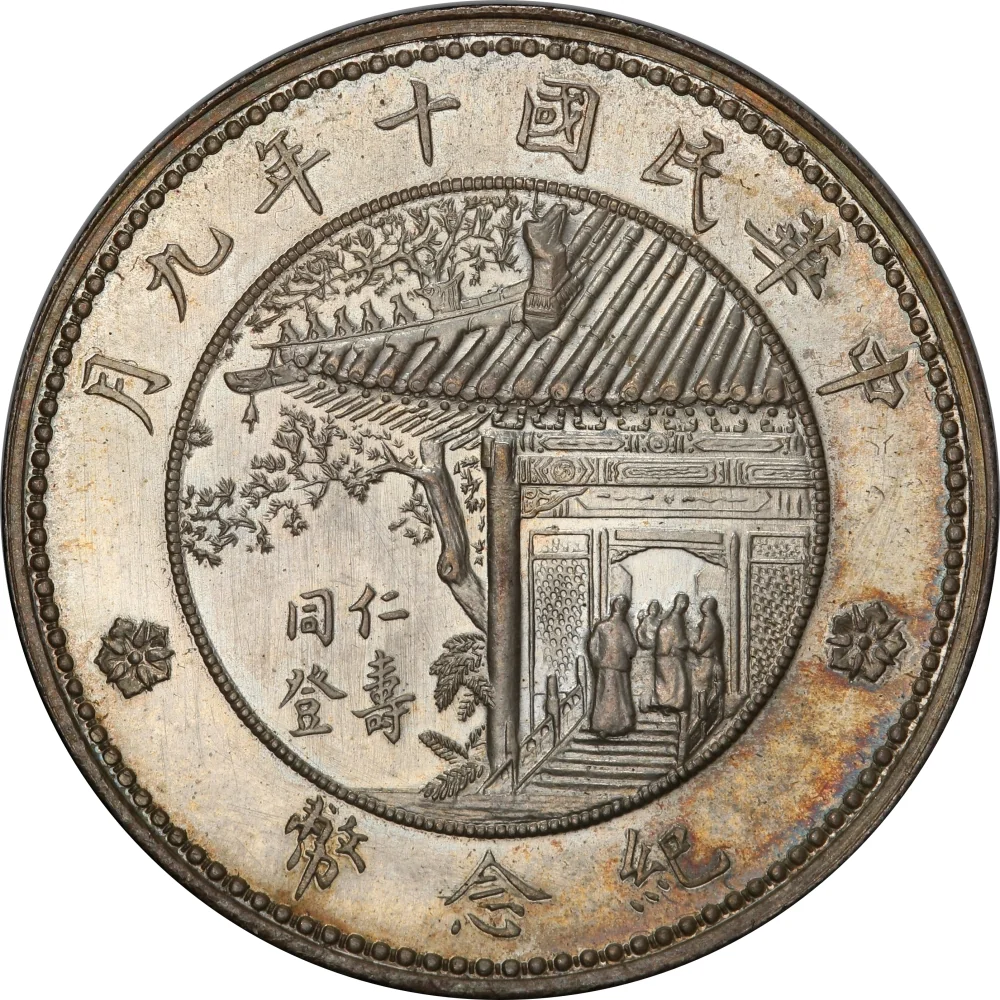
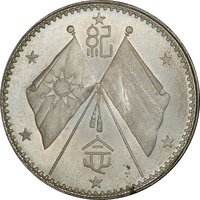
A pavilion entrance with a tree, flanked by Chinese ideograms.
Inscription:
月九年十國民華中
同仁
登壽
幣念紀
同仁
登壽
幣念紀
Translation:
REPUBLIC OF CHINA
19th YEAR, 9th MONTH
TONG REN
DENG SHOU
COMMEMORATIVE COIN
19th YEAR, 9th MONTH
TONG REN
DENG SHOU
COMMEMORATIVE COIN
Language: Chinese
Edge
Reeded or smooth.
Categories
| Building> Palace |
| Person> Politician |
| Mustache/Beard |
| Plant> Tree |
Mintings
| Year | Mint Mark | Mintage | Quality | Collection |
|---|---|---|---|---|
| 1921 | — | — |
Historical background
In 1921, the currency situation in the Republic of China was one of profound and destabilizing complexity, characterized by a fragmented and multi-layered monetary system. The central government in Beijing, its authority weakened by warlordism and political disunity, could not enforce a uniform national currency. Consequently, the monetary landscape was a chaotic patchwork of various mediums of exchange. These included silver sycee (taels), imperial-era copper coins, a plethora of banknotes from both modern commercial banks and provincial warlord regimes, and even foreign currencies like the Mexican Silver Dollar and the Japanese Yen in treaty ports. The lack of a strong central bank and the practice of banks and military governors issuing unbacked notes to finance their operations led to severe inflation in many regions and a complete erosion of public trust in paper money.
This fragmentation was exacerbated by the continued reliance on silver, both in coin and bullion form, which served as the only universally accepted value standard amidst the paper chaos. Transactions often required cumbersome conversions between tael units (based on weight and purity) and dollar units (based on coin count), creating inefficiency and opportunities for arbitrage. The exchange rates between the various notes, coins, and bullion fluctuated wildly from one city to another, depending on the political and military fortunes of the local authorities who issued them. This environment severely hampered inter-regional trade and economic development, as merchants faced significant uncertainty and transaction costs.
The year 1921 fell within a broader period of monetary transition that would eventually lead to the Shanghai-based banking community attempting to impose order through the tael as a unit of account, while the public increasingly used silver dollars for daily transactions. It was a system on the brink, highlighting the fundamental link between political unity and monetary stability. The chaos of 1921 set the stage for the eventual monetary reforms later in the decade and under the Nanjing Government, which sought to abolish the tael and establish a unified, managed currency system, though with limited immediate success against the entrenched forces of regionalism and silver-based tradition.
This fragmentation was exacerbated by the continued reliance on silver, both in coin and bullion form, which served as the only universally accepted value standard amidst the paper chaos. Transactions often required cumbersome conversions between tael units (based on weight and purity) and dollar units (based on coin count), creating inefficiency and opportunities for arbitrage. The exchange rates between the various notes, coins, and bullion fluctuated wildly from one city to another, depending on the political and military fortunes of the local authorities who issued them. This environment severely hampered inter-regional trade and economic development, as merchants faced significant uncertainty and transaction costs.
The year 1921 fell within a broader period of monetary transition that would eventually lead to the Shanghai-based banking community attempting to impose order through the tael as a unit of account, while the public increasingly used silver dollars for daily transactions. It was a system on the brink, highlighting the fundamental link between political unity and monetary stability. The chaos of 1921 set the stage for the eventual monetary reforms later in the decade and under the Nanjing Government, which sought to abolish the tael and establish a unified, managed currency system, though with limited immediate success against the entrenched forces of regionalism and silver-based tradition.
✨ Legendary