

10 cash – South Xinjiang
Add to wishlist
China
Context
Years: 1907–1908
Country: China
Issuer: South Xinjiang
Ruler: Guangxu
Currency:
(1759—1909)
Demonetized: Yes
Material
Diameter: 25 mm
Shape: Round with a square hole
Composition: Copper
Magnetic: No
Technique: Cast
Alignment: Medal alignment
flip
References
Numista: #272755
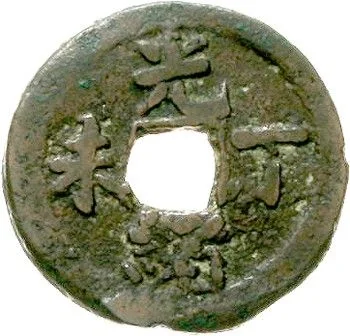
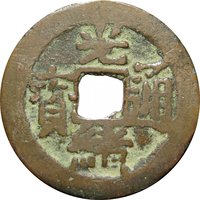
Obverse
Description:
Four Chinese characters read vertically, right to left.
Inscription:
光
未 丁
緒
未 丁
緒
Translation:
Kuang-Hsu, Ting-Wei.
Scripts: Chinese (traditional, regular script)
Language: Chinese
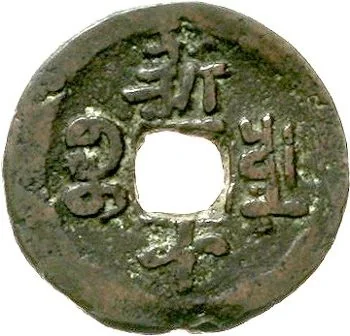
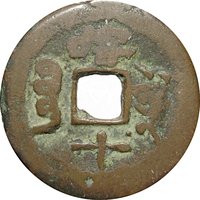
Reverse
Description:
One Chinese ideogram above and below, one Manchu word left and right.
Inscription:
庫
ᠪᠣᠣ ᡴᡠᠴᠠ
十
ᠪᠣᠣ ᡴᡠᠴᠠ
十
Translation:
Treasury
Boo Kuqa
Ten
Boo Kuqa
Ten
Languages: Manchu, Classical Chinese
Edge
Plain
Mints
| Name | Mark |
|---|---|
| Kucha Mint | — |
Mintings
| Year | Mint Mark | Mintage | Quality | Collection |
|---|---|---|---|---|
| 1907 | — | — | ||
| 1908 | — | — |
Historical background
In 1907, the currency situation in South Xinjiang (the Tarim Basin region) was characterized by profound complexity and instability, a direct legacy of the area's position at the crossroads of empires. Following the Qing reconquest of the region from Yakub Beg's state in the late 1870s, the monetary system was a fragmented mix of old and new. Officially, the imperial currency system based on silver taels and copper cash coins was in place, but in practice, these circulated alongside a vast array of local and historical coins. These included heavily debased Qing red cash coins from the Kashgar mint, older pul coins from various oasis cities, and even remnants of Yaqub Beg's coinage, all with fluctuating and locally determined exchange rates.
This monetary chaos was exacerbated by the region's economic ties to British India and Tsarist Russia, whose own currencies exerted strong influence. Russian gold rubles and silver tsarist roubles, alongside British Indian rupees, were widely used for substantial trade, particularly in cities like Kashgar and Yarkand. These foreign coins, seen as more reliable stores of value than the debased local issues, further undermined the Qing's monetary authority. The result was a multi-tiered system where large transactions used silver or foreign coin, small daily purchases used mixed bundles of local copper, and exchange was the domain of money-changers (sarraf) who took significant commissions.
The situation posed a serious administrative and economic challenge for the late Qing authorities, who were struggling to maintain control. The confusion in currency hindered tax collection, facilitated corruption, and disrupted inter-oasis trade. While efforts were made to standardize coinage, the central government's weakness, combined with the region's physical remoteness and powerful foreign economic interests, prevented any effective reform. Thus, in 1907, the monetary landscape remained a tangible reflection of South Xinjiang's contested sovereignty and its uneasy integration into the Qing state just years before the dynasty's collapse.
This monetary chaos was exacerbated by the region's economic ties to British India and Tsarist Russia, whose own currencies exerted strong influence. Russian gold rubles and silver tsarist roubles, alongside British Indian rupees, were widely used for substantial trade, particularly in cities like Kashgar and Yarkand. These foreign coins, seen as more reliable stores of value than the debased local issues, further undermined the Qing's monetary authority. The result was a multi-tiered system where large transactions used silver or foreign coin, small daily purchases used mixed bundles of local copper, and exchange was the domain of money-changers (sarraf) who took significant commissions.
The situation posed a serious administrative and economic challenge for the late Qing authorities, who were struggling to maintain control. The confusion in currency hindered tax collection, facilitated corruption, and disrupted inter-oasis trade. While efforts were made to standardize coinage, the central government's weakness, combined with the region's physical remoteness and powerful foreign economic interests, prevented any effective reform. Thus, in 1907, the monetary landscape remained a tangible reflection of South Xinjiang's contested sovereignty and its uneasy integration into the Qing state just years before the dynasty's collapse.

✨ Legendary