

10 Cash – Fengtien Province
China
Context
Years: 1903–1906
Country: China 
Issuer: Fengtien Province
Ruler: Guangxu
Currency:
(1897—1931)
Demonetized: Yes
Total mintage: 35,036,000
Material
References
Y: #Click to copy to clipboard89
Numista: #25780
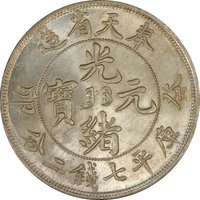
Obverse
Description:
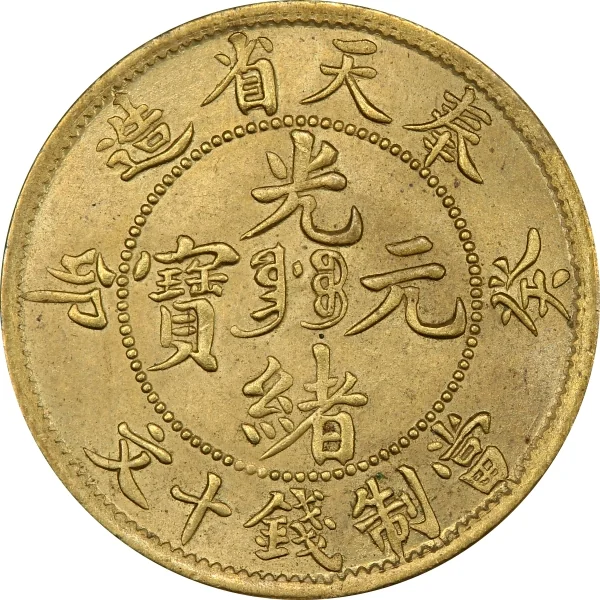
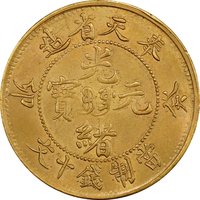
Chinese ideograms top to bottom, right to left, with central Manchu text, all encircled by more Chinese characters.
Inscription:
造省天奉
卯癸
光
寶 ᡶᡠᠩ ᠪᠣᠣ 元
緒
文十錢制當
卯癸
光
寶 ᡶᡠᠩ ᠪᠣᠣ 元
緒
文十錢制當
Translation:
Provincial Bureau of Tianfeng
Mao Gui
Guang
Treasure Fung Boo Dollar
Xu
Wen Ten-Coin System Equivalent
Mao Gui
Guang
Treasure Fung Boo Dollar
Xu
Wen Ten-Coin System Equivalent
Scripts: Chinese, Mongolian / Manchu
Language: Chinese
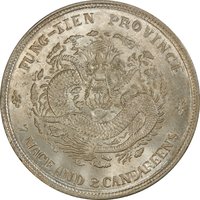
Reverse
Description:
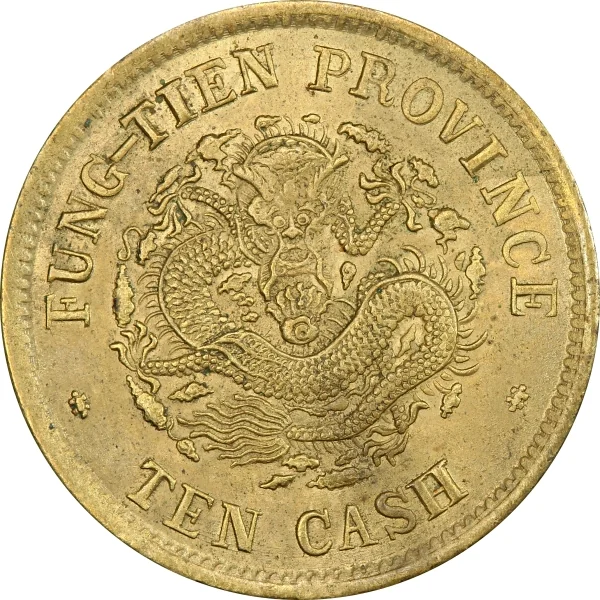
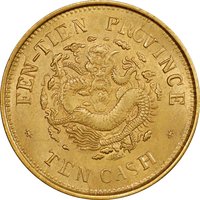
Dragon encircling a pearl, surrounded by English text.
Inscription:
FUNG-TIEN PROVINCE
TEN CASH
TEN CASH
Script: Latin
Edge
Plain
Categories
| Mythology> Fantastic animal |
Mintings
| Year | Mint Mark | Mintage | Quality | Collection |
|---|---|---|---|---|
| 1903 | — | — | ||
| 1904 | — | — | ||
| 1905 | — | — | ||
| 1906 | — | 35,036,000 |
Historical background
In 1903, the currency situation in Fengtien Province (modern Liaoning) was a complex and turbulent reflection of the region's contested sovereignty and rapid economic change. As the political and commercial hub of Manchuria, Fengtien was under the nominal authority of China's Qing Dynasty, but was increasingly dominated by foreign interests following the aftermath of the First Sino-Japanese War (1894-95) and the Boxer Rebellion (1899-1901). Russian influence was particularly strong due to the terms of the Li-Lobanov Treaty and the presence of the Russian-controlled Chinese Eastern Railway, which introduced the silver-based Russian ruble as a major circulating medium alongside Japan's yen. This foreign competition occurred against a backdrop of a weakened Qing monetary system, where the primary official currency, the silver tael (a unit of weight, not a coin), was unstable and fragmented into various local standards.
The domestic currency landscape was chaotic, characterized by a bewildering multiplicity of notes and coins. Official Qing minted silver yuan and copper cash coins circulated, but were often insufficient. This led to a proliferation of privately issued tiao or diao notes, denominated in strings of copper cash, issued by local banks (qianzhuang), pawnshops, and even merchants. These notes were of highly variable credibility, leading to frequent discounts and counterfeiting. Furthermore, the provincial government itself issued its own official paper notes, known as Fengpiao (Fengtien bills), in an attempt to establish control and fund its operations. However, without sufficient silver reserves and in a climate of political uncertainty, these notes were prone to severe depreciation, creating confusion and eroding public trust.
This monetary fragmentation severely hampered trade and daily life, forcing merchants and the public to navigate a precarious system of exchange rates between silver, copper, foreign coins, and various paper issues. The instability was a direct symptom of the wider "Scramble for Concessions" in Manchuria, with Russia and Japan vying for economic and military control. The currency chaos of 1903 would soon be violently exacerbated by the outbreak of the Russo-Japanese War (1904-05), fought largely on Fengtien's soil, which would further destabilize the monetary system and pave the way for increased Japanese financial dominance in the province in the following years.
The domestic currency landscape was chaotic, characterized by a bewildering multiplicity of notes and coins. Official Qing minted silver yuan and copper cash coins circulated, but were often insufficient. This led to a proliferation of privately issued tiao or diao notes, denominated in strings of copper cash, issued by local banks (qianzhuang), pawnshops, and even merchants. These notes were of highly variable credibility, leading to frequent discounts and counterfeiting. Furthermore, the provincial government itself issued its own official paper notes, known as Fengpiao (Fengtien bills), in an attempt to establish control and fund its operations. However, without sufficient silver reserves and in a climate of political uncertainty, these notes were prone to severe depreciation, creating confusion and eroding public trust.
This monetary fragmentation severely hampered trade and daily life, forcing merchants and the public to navigate a precarious system of exchange rates between silver, copper, foreign coins, and various paper issues. The instability was a direct symptom of the wider "Scramble for Concessions" in Manchuria, with Russia and Japan vying for economic and military control. The currency chaos of 1903 would soon be violently exacerbated by the outbreak of the Russo-Japanese War (1904-05), fought largely on Fengtien's soil, which would further destabilize the monetary system and pave the way for increased Japanese financial dominance in the province in the following years.
⭐ Rare