

5 sen – Japan
Add to wishlist
Japan
Context
Material
Diameter: 20.6 mm
Weight: 4.7 g
Thickness: 1.83 mm
Shape: Round
Composition: Copper-nickel
Technique: Milled
Alignment: Coin alignment
flip
References
Y: #
Numista: #10871
Value
Exchange value: 0.05 JPY
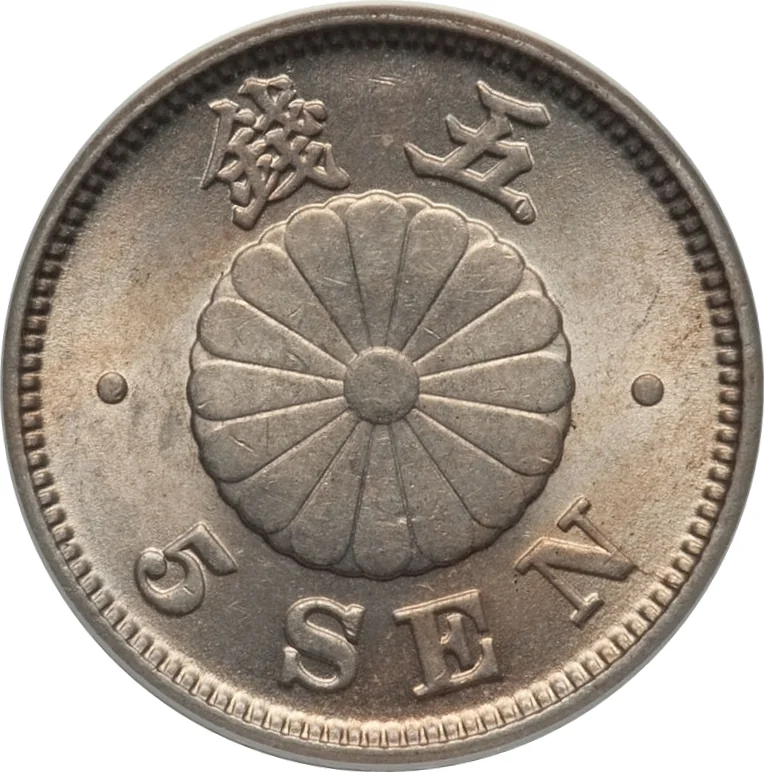
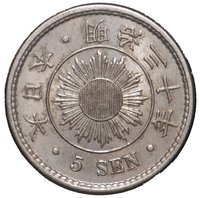
Obverse
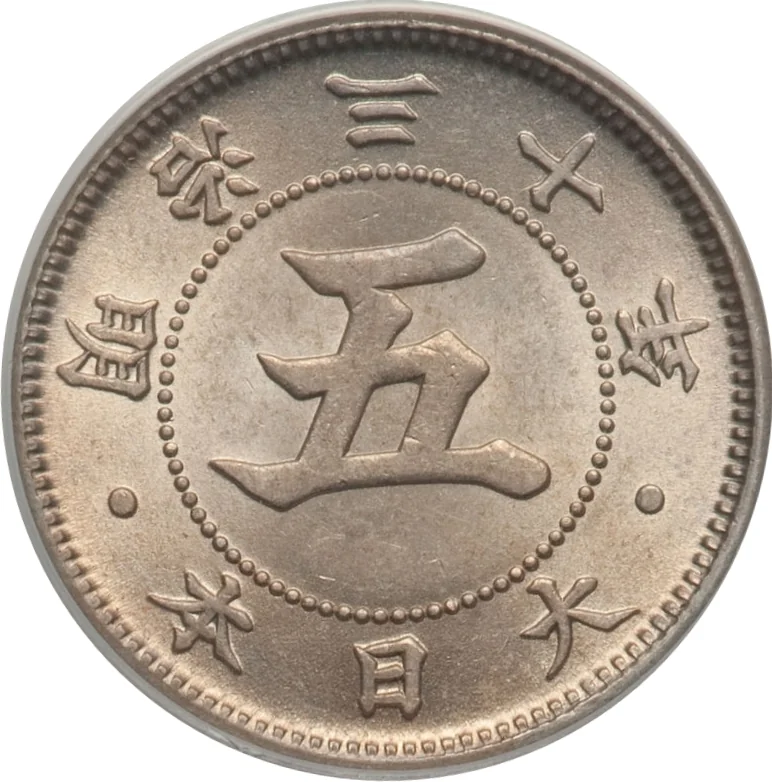
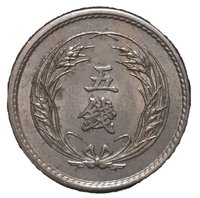
Reverse
Description:
Central value, encircled by legends.
Inscription:
年 十 三 治 明
五
· 本 日 大 ·
五
· 本 日 大 ·
Translation:
Thirteenth year of the Meiji era.
Large Japanese (coin)
Large Japanese (coin)
Language: Classical Chinese
Edge
Plain
Categories
| Plants> Flower |
| Symbols> Coat of Arms |
Mints
| Name | Mark |
|---|---|
| Japan Mint | — |
Mintings
| Year | Mint Mark | Mintage | Quality | Collection |
|---|---|---|---|---|
| 1889 | — | 28,841,944 | ||
| 1890 | — | 39,258,103 | ||
| 1891 | — | 15,924,782 | ||
| 1892 | — | 9,510,289 | ||
| 1893 | — | 8,531,858 | ||
| 1894 | — | 14,680,000 | ||
| 1895 | — | 1,030,000 | ||
| 1896 | — | 5,119,988 | ||
| 1897 | — | 7,857,669 |
Historical background
In 1889, Japan's currency system was in the final stages of a profound and successful transformation, moving from a complex, feudal-era monetary chaos to a modern, unified system based on the gold standard. Following the Meiji Restoration of 1868, the new government faced severe monetary disorder, with a mix of clan notes, gold, silver, and copper coins all circulating at fluctuating values. To enable industrialization and secure international credibility, the government enacted the New Currency Act of 1871, establishing the yen (¥) as the new decimal unit, theoretically on a bimetallic (gold and silver) standard. However, the rapid issuance of convertible notes to finance development led to severe inflation, prompting a period of painful fiscal retrenchment in the 1880s under Finance Minister Masayoshi Matsukata.
By 1889, the key achievement was the establishment of a true gold standard, which was formally adopted in 1897 but effectively operationalized through the policies of the preceding decade. The Matsukata Deflation of the early 1880s had restored the value of paper currency to parity with silver, and the Bank of Japan (founded in 1882) had gained a monopoly on note issue, creating a stable and trusted currency. This stability was crucial for Japan's ambitions, as it facilitated foreign borrowing for infrastructure and military expansion, and integrated Japan into the global financial system on equal terms with Western powers.
Thus, the currency situation in 1889 was one of consolidated stability on the brink of imperial expansion. The yen was a trusted, unified currency backed by substantial specie reserves, primarily silver but with a clear trajectory toward gold. This financial foundation directly supported the monumental projects of the era—the building of railroads, factories, and a modern navy—and would soon underwrite the costs of the First Sino-Japanese War (1894-95). The monetary reforms symbolized Japan's completed transition from a fragmented agrarian economy to a centralized, capitalist state poised to become a major world power.
By 1889, the key achievement was the establishment of a true gold standard, which was formally adopted in 1897 but effectively operationalized through the policies of the preceding decade. The Matsukata Deflation of the early 1880s had restored the value of paper currency to parity with silver, and the Bank of Japan (founded in 1882) had gained a monopoly on note issue, creating a stable and trusted currency. This stability was crucial for Japan's ambitions, as it facilitated foreign borrowing for infrastructure and military expansion, and integrated Japan into the global financial system on equal terms with Western powers.
Thus, the currency situation in 1889 was one of consolidated stability on the brink of imperial expansion. The yen was a trusted, unified currency backed by substantial specie reserves, primarily silver but with a clear trajectory toward gold. This financial foundation directly supported the monumental projects of the era—the building of railroads, factories, and a modern navy—and would soon underwrite the costs of the First Sino-Japanese War (1894-95). The monetary reforms symbolized Japan's completed transition from a fragmented agrarian economy to a centralized, capitalist state poised to become a major world power.
🌱 Common