

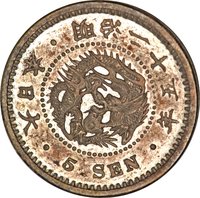
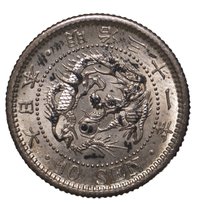
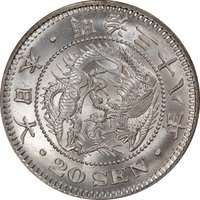
Obverse
Description:
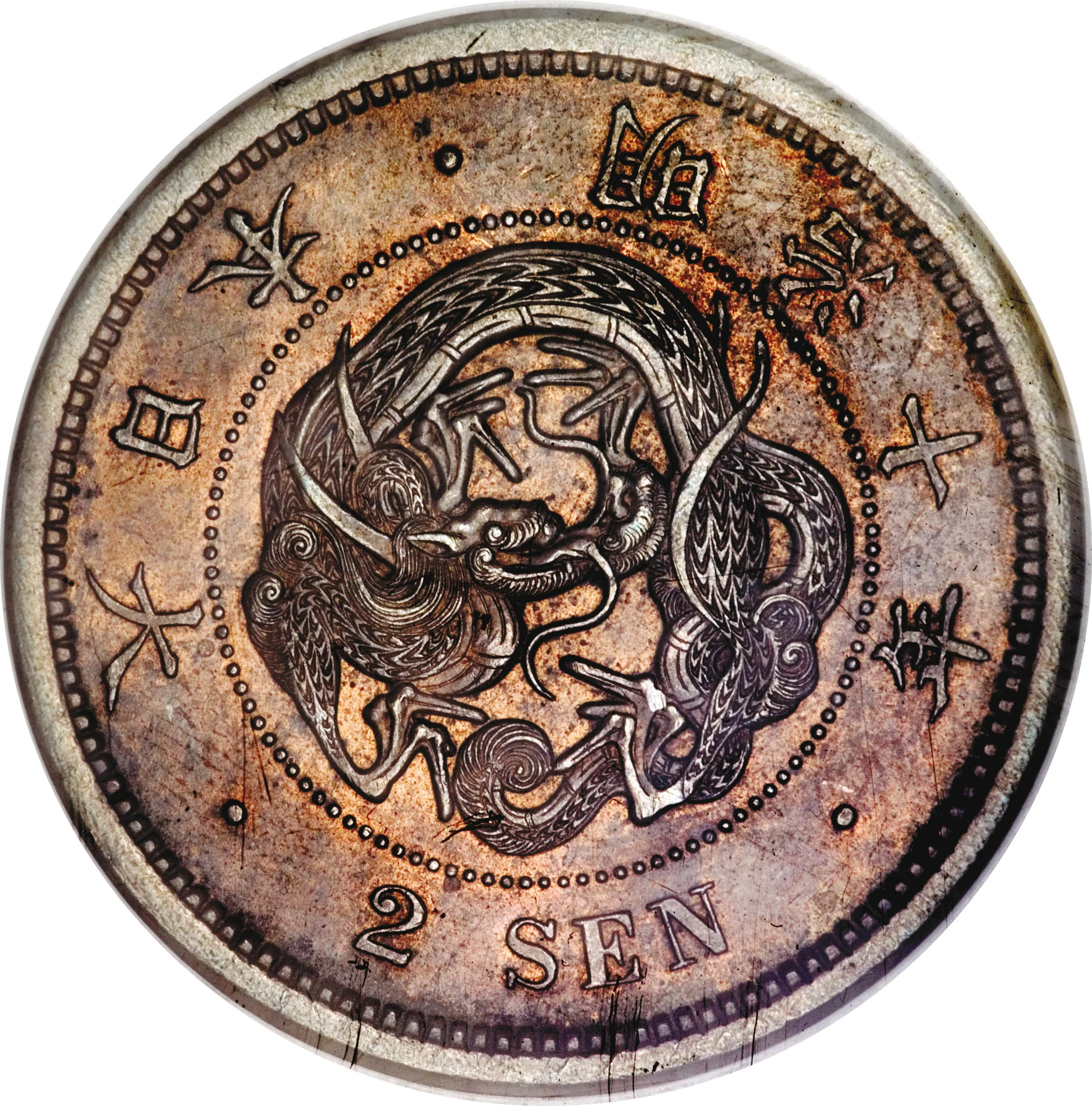
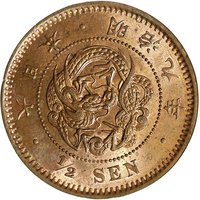
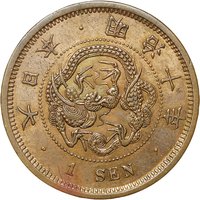
Entwined dragon in beaded circle, legends above, value below.
Inscription:
年 十 治 明 · 本 日 大 ·
· 2 SEN ·
· 2 SEN ·
Translation:
Tenth Year of Meiji · Great Japan ·
· 2 SEN ·
· 2 SEN ·
Language: Japanese
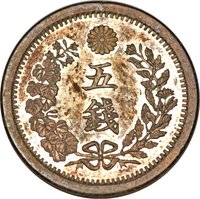
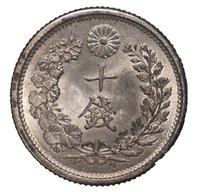
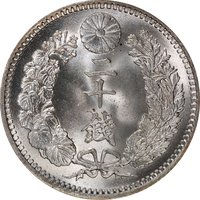
Reverse
Description:
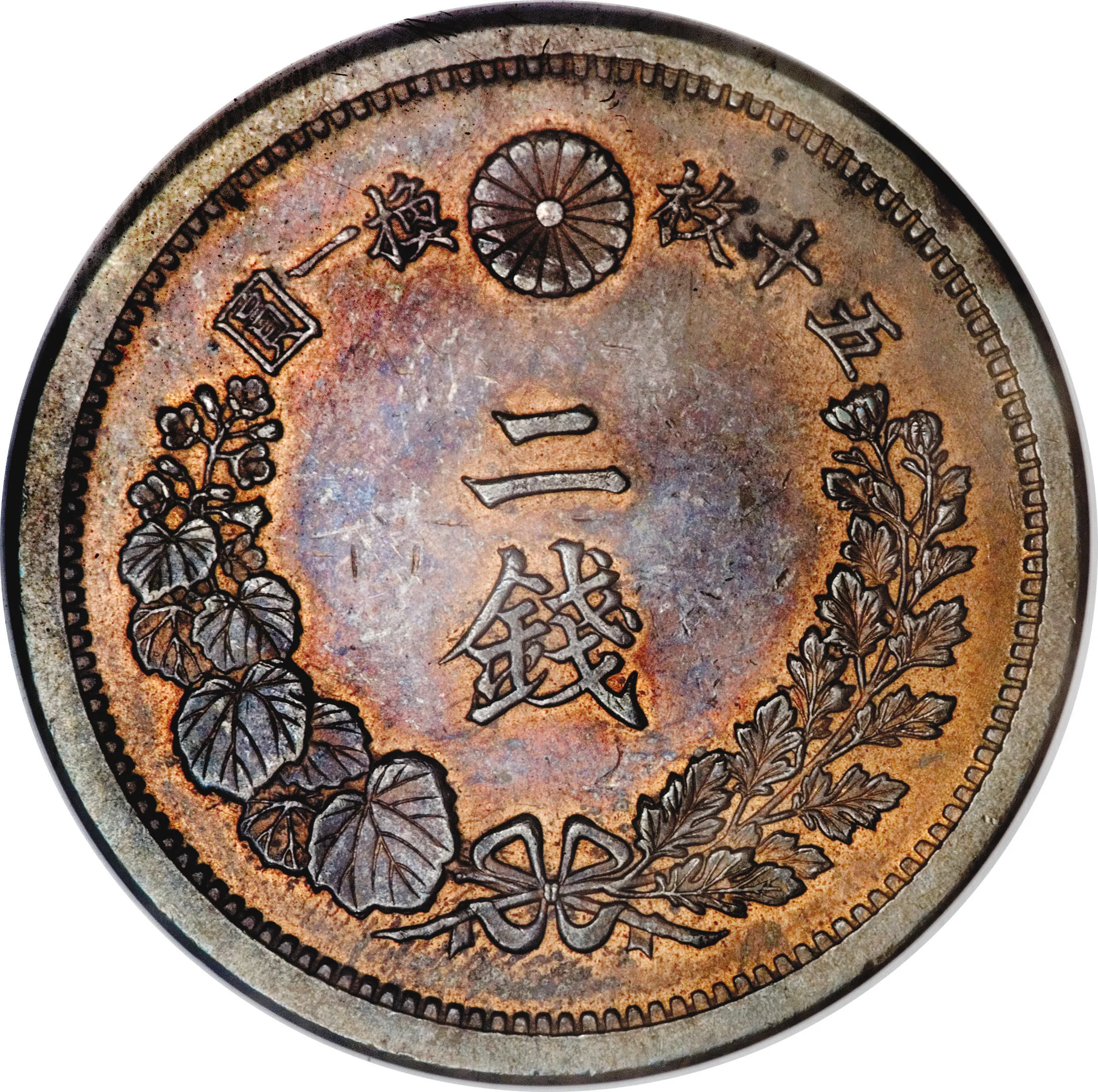
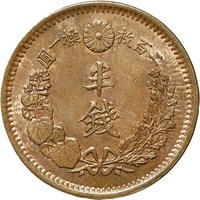
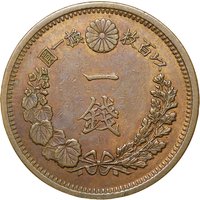
Imperial Seal chrysanthemum, Paulownia branches, and flanking chrysanthemums.
Inscription:
圓一換 枚十五
二
錢
二
錢
Translation:
One round (coin) exchanges for fifteen pieces.
Two
Coins
Two
Coins
Language: Chinese
Edge
Plain
Categories
| Plants> Flower |
| Symbols> Coat of Arms |
| Symbol> Wreath |
| Mythology> Fantastic animal |
Mints
| Name | Mark |
|---|---|
| Japan Mint | — |
Mintings
| Year | Mint Mark | Mintage | Quality | Collection |
|---|---|---|---|---|
| 1873 | — | 3,949,758 | ||
| 1874 | — | — | ||
| 1875 | — | 22,835,255 | ||
| 1876 | — | 25,817,750 | ||
| 1877 | — | 33,097,868 | ||
| 1880 | — | 33,142,307 | ||
| 1881 | — | 38,475,569 | ||
| 1882 | — | 43,527,187 | ||
| 1883 | — | 19,476,164 | ||
| 1884 | — | 12,090,586 | ||
| 1892 | — | — |
Historical background
In 1873, Japan was in the midst of the profound economic and social transformation of the Meiji Restoration. The new government, having abolished the feudal han system, sought to modernize the nation and centralize financial authority. A critical step was the establishment of a unified, modern currency system to replace the complex patchwork of clan notes and heterogeneous metallic coins from the Edo period. The foundational New Currency Act of 1871 introduced the Yen (¥), based on a decimal system and aligned with the global gold standard, aiming to facilitate international trade and signal Japan's entry into the modern world economy.
However, the currency situation in 1873 was one of tense transition and unintended consequences. While the new yen-denominated notes and coins (including sen and rin) were being issued by the newly created National Bank System, they circulated alongside older forms of money, causing public confusion. More critically, the government's decision to set the official exchange rate for the former gold ryō coins was significantly below their market value, leading to a massive outflow of gold from Japan as foreigners exploited the arbitrage. This drained the nation's gold reserves and undermined the very gold standard the system was meant to uphold.
Consequently, by 1873, the government faced a fiscal crisis. The costs of modernization, samurai stipends, and suppressing domestic rebellions like the Saga Rebellion (1874) forced it to print large amounts of inconvertible paper currency, leading to inflation. This period set the stage for the eventual de facto abandonment of the gold standard in 1873 (though not formally until 1897) and a prolonged struggle with paper currency depreciation. Thus, 1873 represents a pivotal year where the ambitious design of Japan's modern monetary system collided with economic realities, revealing the profound challenges of financial modernization.
However, the currency situation in 1873 was one of tense transition and unintended consequences. While the new yen-denominated notes and coins (including sen and rin) were being issued by the newly created National Bank System, they circulated alongside older forms of money, causing public confusion. More critically, the government's decision to set the official exchange rate for the former gold ryō coins was significantly below their market value, leading to a massive outflow of gold from Japan as foreigners exploited the arbitrage. This drained the nation's gold reserves and undermined the very gold standard the system was meant to uphold.
Consequently, by 1873, the government faced a fiscal crisis. The costs of modernization, samurai stipends, and suppressing domestic rebellions like the Saga Rebellion (1874) forced it to print large amounts of inconvertible paper currency, leading to inflation. This period set the stage for the eventual de facto abandonment of the gold standard in 1873 (though not formally until 1897) and a prolonged struggle with paper currency depreciation. Thus, 1873 represents a pivotal year where the ambitious design of Japan's modern monetary system collided with economic realities, revealing the profound challenges of financial modernization.
Series: 1873 Japan circulation coins
🌱 Very Common