

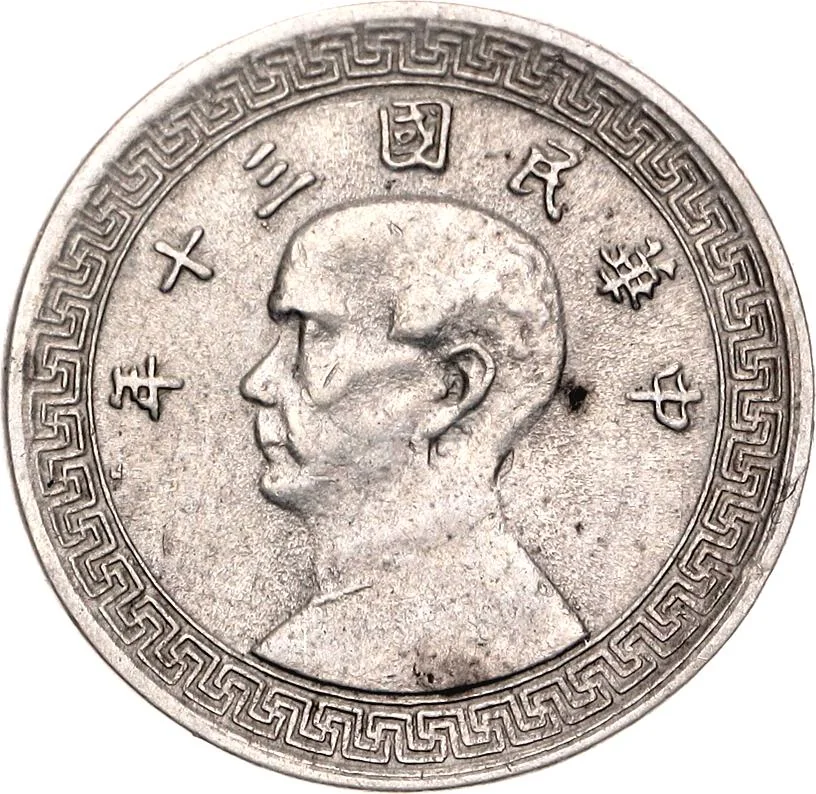
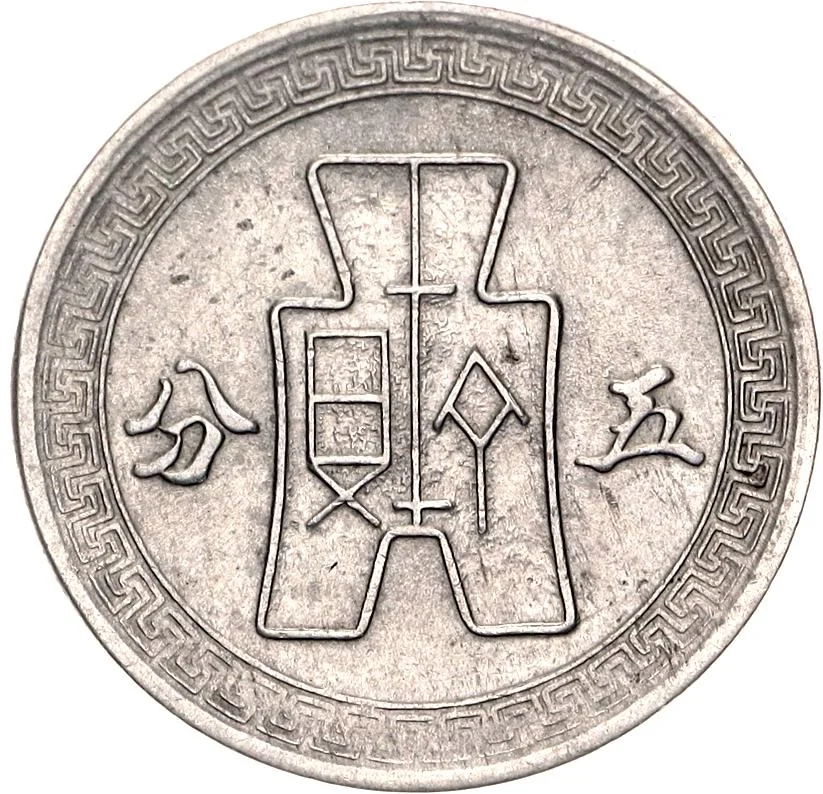
5 fen – Republic of China
Add to wishlist
China
Context
Years: 1940–1941
Country: China
Issuer: Republic of China
Period:
(1912—1949)
Currency:
(1912—1948)
Demonetized: Yes
Total mintage: 153,000,000
Material
Diameter: 17.25 mm
Weight: 1.85 g
Thickness: 1.1 mm
Shape: Round
Composition: Copper-nickel
Technique: Milled
Alignment: Medal alignment
flip
References
Y: #
Numista: #22851
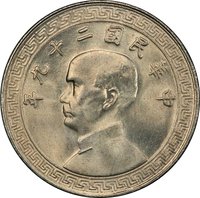
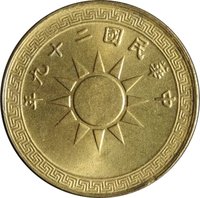
Obverse
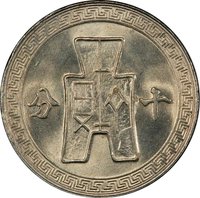
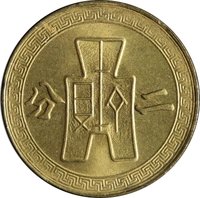
Reverse
Description:
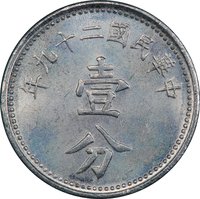
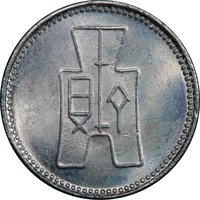
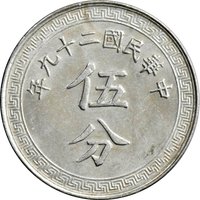
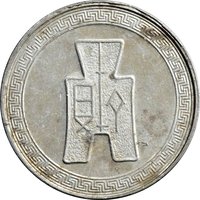
Ancient Chinese spade coin with one ideogram per side within a decorative border.
Inscription:
分五
貝齊
貝齊
Translation:
Five-cent coin of Qi.
Script: Chinese
Language: Classical Chinese
Edge
Reeded.
Categories
| Currency> Coin depiction |
| Person> Politician |
Mintings
| Year | Mint Mark | Mintage | Quality | Collection |
|---|---|---|---|---|
| 1940 | — | 57,000,000 | ||
| 1941 | — | 96,000,000 |
Historical background
By 1940, the currency situation in the Republic of China was one of extreme fragmentation and severe inflation, directly caused by the ongoing Second Sino-Japanese War. The Nationalist government (Kuomintang), having retreated inland to Chongqing, struggled to maintain the authority of its official Chinese National Currency (CNC or fabi). However, vast areas of coastal and northern China were under Japanese occupation, where puppet regimes, most notably the Wang Jingwei government in Nanjing, were forced to use Japanese-sponsored currencies like the Japanese Military Yen and the Federal Reserve Bank of China (FRB) notes. This created a complex monetary landscape of competing currencies, each with fluctuating and politically charged values.
The war devastated the Chinese economy, stripping the fabi of its fiscal foundations. To finance massive military expenditures, the Chongqing government resorted to printing money with little reserve backing, leading to the beginning of a destructive inflationary spiral. While inflation in 1940 was serious—with prices in fabi areas rising over 100%—it was merely a precursor to the hyperinflation that would cripple the economy later in the decade. The government attempted controls, but the loss of major tax revenue sources, productive coastal regions, and access to international trade made these measures largely ineffective.
This fractured monetary system became a critical front in the economic warfare of the wider conflict. The Japanese actively sought to undermine the fabi by forcing its use to purchase fabi on black markets, then dumping it in free China to drive inflation, while also prohibiting its use in occupied zones. Consequently, multiple currency zones operated with different exchange rates and levels of stability, causing hardship for civilians and complicating all commercial activity. This period marked the decisive erosion of a unified national currency, setting the stage for the complete monetary collapse of the fabi in the post-war years.
The war devastated the Chinese economy, stripping the fabi of its fiscal foundations. To finance massive military expenditures, the Chongqing government resorted to printing money with little reserve backing, leading to the beginning of a destructive inflationary spiral. While inflation in 1940 was serious—with prices in fabi areas rising over 100%—it was merely a precursor to the hyperinflation that would cripple the economy later in the decade. The government attempted controls, but the loss of major tax revenue sources, productive coastal regions, and access to international trade made these measures largely ineffective.
This fractured monetary system became a critical front in the economic warfare of the wider conflict. The Japanese actively sought to undermine the fabi by forcing its use to purchase fabi on black markets, then dumping it in free China to drive inflation, while also prohibiting its use in occupied zones. Consequently, multiple currency zones operated with different exchange rates and levels of stability, causing hardship for civilians and complicating all commercial activity. This period marked the decisive erosion of a unified national currency, setting the stage for the complete monetary collapse of the fabi in the post-war years.
🌟 Uncommon