

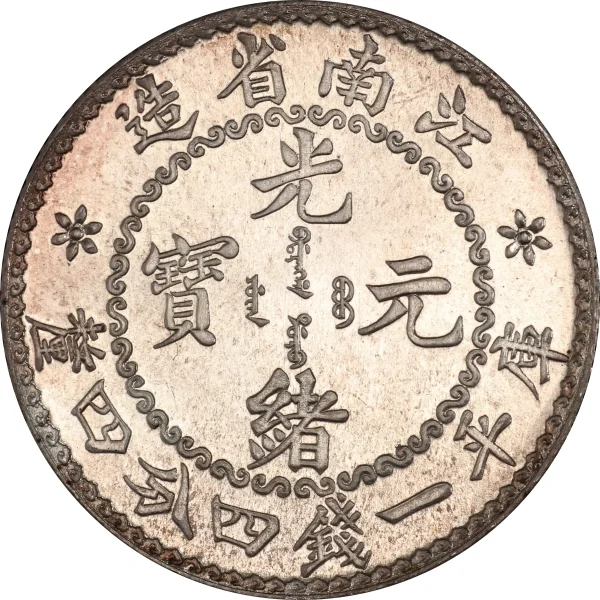
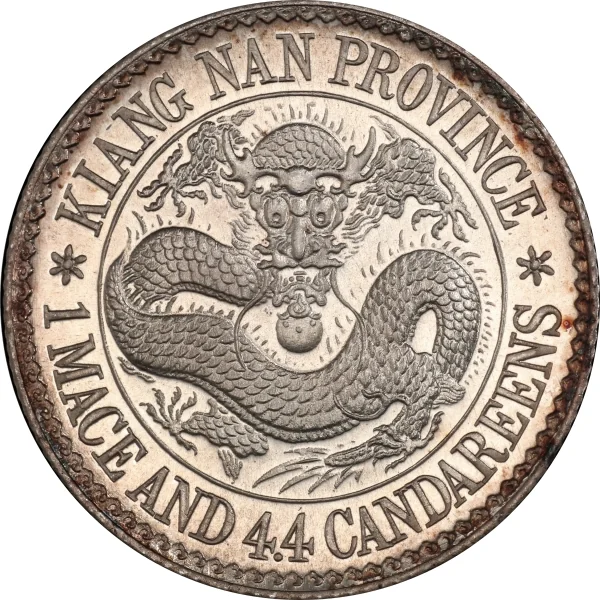
20 Fen – Kiangnan Province
China
Context
Year: 1898
Country: China 
Issuer: Kiangnan Province
Ruler: Guangxu
Currency:
(1898—1949)
Demonetized: Yes
Total mintage: 7,000,000
Material
References
Y: #Click to copy to clipboard143
Numista: #22795
Value
Bullion value: $12.23
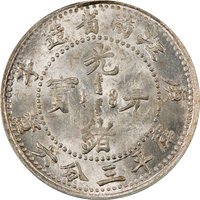
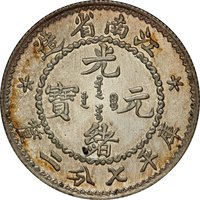
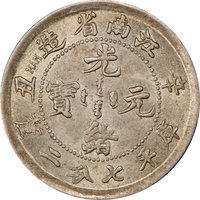
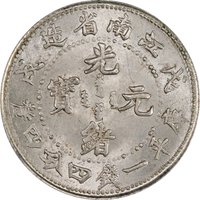
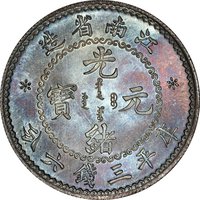
Obverse
Description:
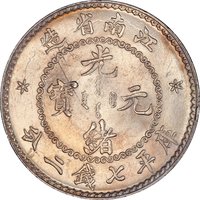
Chinese ideograms read vertically, right to left, with Manchu text in the center, all encircled by more Chinese characters.
Inscription:
造省南江
光
ᠪᠠᡩᠠᡵᠠᠩᡤᠠ
寶 ᠶᡠᠸᠠᠨ ᠪᠣᠣ 元
ᡩᠣᡵᠣ
緒
釐四分四錢一平庫
光
ᠪᠠᡩᠠᡵᠠᠩᡤᠠ
寶 ᠶᡠᠸᠠᠨ ᠪᠣᠣ 元
ᡩᠣᡵᠣ
緒
釐四分四錢一平庫
Translation:
Made in the Southern Jiangsu Province
Guangxu (reign era)
Badarangga (Manchu for Guangxu)
Yuan Bao (Treasure)
Doro (Manchu for reign/era)
One Pingku (Treasury Standard) tael, four mace, four candareens
Guangxu (reign era)
Badarangga (Manchu for Guangxu)
Yuan Bao (Treasure)
Doro (Manchu for reign/era)
One Pingku (Treasury Standard) tael, four mace, four candareens
Scripts: Chinese, Mongolian / Manchu
Languages: Manchu, Classical Chinese
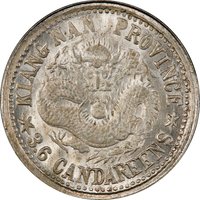
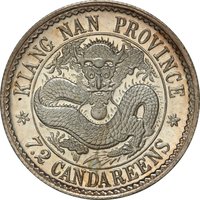
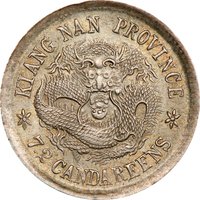
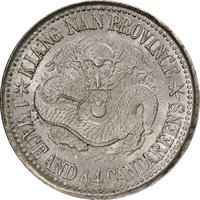
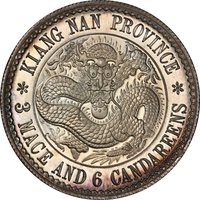
Reverse
Description:
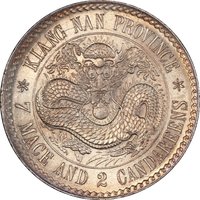
Dragon encircling a pearl, surrounded by English text.
Inscription:
KIANG NAN PROVINCE
7.2 CANDAREENS
7.2 CANDAREENS
Script: Latin
Edge
Reeded.
Categories
| Mythology> Fantastic animal |
Mintings
| Year | Mint Mark | Mintage | Quality | Collection |
|---|---|---|---|---|
| 1898 | — | 7,000,000 | ||
| 1898 | — | — | Proof | |
| 1898 | — | — |
Historical background
In 1898, the currency situation in Kiangnan Province (centered on Shanghai and the lower Yangtze Delta) was one of profound complexity and instability, reflecting China's semi-colonial condition at the end of the 19th century. The monetary system was not unified but a chaotic mix of competing mediums. The primary foundation was the silver tael, a unit of weight rather than a coin, with multiple local standards—the Shanghai tael for trade and the Kuping tael for taxes—creating constant exchange headaches. Alongside this, a vast quantity of silver dollars, primarily Mexican "Eagle" dollars and later British trade dollars, circulated as physical coinage, their value fluctuating against the tael. Furthermore, a massive and unstable system of copper cash coins and privately issued cash notes served the daily needs of the common people, subject to severe local depreciation and counterfeiting.
This disarray was exacerbated by the aggressive financial incursions of foreign powers and domestic weakness. Foreign banks, like the British-controlled Hongkong and Shanghai Banking Corporation (HSBC), issued their own banknotes, which circulated with reliability and prestige, undermining Qing monetary authority. The imperial government's attempts to standardize currency, including minting provincial silver and copper coins, were inconsistent and failed to establish national trust. Crucially, the revenue-strapped Qing dynasty had moved significant fiscal operations to Shanghai, and the provincial authorities often had to negotiate loans from foreign consortia, further ceding financial control. This environment made Kiangnan, China's commercial heart, acutely vulnerable to international silver price fluctuations and speculative attacks.
The cumulative effect was a drag on economic modernization and a source of daily friction. Merchants faced high transaction costs and exchange risks, while peasants suffered when copper cash devalued against silver for tax payments. The situation highlighted the Qing state's inability to exercise one of its fundamental sovereign powers: control over the money supply. This monetary crisis in Kiangnan thus became a powerful impetus for the financial reforms attempted in the post-Boxer New Policies era, as both Chinese reformers and foreign interests sought to create a more predictable monetary system for trade and investment.
This disarray was exacerbated by the aggressive financial incursions of foreign powers and domestic weakness. Foreign banks, like the British-controlled Hongkong and Shanghai Banking Corporation (HSBC), issued their own banknotes, which circulated with reliability and prestige, undermining Qing monetary authority. The imperial government's attempts to standardize currency, including minting provincial silver and copper coins, were inconsistent and failed to establish national trust. Crucially, the revenue-strapped Qing dynasty had moved significant fiscal operations to Shanghai, and the provincial authorities often had to negotiate loans from foreign consortia, further ceding financial control. This environment made Kiangnan, China's commercial heart, acutely vulnerable to international silver price fluctuations and speculative attacks.
The cumulative effect was a drag on economic modernization and a source of daily friction. Merchants faced high transaction costs and exchange risks, while peasants suffered when copper cash devalued against silver for tax payments. The situation highlighted the Qing state's inability to exercise one of its fundamental sovereign powers: control over the money supply. This monetary crisis in Kiangnan thus became a powerful impetus for the financial reforms attempted in the post-Boxer New Policies era, as both Chinese reformers and foreign interests sought to create a more predictable monetary system for trade and investment.
💎 Very Rare